
At least 67 killed in Occupation airstrikes on crowded Rafah, residents describe terror, confusion amid Israeli ‘rescue operation’
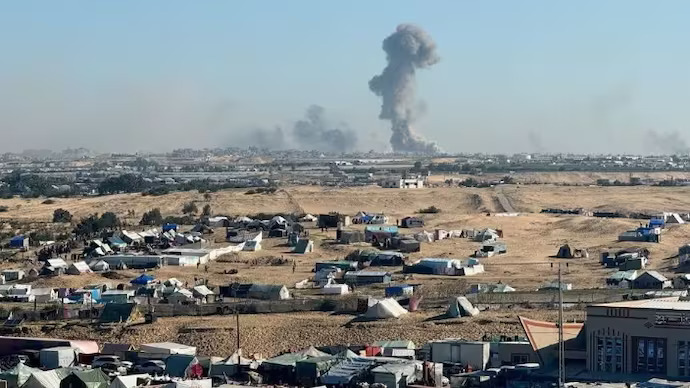
Heavy bombing in crowded Rafah has killed at least 67 Palestinians, a large number of them children, in the early hours of Monday morning, according to the Palestinian Health Ministry in Gaza. Bodies were still being retrieved from under the rubble later on Monday.
The Israeli military claimed that the attacks were an operation to free two Israeli prisoners who were being held in northern Rafah.
The bombardment on Rafah, where over half of the population is currently taking shelter, comes as Occupation forces say they’re planning a ground operation in the area of southern Gaza, prompting an outcry about the potential of hundreds of thousands being killed.
“The sky was filled with lightning bombs. A night the likes of which we have not witnessed since our displacement from the northern Gaza Strip. There are still bodies under the rubble,” said Noor Swirki, a journalist displaced to Rafah, describing the operation beginning at 2 am on Monday.
Israeli forces conducted the operation in the Shaboura district, one of the most overcrowded areas in Rafah, she added.
Waad Abu Zaher, who was displaced from Gaza City in central Gaza to Rafah, said that she experienced a night of terror, waking up in a state of horror and fear to the sound of bombing at 3 am in her tent in the Awda area on the border with Egypt.
Local sources told Palestinian News and Information Agency Wafa that the Occupation aircraft launched nearly 40 air raids on a number of civilian homes and mosques where those displaced are taking refuge. Intense artillery warship strikes also targeted the coast of Rafah from the sea.
The Palestinian Foreign Ministry issued a statement condemning the “massacre in Rafah” on Monday morning.
A few hours earlier, on Monday at dawn, Occupation forces said they had recovered two Israeli nationals who were in good condition and transferred them to health authorities in Israel. They said the joint “rescue” operation was conducted by the Israeli Defense Forces, the domestic security service Shin Bet and the Occupation’s Special Police Forces. Israeli military spokesperson Richard Hecht later said that the operation was “very complex,” adding that work on the operation was long and that they were waiting for the right conditions.
Hecht described the intensive airstrikes as intended to allow the Occupation’s forces to be extracted.
In its Monday morning statement, the Palestinian Foreign Ministry said the operation evidences the validity of the Palestinian government’s repeated warnings about the catastrophic outcomes that would result from the Occupation’s planned ground invasion of Rafah.
The city is currently thought to be hosting around 1.4 million people taking refuge in the southernmost area of Gaza on the border with Egypt after consecutive waves of displacement during 129 days of the Israeli occupation’s aggression on the strip.
Swirki said that the situation in Rafah remains unchanged, explaining that before the strikes, upon learning that the ground invasion was edging closer, residents started to pack up their tents and plan their relocation elsewhere, namely Tal al-Sultan and Shaboura, which was targeted later that night.
“People’s faces seemed like they were witnessing the apocalypse. The situation is very tense, but no evacuation orders were issued until now,” she added.
Abo Zaher also said she saw people running in the streets of Rafah on their own and in groups, not knowing what to do or where to go if Israel began its ground invasion. Some began to move toward central Gaza, said Abo Zaher.
Displaced people carrying their tents from Rafah have begun arriving in waves to areas in Deir al-Balah and around central Gaza, said journalist Karam Abo Hassanain, describing the reverse displacement as beginning several days ago with the threat of Israel’s ground invasion of Rafah.
Israeli Prime Minister Benjamin Netanyahu had ordered the military and security establishments to put together a plan to evacuate people from Rafah, his office announced on Friday, to allow for combat in the city directly on the border with Egypt, claiming that a ground operation was necessary to confront Hamas battalions he claimed were stationed in Rafah.
International actors have spoken out to condemn Israel undertaking a ground operation in Rafah, with chief European Union diplomat Josep Borrel and the foreign ministries of the United Kingdom, France, the Netherlands, Oman, Jordan, Qatar and Saudi Arabia issuing warnings against the prospects of the operation for the thousands of civilians taking shelter there.
US President Joe Biden also expressed his rejection of Israel launching a military operation in Rafah without a “credible plan” on Sunday, urging Netenyahu to protect civilians after expressing concern over the rising death toll in Gaza.
Accordingly, Netanyahu said on Sunday that plans are being prepared to evacuate civilians via “a safe corridor” and that Israel is pushing ahead with its plans for a ground invasion.
“We're going to do it. We're going to get the remaining Hamas terrorist battalions in Rafah, which is the last bastion, but we're going to do it,” Netenyahu said in an interview with US TV anchor Jonathan Karl on Sunday. “Those who say that under no circumstances should we enter Rafah are basically saying lose the war. Keep Hamas there,” he continued.
He did not further elaborate on plans for an evacuation of the thousands sheltering in Rafah. There are few destinations to which Palestinians in Rafah could be evacuated, with the majority of the strip’s civilian infrastructure destroyed and the Occupation’s targeting of designated safe zones.
From its side of the Rafah border crossing, the Egyptian Cabinet issued a statement on Sunday rejecting Israeli operations in Rafah and warned of serious consequences while calling for international and regional efforts to prevent the targeting of Rafah.
Egyptian officials have previously warned that the two scenarios of forcing Palestinians into Sinai or an invasion of Rafah could result in the suspension of the 1979 peace treaty between Egypt and Israel, which says military decisions in the area can only be jointly decided.
In preparation for the potential Israeli invasion of Rafah, Egypt is reportedly building fortifications on its border with Gaza, according to an Egyptian administrative source who spoke to Mada Masr and eyewitnesses in Rafah.
A senior Hamas leader cited anonymously in reports on Sunday said that Netanyahu is evading the prisoner exchange deal by committing genocide and a humanitarian disaster in Rafah.
Following the last round of negotiations initiated last December by Qatar, Egypt and the United States, Hamas delivered its response to its Arab counterparts last week, outlining a three-stage deal to reach a complete ceasefire and an exchange of prisoners with Israel.
Since October 7, the war has only paused for seven days during a temporary ceasefire agreed upon by Gaza’s resistance factions and Israel. As part of that ceasefire, Hamas released 80 Israeli prisoners and several Thai workers, in exchange for the release of 240 Palestinians from Israeli prisons.
أخبار ذات صلة

Hundreds of Gaza students demonstrate for right to study abroad
Hundreds of university students trapped in the besieged Gaza Strip gathered on Monday outside the Journalists Syndicate’s headquarters in western Gaza City…

In meeting with Board of Peace director-general, Hamas refuses UN disarmament plans until Israel commits to withdrawal
Hamas has refused to commit to the plans proposed by the United Nations for its disarmament, citing lack of advancement in Israel’s…

Israel agrees to limited reopening of Rafah border crossing — details pending
Israeli Prime Minister Benjamin Netanyahu’s office announced on Monday that it has agreed to a “limited reopening” of the Rafah border crossing…

Sisi touts ‘stabilization’ agenda at first Davos appearance in over 10 years
President Abdel Fattah al-Sisi advertised Egypt’s “stabilization” agenda in Davos on Wednesday, saying the country’s focus on steering away from regional conflicts…
Your support is the only way to ensure independent, progressive journalism survives.
You have a right to access accurate information, be stimulated by innovative and nuanced reporting, and be moved by compelling storytelling. Subscribe now to become part of the growing community of members who help us maintain our editorial independence.
Join us