
Health Ministry spox on specialized doctors ‘loan’ to Saudi Arabia: I don’t know anything about this decision
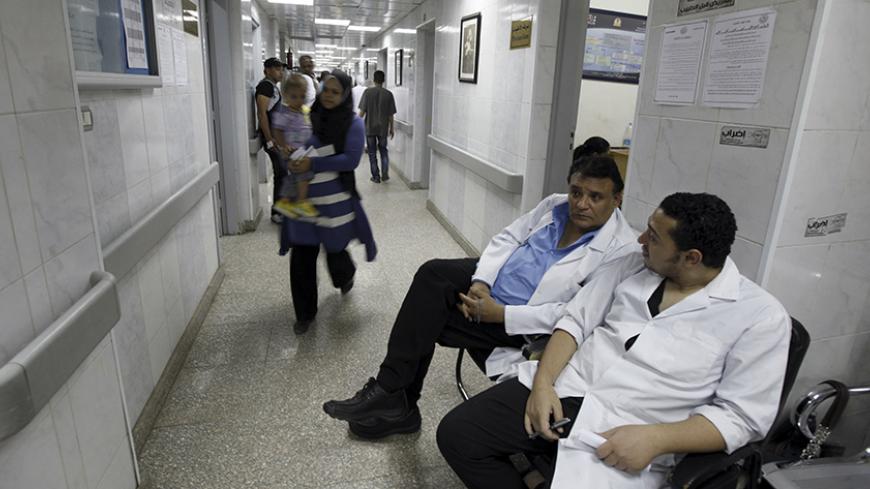
The Saudi Health Ministry and the General Organization for Teaching Hospitals and Institutes (GOTHI) in Egypt signed a cooperation protocol last week to dispatch medical professionals in “rare specialties” to Saudi Arabia.
The move comes at a time when Egypt is grappling with a scarcity of specialized doctors due to a general trend of doctors emigrating, according to members of the House Health Committee and the Doctors Syndicate board, who said that they were not made aware of the agreement.
The agreement between the Saudi Health Ministry and the Health Ministry-affiliated authority was signed on March 4 on the sidelines of the Egyptian-Saudi joint committee meeting chaired by both countries’ trade ministers in Riyadh. The meeting discussed strategies to increase trade exchange, investments and joint industrial cooperation, according to the Egyptian government’s statement.
"I don't know anything about this matter," the Health Ministry’s spokesperson, Hossam Abdel Ghaffar, told Mada Masr. He added, "[GOTHI] is indeed under the Health Ministry, but I have no information about this agreement. The Trade Ministry signed it."
The agreement was, in fact, signed by GOTHI head Mohamed Mostafa Abdel Ghaffar.
The ministry is not responsible for all doctors in Egypt, the spokesperson said, noting that “there are doctors employed by the Transport Ministry at the Railway Hospital, and others employed by the Higher Education Ministry in university hospitals, and so on across various other entities.”
The agreement aims to lend hospitals under the Saudi Health Ministry specialized consultants in rare medical fields, such as adult, pediatric, and preterm neonatal intensive care, the GOTHI head said, as reported by Veto.
A Doctors Syndicate board member who spoke to Mada Masr on condition of anonymity expressed surprise at the decision, highlighting that GOTHI, a small but “distinguished” entity, is gaining importance at a time when doctors are increasingly emigrating from Egypt to work abroad. Another council member gave an exasperated and curt reply, "May God forgive this country."
House Health Committee members Soheir Abdel Hamid and Ashraf Hatem told Mada Masr that they were unaware of the agreement. Abdel Hamid added that Egypt faces a shortage of doctors within the specialties covered by the agreement.
Abdel Hamid further noted that Health Minister Khaled Abdel Ghaffar decided in March last year to form a committee under his remit to address doctors' conditions, focusing on three aspects: financial remuneration, training and education, and legal status. Abdel Hamid, a member of the committee, said that it has yet to complete its intended work.
2022 witnessed the highest number of doctors resigning from government positions, totaling 4,261 doctors at a daily rate of 12 resignations, data from the Doctors Syndicate revealed. The figure quadrupled from 1,044 resignations in 2016 to 4,127 resignations in 2021.
"Doctors are leaving us to find opportunities elsewhere because they want to sustain themselves," President Abdel Fattah al-Sisi said during a National Project for Egyptian Family Development event in 2021. "Am I offering them a good salary? Is it that I do not want to give them a good salary, or is it that I’m unable to? I’m unable to." The president made these comments after a significant increase in Egyptian doctors leaving for Gulf countries, Europe and the United States.
More than two years before these statements, in 2018, the House’s Health Committee held an emergency meeting where former Health Minister Hala Zayed complained about the significant shortage of doctors in ministry hospitals due to their inability to compete with salaries offered abroad or in the private sector. The minister estimated that 60 percent of Egyptian doctors were in Saudi Arabia at that time, while Egypt was already facing a shortage of doctors relative to the population.
According to World Health Organization statistics at the time, Egypt had 2.2 healthcare providers (doctors, nurses, etc.) per 1,000 citizens, which is below the WHO's set minimum of 3.4 per 1,000 citizens. There was less than one doctor for every 1,000 citizens at the time.
Your support is the only way to ensure independent, progressive journalism survives.
You have a right to access accurate information, be stimulated by innovative and nuanced reporting, and be moved by compelling storytelling. Subscribe now to become part of the growing community of members who help us maintain our editorial independence.
Join us