
Haniyeh, Shukr assassinations ‘fireball’ to ceasefire talks, Egyptian security source says
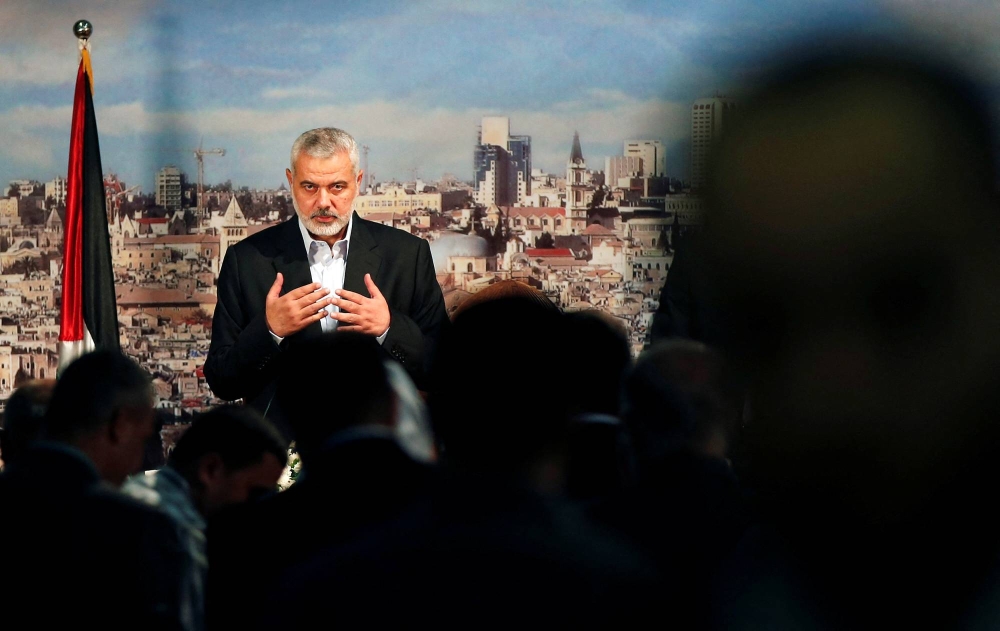
Ismail Hanyieh, the chief of Hamas’ political bureau, was killed on Wednesday morning by an Israeli airstrike that targeted him while he was visiting Tehran, the Palestinian faction announced.
Haniyeh, who had led Hamas since 2017, was assassinated hours after another Israeli strike had targeted Hezbollah commander Fouad Shukr in Beirut.
Before the two attacks, Israel had vowed to retaliate against Hezbollah for what it claimed was a rocket attack by the Lebanese group that killed 12 Syrian Druze residents of the Israeli-occupied Golan Heights. Hezbollah has denied responsibility for the attack. Both strikes were preceded by “indirect” negotiations between Israel and Hezbollah on the nature of the Israeli retaliation amid western and regional pressures to contain the situation, sources told Mada Masr. With the pressures proving unsuccessful, the situation could turn into a fireball, an Egyptian security source said.
Iranian press agency Tasnim said Haniyeh and one of his guards were targeted in an airstrike at 2 am at "a special residence" for war veterans in northern Tehran, where he was staying after attending the inauguration of new Iranian President Masoud Pezeshkian. His funeral will likely be held tomorrow in Tehran, after which he will be buried in Doha on Friday, the agency added.
Cairo was not surprised by the assassination of Haniyeh, an Egyptian security source told Mada Masr on the condition of anonymity, as it was aware that Israel is out to kill as many of the Hamas leadership as possible.
Still, according to the source, Cairo is furious about how the assassinations will complicate the situation in the region, saying that they decrease the chances for a ceasefire deal in Gaza.
“Now that Haniyeh was assassinated in Tehran, we are looking at a fireball,” the source said.
The source also noted that Haniyeh “was not among the Hamas hardliners,” and a new Hamas head with a more rigid position should be expected.
Without naming Haniyeh, a statement by the Egypt Foreign Ministry condemned today “the dangerous Israeli escalatory policy over the past two days,” warning of the consequences of the assassinations and calling on influential international powers to prevent the security situation in the region from getting out of control, which coincides with the lack of progress in the Gaza ceasefire negotiations, indicating “the absence of Israeli political will for de-escalation.”
According to the source, the statement did not name Haniyeh so as not to come across as defending him in particular, but to make it clear that Egypt’s concern is for Gaza.
Hamas political bureau member Moussa Abu Marzouq said that the assassination of Haniyeh “will not go unpunished.” Hamas official Sami Abu Zuhri likewise told Al-Araby TV that the Occupation is trying to break the will of the Palestinian people, but stressed that the assassination of the faction’s leaders will not affect it.
Palestinian President Mahmoud Abbas condemned Haniyeh’s assassination, considering it a “dangerous escalation,” calling on the Palestinian people to unite, while Palestine’s national and Islamic forces announced a general strike and marches in condemnation of the assassination.
For his part, Iran's Supreme Leader Ayatollah Khamenei said that Israel has “paved the way for severe punishment” by assassinating Haniyeh, stressing that retaliation for the attack is “Tehran's duty,” because it happened on Iranian soil. However, Iran does not intend to escalate, Iranian First Vice President Mohamed Reza Aref said today.
Russia, Turkey and Qatar also joined in condemning Haniyeh’s assassination, with Qatari Prime Minister Mohamed bin Abdel Rahman al-Thani tweeting his concern about the future of the ceasefire and prisoner exchange talks, in which his country is serving as a mediator, adding, “how can mediation succeed when one party assassinates the negotiator on the other side?”
In Lebanon, Hezbollah confirmed today that Shukr was in the building targeted by the Israeli strike on Beirut’s southern suburb, without confirming his death. Meanwhile, the Occupation’s military spokesperson, Avichay Adraee, claimed the success of the assassination operation, which he said was in response to Saturday’s missile attack on the town of Majdal Shams.
A source from the Lebanese Amal Movement political party confirmed Shukr’s death to Mada Masr.
Tuesday night’s strike is the culmination of days of tension after a rocket killed 12 people, including children, and injured a further 30, when it exploded on a football pitch in the Israeli-occupied Golan Heights on Saturday.
Israel blamed Hezbollah, but the group has denied responsibility for the attack. Israel vowed retaliation, with Israeli Foreign Minister Israel Katz saying that Israel was “approaching an all-out war against Hezbollah and Lebanon.” US Secretary of State Antony Blinken, however, said that the US did not want to see the conflict escalate.
Hezbollah had preemptively cleared key sites in southern Lebanon and the eastern Beqaa Valley on Sunday in anticipation of a possible Israeli retaliation, though smaller clashes at the border between Israel and Hezbollah continued through Monday and Tuesday.
Prior to Israel’s strikes in Beirut and Tehran, sources told Mada Masr that there were “indirect” negotiations between Israel and Hezbollah amid pressures to contain the situation.
A UN diplomatic source told Mada Masr on condition of anonymity that there was mounting pressure on Israel by the US and France to carry out a limited strike. Meanwhile, Hezbollah is also being pressured to move further west from the Blue Line.
According to a source from the Amal Movement, there were indirect negotiations around the Israeli retaliation, pointing to talks between Lebanese Parliament Speaker Nabih Berri and the French embassy to pressure Israel not to retaliate, in exchange for guarantees that Hezbollah would not escalate.
In response to Israel's request for Hezbollah to withdraw approximately ten kilometers, Hezbollah has asked for the withdrawal to be mutual. The group also sought official guarantees that if they retreat, there will be no Israeli violations. Additionally, they requested a complete Israeli withdrawal from the south of the Litani River in accordance with Security Council Resolution 1701 of 2006, which calls for the establishment of a demilitarized zone between the Blue Line and the Litani River save for the Lebanese Armed Forces and the United Nations Interim Force in Lebanon.
He added that the US was working to convince Israel to agree to halting reconnaissance airplanes in exchange for US satellite imagery.
Speaking immediately after the Beirut attack, the UN diplomatic source told Mada Masr that pressures to prohibit a high-level attack have clearly failed, but that delegations will still come to the region to try to contain the situation.
How much sway they will have with the Israelis is unclear. The Egyptian security source told Mada Masr that there is currently a political void that Netanyahu can fill in whatever way he wants, pointing to the fact that Joe Biden has little leverage since he won’t be continuing on as president and the race between Donald Trump and Kamala Harris remains undecided.
According to Sky News Arabia, Shukr played a major role in the 1983 Marine barracks bombing in Beirut, which killed 241 US service members, and was designated a terrorist by the US State Department in 2019, with a US$5 million prize for any information on him.
Hezbollah MP Ali Ammar said that his group is ready to wage war against Israel in response to the attack, while Information Minister Ziad Makary indicated today that his government will participate in diplomatic efforts to calm tensions.
A source from the Amal Movement told Mada Mada Masr that Hezbollah leaders and their families have been evacuating from their homes and offices in southern Lebanon and Beirut’s southern suburb to other parts of the country. The source noted that some Hezbollah officials have evacuated to Druze-majority areas, with fears among Chrisitian leaders that Shia presence in their areas would bring their districts into the line of fire.
Tehran condemned the Israeli attack on Beirut in a letter to the UN Security Council, describing the strike as “a crime that constitutes a clear violation of Lebanon's sovereignty and the UN Charter,” and calling for the condemnation of the operation and for swift measures to ensure that attacks that pose a threat to regional peace and security are not repeated.
أخبار ذات صلة

Hundreds of Gaza students demonstrate for right to study abroad
Hundreds of university students trapped in the besieged Gaza Strip gathered on Monday outside the Journalists Syndicate’s headquarters in western Gaza City…

In meeting with Board of Peace director-general, Hamas refuses UN disarmament plans until Israel commits to withdrawal
Hamas has refused to commit to the plans proposed by the United Nations for its disarmament, citing lack of advancement in Israel’s…

Israel agrees to limited reopening of Rafah border crossing — details pending
Israeli Prime Minister Benjamin Netanyahu’s office announced on Monday that it has agreed to a “limited reopening” of the Rafah border crossing…

Sisi touts ‘stabilization’ agenda at first Davos appearance in over 10 years
President Abdel Fattah al-Sisi advertised Egypt’s “stabilization” agenda in Davos on Wednesday, saying the country’s focus on steering away from regional conflicts…
Your support is the only way to ensure independent, progressive journalism survives.
You have a right to access accurate information, be stimulated by innovative and nuanced reporting, and be moved by compelling storytelling. Subscribe now to become part of the growing community of members who help us maintain our editorial independence.
Join us