
Gov’t moves to implement new tuition system at state universities
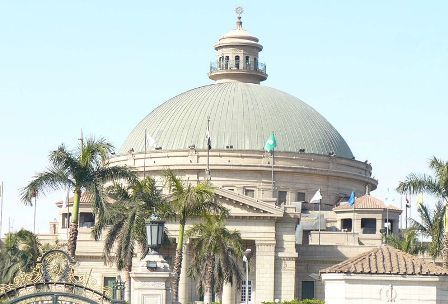
Draft amendments to higher education laws seem to indicate that the Egyptian government is poised to eliminate free university education.
The newly formed presidential advisory council for education and scientific research affairs announced that President Abdel Fattah al-Sisi has approved a package of recommendations for education reform. Chief among those is a decision to tighten government expenditures on higher education by offering free tuition on a merit-only basis.
Council head Tarek Shawky said in an interview with the privately owned Sada al-Balad news site that spending on higher education will be based on a scholarship system, whereby students with an average grade of more than 70 percent would receive a full tuition waiver. Students under that line would be required to pay partial tuition, while those with less than a 50 percent average would pay full tuition.
The new system aims at shifting the mentality of Egyptians, who should start to realize that an “absolute claim [on the right to education] has to change,” Shawky said.
“This claim is based on work. [Students have to] earn the free service they are provided with. Free education is not an absolute right, but [is given] within a limited scope,” he argued.
Although the cost of education per student varies based on university and major, Shawky asserted that an average student costs the state around LE7,000 to LE10,000 annually in university tuition fees.
He added that the money saved from this amendment would go toward improving the quality of educational services, and would not be used to boost salaries for faculty or staff.
“The decision is not targeted at ending free education, but is just to ensure better resource allocation. [It also intends to] establish a principle that the state invests in a student’s education, but if that investment is squandered, the student has to pay for his or her education,” Shawky explained.
Shawky went on to assert that the landmark increase in student enrollment at universities is “a catastrophe, not an achievement. Some people only enter university to get a degree.”
But Abdel Hafeez Tayel, head of the Egyptian Center for the Right of Education, told Mada Masr that the decision is an “extremely dangerous move.”
For Tayel, the amendment represents an extension of former President Hosni Mubarak’s neoliberal policies. The Mubarak administration led various initiatives to implement the World Bank’s recommendations in order to obtain aid, a major thrust of which was cutting government spending on higher education.
The World Bank recommendations obliged the Egyptian government to move its education dollars into elementary and technical education.
“But these policies never led to improving technical education, nor did they yield better results in elementary education. Less spending on higher education meant fewer motives for Egyptians to get educated in the first place,” Tayel asserted.
The state has retreated from its direct role in supporting higher education since the 1990s, when Law 101/1992 was introduced to legalize private universities. In 2002, another decree was passed to sanction for-profit private universities.
Critics have castigated this trend as an attempt to turn universities into corporations, where education is designed to respond to market needs rather than serving basic intellectual goals.
The government subsequently introduced a new system of privatized education within state universities, where students can pay a few extra thousand pounds to enter specific English departments attached to various faculties. This dual system allows wealthier students access to better education while poorer students are only provided with standard free education, all inside the same state university.
“By doing this, we cannot say that higher education is free in the first place,” Tayel argued, adding that Egyptians pay for education twice: first through their taxes, and second through extra university expenses such as textbooks, educational tools and private tutoring.
“According to international agreements, the first guarantee of a good-quality education is availability, and availability here means having free education for all. Higher education cannot be provided based on merit, because there is inequality in the first place,” Tayel asserted. “We have discrimination based on gender, geography, and social and economic status when it comes to education. When we eliminate all of these boundaries, then we can talk about ending free education.”

أخبار ذات صلة
Income slashed for thousands of teachers after changes to high school curriculum
When the education minister announced that several subjects would become non-essential to school curriculums last month, Ali Abdou al-Sheikh, a teacher of…
New budget: Health, education spending less than half constitutionally required amount
Only around 1.16 percent of Egypt’s gross domestic product is to be allocated to government spending on health in the new general…
Teachers protest after mass rejections from state hiring scheme without clear criteria for acceptance
A chronic teachers shortage and a hiring freeze has strained public schools for year
FY 23/24 draft budget: Health, education allocations continue to fall, sit below half constitutional mandate
Continuing a long-standing trend, Egypt’s budget for the coming fiscal year will fall below constitutional mandates for allocations to health and education…
Your support is the only way to ensure independent, progressive journalism survives.
You have a right to access accurate information, be stimulated by innovative and nuanced reporting, and be moved by compelling storytelling. Subscribe now to become part of the growing community of members who help us maintain our editorial independence.
Join us