
For residents of Gaza City’s Zeitoun neighborhood, Israel’s avowed ground campaign is already here
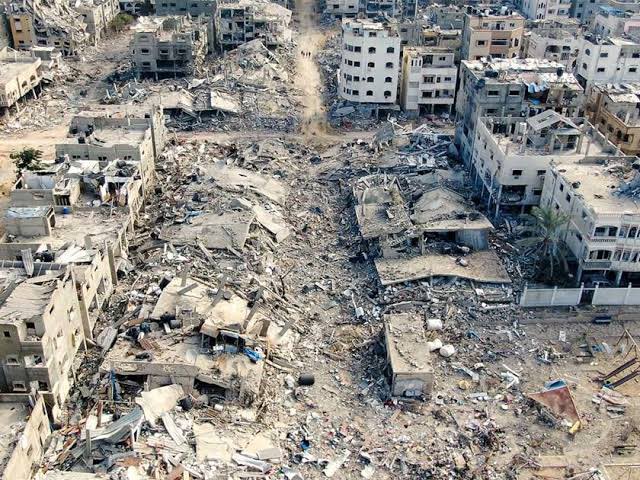
While Israeli officials continue to gesture toward a forthcoming ground campaign to seize control of Gaza City, for residents of the metropole’s southeastern neighborhoods, the campaign has already arrived.
Over the past week, Israel has pummeled Zeitoun and Sabra, ripping apart the urban fabric of the neighborhoods with demolitions, airstrikes and armored vehicles that have flattened urban infrastructure. In many instances, those demolitions and attacks have targeted tall residential buildings where people have taken cover from the “inferno” that Israel has turned the neighborhood’s streets into with sniper fire and quadcopters.

As of Saturday, the Occupation’s ground offensive had reached the center of the neighborhood, according to those in the neighborhood who have spoken to Mada Masr.
While the worst of the attacks have played out in Zeitoun, eyewitnesses said artillery fire on Sabra has also intensified, as the military began spreading fire belts across the two neighborhoods.
Mohamed Malaka, who lives in the west of Zeitoun, said it is clear that Israel has begun occupying Gaza City, starting with Zeitoun after seizing the southern and eastern areas adjacent to it.

“The neighborhood holds strategic importance because of its proximity to Netsarim corridor and Shujaiya. Tightening Israel’s grip on the city becomes easier from there,” Malaka said.
Israel reassumed control over Netsarim and the eastern Gaza City neighborhood of Shujaiya after the brief ceasefire collapsed earlier this year. To the north, Israel launched a devastating ground offensive earlier this year that sent hundreds of thousands fleeing to the relative safety of Gaza City.
Now, however, even that relative safety is disappearing. The Israeli military approved a plan to invade and establish complete security control over Gaza City — Gaza’s largest urban center, currently home to around 1 million people. Israeli officials have made repeated comments about preparation for the offensive, even as their troops began their march into Gaza City through Zeitoun.

Since the ground campaign into Gaza City began last week, Israeli troops have focused on leveling buildings.
On Friday, Israel announced that the offensive into Zeitoun is being carried out by the 99th Division, the Nahal infantry brigade and the 7th Armored Brigade, supported by the Israeli Air Force, acknowledging these forces were demolishing buildings that it described as “booby-trapped” or “sites where weapons were stored.”
The scene from the ground underlines the significant gap between Israeli claims and reality.

Moataz Diab, who lives in Zeitoun, told Mada Masr on Saturday that armored vehicles are bulldozing and demolishing large parts of the neighborhood’s center, while remote-controlled robotic explosives are being deployed around the Ali Mosque and Maslaba areas.
In Diab’s estimation, hundreds of residential buildings have been leveled, with fire concentrated on tall buildings.
Gaza Civil Defense spokesperson Mahmoud Basal confirmed the relentless bombardment in Zeitoun. The military, he said, is deliberately striking tall, inhabited residential buildings without prior warning, using powerful explosives that destroy even the buildings’ surrounding areas.
The massive blasts have brought buildings down onto those inside, killing large portions of extended families, Basal said, stressing that reaching the sites to rescue victims is very dangerous.
Shady Mohamed, who lives in Zeitoun, told Mada Masr that Israeli strikes have demolished homes belonging to the Seyam, Kahil, Shahd and Hosary families. “Hundreds have been killed, but civil defense crews cannot reach them,” he said.

On Tuesday, Israeli aircraft struck a building sheltering displaced members of the Hosary family, killing more than 28 people, according to the civil defense spokesperson. Many remain trapped under the rubble, Basal added, but reaching these areas to recover victims is extremely difficult as Israel maintains control from both the air and on the ground, targeting anyone moving in the area.
Mohamed said he fears for his family’s life as Israeli forces tighten their grip on Zeitoun from the south and east. Stepping outside now is certain death, he said. “We are terrified because most of the airstrikes on homes came without warning. The bombardment is everywhere around us. We can’t even leave our house to evacuate.” Many who tried to flee in recent days were targeted while escaping, he said.
Israeli snipers are heavily deployed on the outskirts, firing at anyone who moves, while quadcopter drones and surveillance aircraft target those attempting to flee, eyewitness Samer Daloul told Mada Masr.
“We barely managed to leave after Israeli vehicles advanced into the center,” he said. “We fled under heavy bombardment and fire that nearly hit us several times.”
Footage capturing the moment a child was injured by shrapnel during an Israeli airstrike on the Zeitoun neighborhood. August 15. Source: Mahmoud al-Mashharawi
Many of the bodies lie in the streets and no one is able to reach them, Daloul added. Quadcopters hovered overhead, broadcasting evacuation orders under threat of death for anyone who stayed, he added.
Mohamed Jabr, who also lives in Zeitoun, told Mada Masr that Nadim Street, one of the neighborhood’s main streets, has been turned into a “literal inferno.”
Israel is also targeting Gaza City’s already dilapidated health infrastructure.
In the early hours of Sunday, an Israeli drone struck the Ahli Arab Hospital in Zeitoun.
According to eyewitnesses, the attack hit the main building’s rear courtyard. An issue had arisen inside the hospital shortly before the strike, drawing crowds — including security personnel — into the courtyard, an eyewitness told Mada Masr. Minutes later, a massive explosion caused by the drone strike resounded.
“It was a single missile, but it caused great destruction to the place,” the witness recounted. “Dozens of people were killed or injured in the courtyard.”
People tried to recover the dead, but quadcopter drones appeared, “hovering very low above our heads to stop us from retrieving the victims,” they said.
Quadcopter drones outfitted with machine guns, along with other drones, continued to circle in large numbers over the hospital’s area for over half an hour. Eventually, paramedics managed to evacuate the injured and retrieve the bodies, the witness said.
The strike killed seven and wounded several others, a medical source in the hospital told Mada Masr. Injury cases ranged from minor to moderate.
The blast caused damage to the hospital’s main building, shattered windows in treatment wards and patient rooms within.
The Ahli Arab Hospital serves a number of Gaza City’s one million residents, but its operations are now under threat due to the ongoing Israeli military operation in the city’s southeastern Zeitoun neighborhood.

The assault on Zeitoun was preceded by an expulsion order issued by Israel on August 6 to those in nine areas of the neighborhood, calling on them to move south toward the Mawasi coastal region in southern Gaza.
The spectre of displacement does not only loom over Zeitoun. Israel has stated that its move to occupy Gaza City will come with the forced displacement of the approximately 1 million of those currently sheltering there.
The decision to leave, however, is not only made difficult by the recurrent threat of Israeli sniper fire and moving through dangerous military zones, but is also complicated by the fact that malnutrition caused by Israel’s induced famine is applicable to 21.5 percent of the city’s inhabitants, according to UNRWA’s latest Mid-Upper Arm Circumference (MUAC)-based findings.
The Israeli Army Radio reported on Sunday that the chief of staff had convened an expanded meeting with the Southern Command to finalize plans for Gaza City’s “capture.” It would be impossible to accommodate all the expelled residents of Gaza City in the “humanitarian zones in central Gaza and Mawasi camps that exist today,” its correspondent said.
The camps of Bureij, Maghazi and Nuseirat in central Gaza, as well as the tented coastal area of Mawasi, are already packed with residents displaced from across the strip by nearly two years of war.
Instead, according to the Israeli Army Radio correspondent, “the IDF will be required to withdraw from a certain area that it currently controls in the southern Gaza Strip in order to turn it into a humanitarian zone for hundreds of thousands of evacuees from Gaza City.”
أخبار ذات صلة

Hundreds of Gaza students demonstrate for right to study abroad
Hundreds of university students trapped in the besieged Gaza Strip gathered on Monday outside the Journalists Syndicate’s headquarters in western Gaza City…

In meeting with Board of Peace director-general, Hamas refuses UN disarmament plans until Israel commits to withdrawal
Hamas has refused to commit to the plans proposed by the United Nations for its disarmament, citing lack of advancement in Israel’s…

Israel agrees to limited reopening of Rafah border crossing — details pending
Israeli Prime Minister Benjamin Netanyahu’s office announced on Monday that it has agreed to a “limited reopening” of the Rafah border crossing…

Sisi touts ‘stabilization’ agenda at first Davos appearance in over 10 years
President Abdel Fattah al-Sisi advertised Egypt’s “stabilization” agenda in Davos on Wednesday, saying the country’s focus on steering away from regional conflicts…
Your support is the only way to ensure independent, progressive journalism survives.
You have a right to access accurate information, be stimulated by innovative and nuanced reporting, and be moved by compelling storytelling. Subscribe now to become part of the growing community of members who help us maintain our editorial independence.
Join us