
Egyptian pound drops to LE47.9 against the dollar
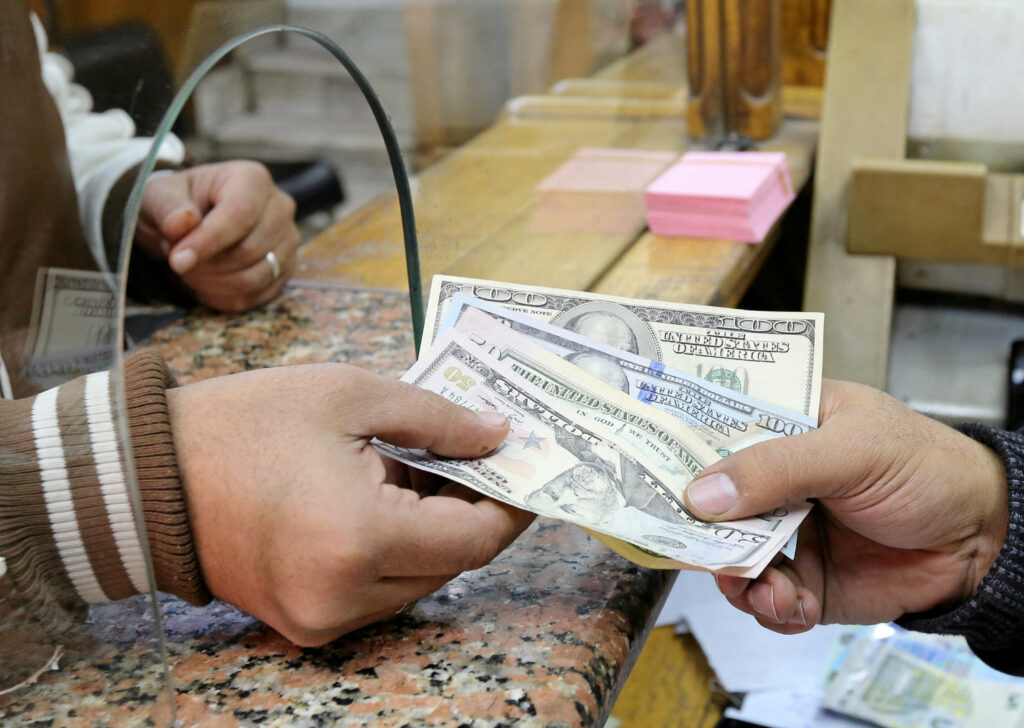
The value of the Egyptian pound has declined steadily against the US dollar in recent days, reaching LE47.95 on Tuesday from LE 46.72 a week earlier.
The drop comes as foreign investors and funds pull out of emerging nation bond markets, with a total of nearly LE12 billion (US$250 million) exiting Egypt’s market over the past week, according to stock exchange data from last week reviewed by Mada Masr.
From his side, Mahmoud Nagla, the executive director of money markets and fixed income at Al Ahly Financial Investments Management, linked the drop in the pound’s value to foreign currency outflows amid geopolitical threats affecting investors’ appetite for government debt.
Global markets have reacted over recent weeks to the United States’ deployment of military assets to the region as it threatens to strike Iran.
The pound is fluctuating in line with declining confidence in global markets, he noted, since the government no longer intervenes to manage the value as it did before.
The speed of the pound’s decline this time, said Nagla, is linked to increased exchange rate flexibility rather than the scale of capital exiting the local market.
The pound’s value has previously dropped sharply over short periods of time due its increased exchange rate flexibility. In April, the dollar surpassed LE51 amid foreign currency outflows that amounted to LE2.25 billion over the course of one week.
Nagla underlined that in previous years, the pound’s more rigid exchange rate meant that foreign capital outflows were accompanied by slower declines — or even temporary stability — in its value.
“Foreigners’ exit from the government debt market over the last few days cannot be considered an exceptional situation, and cannot be called an ‘exit.’ It can, however, be considered a simple adjustment in portfolio rebalancing — which means that foreign investors adjusted the relative share allocated to Egyptian debt instruments due to rising regional risks,” Nagla explained.
MP Mohamed Fouad, a member of the House of Representatives’ Economic Affairs Committee, anticipated that the pound’s value will not continue to drop indefinitely.
“There are favorable global conditions that could keep the dollar trading within a range of LE47.5 to LE50 over the next 12 months,” said Fouad.
He indicated the anticipation of a global monetary easing cycle, and the government’s intention to maintain a positive real interest rate domestically to keep Egypt’s debt market attractive.
A real interest rate is maintained as long as interest rates exceed inflation, making sovereign debt instruments attractive to foreign investors.
Nagla agreed that overall, “it is likely for the pound's flexibility and depreciation to lead to foreign investors returning at a later point and realizing profits once again, given that a higher dollar price becomes profitable to foreign investors when they enter the market.”
“We cannot compare what is currently happening,” said Nagla, “with what occurred [to the pound] following the outbreak of Covid-19 in 2020, or after the start of the Russia-Ukraine war in 2022. We are not currently witnessing any rush to sell government debt securities, as was the case then.”
The Egyptian debt market witnessed a quick flight of “hot money” with the outbreak of Covid-19 in 2020.
At the time, the International Monetary Fund said that foreign investors sold more than US$15 billion in treasury bills and bonds in March and April 2020. Foreign holdings then fell to a low of about $10.4 billion in May 2020, before later recovering to around $24-25 billion by the end of that year.
Then, after the outbreak of the Russia-Ukraine war in January 2022, the Egyptian market witnessed a new wave of foreign capital flight, including about $20 billion exiting the market, former Finance Minister Mohamed Maiet announced at the time.
أخبار ذات صلة
Dollar price falls in parallel markets relieving pressure on consumers but causing uncertainty for businesspeople, traders
The Egyptian pound has rallied on parallel markets over recent days, after reaching an all-time low last week at an exchange value…
Capital Intelligence downgrades Egypt’s credit score, citing delays in privatization, exchange rate liberalization
Credit rating agency Capital Intelligence downgraded Egypt’s long-term sovereign debt rating from B+ to B, citing delays in implementing structural reforms recommended…
Moody’s extends Egypt’s credit review for 3 months
Citing an attempt to “balance” government progress with concerns about Egypt’s foreign currency inflows, Moody's Investors Service extended its review of Egypt's…
Reaching a dead end? Where Egypt and the IMF stand on the stalled loan program
The state might have to renegotiate some debt servicing deadlines.
Your support is the only way to ensure independent, progressive journalism survives.
You have a right to access accurate information, be stimulated by innovative and nuanced reporting, and be moved by compelling storytelling. Subscribe now to become part of the growing community of members who help us maintain our editorial independence.
Join us