
Doctor claims Khaled Saeed not beaten to death

Khaled Saeed was not beaten to death, but died of asphyxiation after swallowing a bag of hashish, forensics doctor Mohamed Abdel Aziz claimed on Monday.
He was testifying in the fifth session of the retrial of two police officers previously convicted of murdering the now-iconic victim.
In 2012, police officers Mahmoud Salah Mahmoud and Awad Soliman were convicted and sentenced to seven years in prison for Saeed’s murder in June 2010. After filing an appeal, the two men are now facing a retrial.
Abdel Aziz had concluded asphyxiation was the cause of death in the initial report he prepared with other doctors at the forensics authority in 2010. However, multiple eyewitnesses had reported seeing the accused officers beating Saeed to death in the street in front of the cyber cafe in Sidi Gaber where he was apprehended.
Abdel Aziz did testify that Saeed suffered a number of bruises, including one on his head, which resulted from impact with a sharp object. He also suffered bruises on his jaw that resulted from pressure of someone who attempted to open his mouth, the doctor alleged.
Nonetheless, he maintained than any cause of death other than suffocation was “fiction."
Saeed’s death became a symbol of police brutality, with photographs of his disfigured face quickly going viral on social media. He has been referred to as “the face that started a revolution,” as many believe his death was the spark that led to the January 25 2011 revolution.
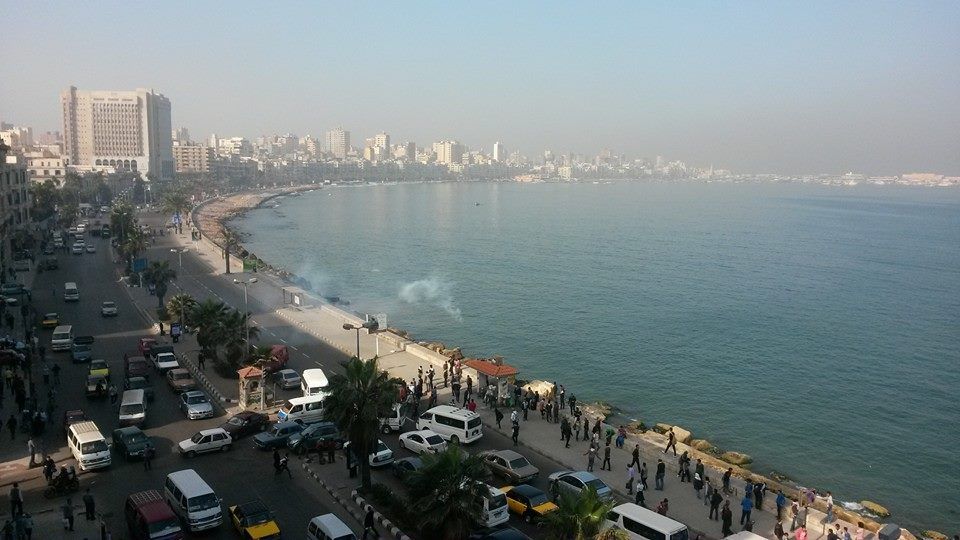
Before the session started on Monday, activists protested against the retrial in front of the Alexandria Criminal Court. Police forces fired tear gas to disperse the demonstrators.
The court decided to resume the session on December 4 in order to hear testimony from another witness, the state-run newspaper Al-Ahram reported.

أخبار ذات صلة

Interior Ministry announces execution of Alexandria man found guilty of killing teen
In a statement Saturday, the Interior Ministry announced the execution of Mahmoud Hassan Ramadan, convicted of throwing a teenager to his death…
Alleged Egyptian Al-Qaeda member sentenced to life
An Egyptian allegedly belonging to Al-Qaeda was handed a life sentence on Thursday by Alexandria Criminal Court for conducting terrorist operations in…
Low turnout and apathy among voters in Alexandria
Alexandria witnessed lower-than-expected turnout rates on Monday, the first day of the presidential elections, and an even lower turnout on Tuesday. In…

Death sentence upheld for Alexandria man found guilty of killing teen
The Alexandria Criminal Court upheld the death sentence handed down to Mahmoud Hassan on March 29 after he was found guilty of…
Your support is the only way to ensure independent, progressive journalism survives.
You have a right to access accurate information, be stimulated by innovative and nuanced reporting, and be moved by compelling storytelling. Subscribe now to become part of the growing community of members who help us maintain our editorial independence.
Join us