
Authorities prevent lawyer from visiting imprisoned activist Alaa Abd El Fattah as Interior Ministry denies he is on hunger strike
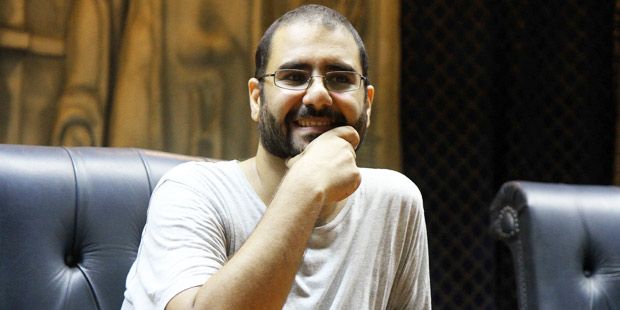
Prison authorities refused to allow the lawyer of imprisoned activist Alaa Abd El Fattah to visit his client on Thursday, over two months after Abd El Fattah began a hunger strike to protest the conditions of his detention.
Since his most recent arrest in 2019, the activist and software developer has submitted multiple requests for the public prosecutor to investigate counts of assault against him perpetrated by prison officials and to restore to him the rights to exercise and receive letters and reading materials, of which he has been deprived at various points of his detention.
Also on Thursday, the Interior Ministry released a statement claiming it had video evidence that disproved what it called “allegations” that Abd El Fattah is on hunger strike and that demonstrated it has allowed Abd El Fattah to obtain books to read while in prison.
“At least until last week,” Abd El Fattah’s mother Laila Soueif said on Thursday, her son had told her he was still on hunger strike. That was the last time that a family member received a letter from him, explained Soueif, adding that Abd El Fattah’s sister was not permitted to receive his letters at the prison on Thursday morning. Soueif did confirm, however, that Abd El Fattah told family members that he received books they had delivered to the prison for him
“If we’re lying,” Soueif told Mada Masr, “and Alaa really isn’t on hunger strike, they would have let his lawyer visit him and make sure of that for himself, and they would have prosecuted us for false reporting.”
Lawyer Khaled Ali, who is acting in Abd El Fattah’s defense, described the Interior Ministry's claim that the hunger strike is over as “a good step,” but requested a hearing with his client, a viewing of the video footage and an independent medical examination to ascertain Abd El Fattah’s health condition and to determine whether or not he is on hunger strike.
Abd El Fattah is serving a five-year sentence for criticizing inhumane conditions at detention facilities in a social media post. He began a hunger strike in April, and after gaining British citizenship, he called on British and Egyptian authorities to take action to investigate the conditions in which he and other detainees are held, and for British representatives to be permitted to visit him in detention.
The only official body to acknowledge the hunger strike thus far was the National Council for Human Rights, whose chair, Moushira Khattab, called on Abd El Fattah to end his strike in May. Khattab later requested that Abd El Fattah be transferred to an alternative detention site with superior health facilities. The following day, he was moved from the Tora Prison Complex to a new complex in Wadi al-Natrun.
Yet, on June 5, the NCHR said it had paid a visit to the facility, that Abd El Fattah was receiving food and drink regularly, and that there was no record of his hunger strike on prison books.
Abd El Fattah’s lawyer, Khaled Ali, told Mada Masr that the Public Prosecution had granted him permission to visit his client, though the rest of the defense team’s requests were denied. Ali said he waited for hours at the Wadi al-Natrun detention complex, where authorities refused to acknowledge the prosecution’s clearance. Both prison authorities and police, said Ali, also refused to officially note that the visit was denied. The lawyer said he would report the prison authorities to the Public Prosecution in the coming week.

أخبار ذات صلة
Limited access to prisons still undermines national rights council’s efforts to protect detainees
The National Council for Human Rights published its annual report on Sunday, detailing the state’s work to guarantee Egyptians’ rights and its…

Belqas protestors clash with police after torture kills detainee, lawyer says
Following 21-year-old Ayman Sabry’s death in police custody, footage published on social media showed clashes taking place on Sunday night between residents…
Former political detainee prevented from granting power of attorney
It amounts to a denial of the constitutional right to litigation, said lawyer Khaled Ali.

Rights group says highschooler Mostafa Montaser died in police custody due to torture, authorities deny
The prosecution's investigations attributed his death to natural causes.
Your support is the only way to ensure independent, progressive journalism survives.
You have a right to access accurate information, be stimulated by innovative and nuanced reporting, and be moved by compelling storytelling. Subscribe now to become part of the growing community of members who help us maintain our editorial independence.
Join us