
As unemployment rises, government hikes metro prices and reduces bread subsidy
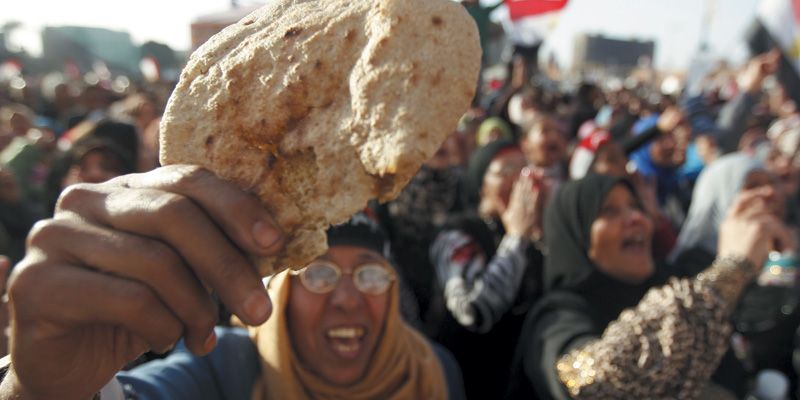
Beneficiaries of the Supply Ministry’s subsidy system, who are assessed by criteria including household income and assets, will be receiving less bread for their money after an adjustment to the price of subsidized flour.
News broke on Monday that the Supply Ministry was shrinking the size of a loaf of subsidized bread available to low-income households by 20 grams — from 110 grams to 90 grams — though the price would remain the same at five piasters. The ministry also increased the cost of subsidized flour allocated to bakeries and the number of loaves produced from each sack of flour.
In a statement on its official Facebook page on Tuesday, the ministry did not mention the altered size of each loaf, only that it had recalculated the cost of each flour sack from LE213 to LE265 and that each sack would yield 1,450 loaves instead of 1,250.
“A set of constant factors will be preserved in the bread subsidy system, the most important of which is the price of a loaf of bread for the Egyptian citizen (5 piasters with a ration card), while the state, through the Supply Ministry, continues to bear the difference in the cost of production, which amounts to more than 50 piasters per loaf, as well as maintaining the quantity available to the Egyptian citizen, ” the ministry said.
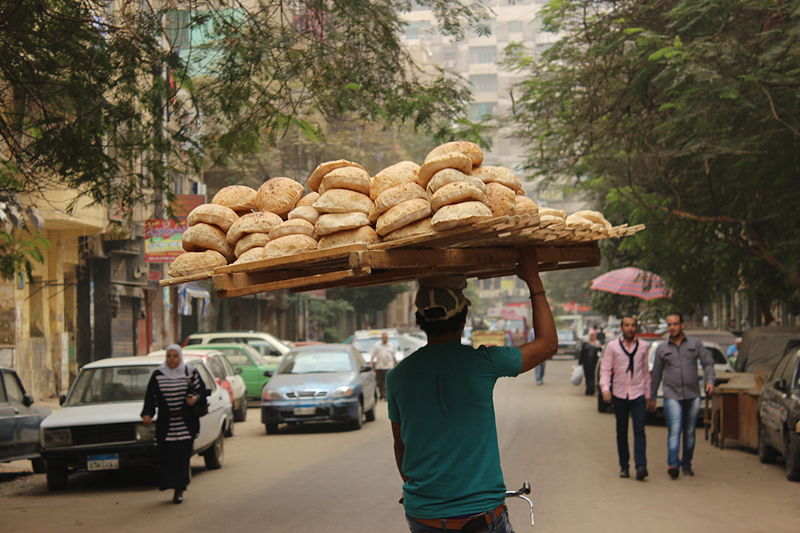
The “quantity” the ministry refers to is the number of loaves each ration cardholder receives daily: five loaves for each family member, with a maximum of 900 loaves per month. Yet with the reduction in the size of each loaf by 20 grams, the per capita daily share of subsided bread has actually shrunk from 550 grams (five loaves x 110 grams) to 450 grams (five loaves x 90 grams). The 100-gram reduction is roughly equivalent to the loss of one loaf of bread per day for the 72 million citizens that the ministry says are eligible to receive subsidized bread.
On average, Egyptians rely on bread for 70 percent of their starch and protein intake and 52 percent of their caloric intake, according to a 2014 study by the official Central Agency for Mobilization and Statistics.
The ministry's latest decision is not the first of its kind. According to the study, the standard weight of a loaf of bread in 2014 was determined to be no less than 130 grams, yet new requirements set in 2017 reduced the weight of a standard loaf to 110 grams.
Food subsidies in the current government budget decreased by LE4.5 billion, to LE84.5 billion in the fiscal year 2020/2021 — down from LE89 billion in the previous fiscal year.
The effective reduction in the bread subsidy for Egypt’s poorest households came on the same day as the Egyptian Company for Metro Management and Operation announced an increase in ticket prices on three lines to coincide with the opening of the fourth expansion of the third metro line.
Tickets for travel in one zone (from one to nine stations) increased from LE3 to LE5, while tickets for travel between two zones, or up to 16 different stations, increased from LE5 to LE7, and travel between three or more zones, between 16 or more stations, increased from LE7 to LE12.
After completing all the metro lines currently under construction, the metro company is aiming to connect most neighborhoods in Greater Cairo, with routes connecting 6 of October in the west to Fifth Settlement in the east for the metro’s 7 million daily passengers.
Before the price increase was announced, the head of the National Tunnel Authority — of which the Egyptian Company for Metro Management is a subsidiary — said in a statement on Sunday that current ticket prices do not cover the cost of building the new line and only cover operational and maintenance expenses.
Yet according to a 2018 report by the Egyptian Initiative for Personal Rights, revenues from metro ticket sales far exceed operational and maintenance costs and the metro authority does not incur an operating loss so the recent ticket price increases place the burden of public investment for the new line on passengers rather than the public budget.
According to official data, the general budget estimate for the total expenditures of the Egyptian Company for Metro Management and Operation is approximately LE143 million not including the cost of investment, while revenues from ticket sales amount to LE1.8 billion — more than 12 times the operational expenditures.
The recent ticket price increases coincide with the opening of new stations on the third metro line. The same happened in May 2018 when metro stations in Heliopolis were opened on the third line and ticket prices were increased from a standardized LE2 for all rides to LE3 for rides between one to nine stations, LE5 for rides up to 16 stations and LE7 for rides of more than 16 stations.
Those price increases sparked street protests at metro stations that led to police making dozens of arrests.
With 32.5 percent of Egyptians already living below the official poverty line, a report published by CAPMAS on Monday showed that an additional 338,000 Egyptians had joined the ranks of the country’s unemployed in the past three months.
The second quarter of 2020 saw 2.6 million people unemployed in Egypt, up from around 2.2 million in the previous quarter, pushing the rate of unemployment up to 9.6 percent by the end of June — around 1.9 percent higher than at the end of March.
According to the report, a contraction in economic activity in the wake of the COVID-19 pandemic is behind the rise in unemployment. The wholesale sector was affected most, followed by manufacturing and food services, according to the report.

أخبار ذات صلة
New year, new prices: Increased rates for train tickets, mobile and internet costs, food, electricity
The price hikes will affect transportation, food, telecom services and electricity.
Food subsidies for low income households eroded as government hikes food prices to match inflation
Exceptional support rolled out in September saw households entitled to an additional LE100 monthly
Finance Ministry announces stimulus package amid economic fallout of war in Ukraine
The decision comes amid a raft of other economic measures
Egypt fixes prices for unsubsidized bread as inflation spikes amid war in Ukraine
The government set new price controls for free market bread for the first time since the 1980s.
Your support is the only way to ensure independent, progressive journalism survives.
You have a right to access accurate information, be stimulated by innovative and nuanced reporting, and be moved by compelling storytelling. Subscribe now to become part of the growing community of members who help us maintain our editorial independence.
Join us