
As Foreign Ministry says over 100,000 refugees enter Egypt from Sudan, UN says country needs support to meet humanitarian need
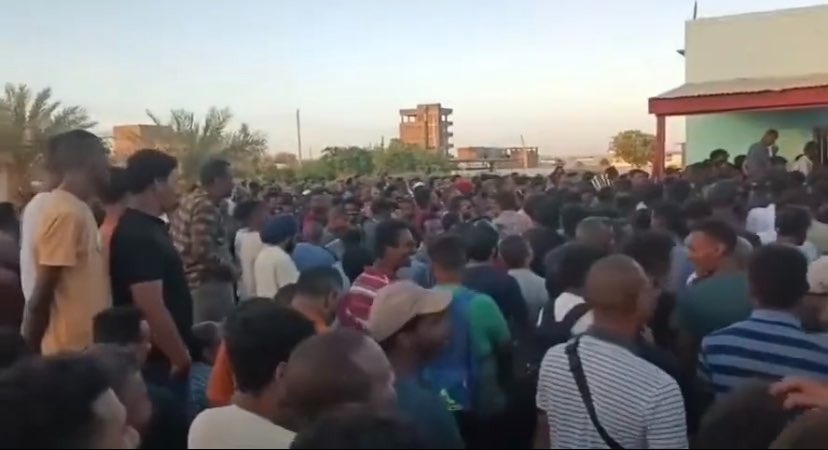
Tahani*, a Sudanese national, managed to flee from the streets of western Khartoum, which have become a battlefield over the past 46 days since the war broke out in Sudan.
Traveling by bus to the Egyptian border from Khartoum’s Qandahar Station, the main station from which travels to Egypt take off, Tahani was ultimately allowed to enter Egypt, qualifying for passage without a visa on a humanitarian basis. Tickets to cross the border from Qandahar used to cost $20 before the conflict broke out, but two weeks ago, ticket prices started ranging from $200 to $600, according to a Sudanese journalist who spoke to Mada Masr.
But men between the ages of 16 and 50, like her brother, must apply for a visa. A Sudanese immigration official told Tahani that her brother might have to wait a very long time, while a notice affixed to the window of the Egyptian consulate in Wadi Halfa now proclaims that visa waiting times are at least a month long.
With a scarcity of resources to serve the swelling crowds, the tens of thousands of people fleeing the war that has devastated Sudan since April — many of whom are in ill health — face a long waiting period with few provisions in the Sudanese desert that skirts Egypt’s south.
Egypt is the main destination accessible by land for around a million people, whom the UNHCR estimates to have been displaced from their homes by the urban warfare ripping through Khartoum and other cities across Sudan.
Around 345,000 of these people, said UN Refugee Agency spokesperson Christine Beshay, have fled to neighboring countries, including Ethiopia, Chad and South Sudan. Over half of them, or around 175,000 people so far, have come to the Egyptian border.
Around 3,000 people per day are arriving at Egypt’s southern border, according to the head of the UN refugee agency, who paid an official visit to the region this week.
The low capacity to process new arrivals has caused a bottleneck to form quickly. A 2004 agreement was intended to provide mutual freedom of movement and residence for Sudanese and Egyptian nationals in one another’s countries, yet the agreement did not enter into effect on the Egyptian side for the most part.
Some are allowed entry into Egypt without waiting, including Egyptian nationals, other foreign nationals with visas for Egypt, and those with visa exemptions on humanitarian grounds: women, like Tahani, children under 16 and men over 50 years of age.
But others must await a visa, with a number of sources describing heightened security measures at the border contributing to a backlog of paperwork and growing crowds of people waiting in limbo.
"It’s getting overcrowded," said the Sudanese journalist, noting that rumor has it there are over 5,000 passports being processed at Egyptian consulate branches in Sudan. "Some people say the embassy processes around 100 passports a day, while others say it is only processing 20 passports a day." As of this week, the consulate is advising people that visa processing will take at least a month.
Long waiting times also affect those allowed in without a visa. One Egyptian national formerly residing in Sudan said,“The security search took six hours on the Egyptian side. We submitted our passports at 6 pm and received them the following morning at 5 am due to all the traffic. Two students were detained by the National Security Agency, and subject to further investigations and security checks.”
“Doubtless there has been an intensification of security measures with regards to who is allowed entry,” said another Egyptian official speaking on condition of anonymity. “Security agencies fear the penetration of elements from the Rapid Support Forces,” the source noted.
It’s not clear how many people have been admitted to Egypt thus far. The Foreign Ministry stated on Monday that 164,000 foreign nationals have entered the country since the war broke out in April, while Beshay said that 64,000 non-Egyptians have crossed Egypt’s land borders since the onset of violence.
These include Ethiopian nationals and citizens from Niger, Chad and Syria, according to two sources speaking to Mada Masr on condition of anonymity — one an official deployed at the Argeen border crossing and the other a Sudanese doctor working on the Sudanese side of the border.
By either calculation, there are still thousands of people stretched out at the primary land border crossings, Qastal-Ashkit and Argeen, as well as in the Sudanese border town of Halfa, in a fast-brewing humanitarian crisis.
Many of those arriving are also in urgent need of support. Families formerly resident in Sudan are scraping together funds to transport their very young, or sick and elderly relatives to comparative safety in Egypt. As a result, buses stuck at the Sudanese side of the border awaiting processing are carrying injured, elderly people and pregnant women among their passengers, according to an Egyptian government official who spoke to Mada Masr on condition of anonymity.
“People are saying there are two to six deaths per day on average,” said a Sudanese journalist who spoke to Mada Masr on condition of anonymity while describing the impact of these indefinite waiting times on the sick and injured at the three main border crossings.
The UNHCR, as the lead coordinator of humanitarian relief at the border area, is funneling aid services through its partner agency, the Egyptian Red Crescent, including food, water, some emergency medical services, some basic devices such as refrigerators, and some cash resources to secure onward travel for the most vulnerable.
Following this week’s visit, United Nations High Commissioner for Refugees Filippo Grandi is calling on the international community to provide more support to Egypt and the surrounding countries, said Beshay, pointing out that the amount of funding dedicated to the Ukrainian war during its first 50 days was much greater than what is being directed toward Sudan.
The US has contributed just $245 million in funding for the humanitarian response, of which $6 million has been dedicated to Egypt so far.
With economic resources in Egypt already scarce, the lack of support has already triggered a reactive thread of commentary among pundits. TV show host Amr Adib dedicated a segment to Sudan during a May edition of his show, Al-Hekaya, on the Saudi-owned MBC Masr channel, highlighting the fallout from the war on Egypt’s borders.
“Of course we welcome and support each other and everything,” he continues, “but there are consequences.” The influx of displaced Sudanese entering Egypt comes as “things are deteriorating,” Adib said, in terms of prices and the availability of supplies, medicine and foreign currency. “Only God knows what’s next.”
*Pseudonym
أخبار ذات صلة

Sudan Nashra: Sudanese bid to rejoin global financial system unlikely to succeed amid wartime realities, sources say | Burhan seeks political backing for state control of aid in brief Jeddah visit | Idris’s intra-Sudanese dialogue proposal lacks seriousness, party sources say | Sudan Shield Forces arrive in Blue Nile | Military launches ground attacks in North Kordofan
Subscribe to our Lens on Sudan newsletter here. A Sudanese delegation pressed for Khartoum’s re-entry into the international financial system on the…
Sudan Nashra: Dengue outbreak in Khartoum, medical sources say capital still unprepared | Measles outbreak causes daily deaths in North Darfur displacement hubs | Mahamid RSF commander, forces defect to the military | RSF-SPLM-N shelling kills 6 in Dalang, military foils new offensive
On the third anniversary of the war, Khartoum — recaptured by the military last year and held up as a symbol of…
Sudan Nashra: Nyala healthcare workers on strike | Burhan abolishes deputy, assistant commander-in-chief positions | Sudanese military intelligence head in high-level talks with Tripoli’s chief of staff | Military operation to retake Blue Nile’s Kurmuk underway
Subscribe to our Lens on Sudan newsletter here. A series of announcements this week has fleshed out the April 2 decision by…
Sudan Nashra: Military retakes North Kordofan’s Bara, RSF attacks villages to its west | White Nile’s Kosti, South Kordofan’s Dalang under RSF fire | Military signals push to integrate armed movements, but leaders worry over loss of leverage
Speaking at a military camp in Khartoum on Saturday, Sudanese Armed Forces Assistant Commander-in-Chief Yasser al-Atta signaled the start of a process…
Your support is the only way to ensure independent, progressive journalism survives.
You have a right to access accurate information, be stimulated by innovative and nuanced reporting, and be moved by compelling storytelling. Subscribe now to become part of the growing community of members who help us maintain our editorial independence.
Join us