
Amid push to avert Rafah invasion, truce talks come up against Israeli vagueness, division
With Israeli officials repeatedly affirming the imminence of an invasion into Rafah, Egypt has submitted a proposal for a truce deal between Hamas and Israel to divert what is widely expected to be an operation that will cause a humanitarian disaster.
An Egyptian delegation headed to Tel Aviv on Friday to discuss with Israeli intelligence officials ways “to restart talks to end the conflict and return the remaining hostages.”
The deal under discussion has three phases.
In the first phase, all preparations for a military operation in Rafah would be stopped. The second phase would see the release of all Israeli prisoners held in the Gaza Strip over a period of ten weeks, in exchange for Israel releasing hundreds of Palestinian prisoners. The third includes a one-year ceasefire, which will be the basis for starting political talks to establish a Palestinian state.
For Egypt, the priority is delaying the attack on Rafah, even if that seems unlikely. “We are trying to do the hostage deal to delay the Rafah invasion and to make it less severe,” an Egyptian security source told Mada Masr. But, in the source’s assessment, the offensive will happen. “[Israeli Prime Minister Benjamin] Netanyahu will get into Rafah. He will get into the Philadelphi corridor. He will destroy all of the tunnels. This we are sure of.”
The fate of the ceasefire proposal hinges on this fundamental point of tension. Hamas wants assurances that any ceasefire will not just delay an inevitable resumption of Israel’s aggression. Public comments by Israeli officials underscore an unwillingness to commit to an end to the war, which has amounted to, according to Hamas and Egyptian sources who spoke to Mada Masr, vagueness on Israel’s guarantees on key points of concern for Hamas.
Israeli government divided
After the Egyptian delegation left Tel Avivi, Israeli Foreign Affairs Minister Israel Katz expressed optimism that a deal could be reached, saying that Israel would agree to postpone the Rafah incursion if a ceasefire-for-hostage deal is agreed upon. “If there’s a deal, we will suspend the operation,” he said.
However, the rest of the Israeli government was not as onboard, as tensions played out over the course of last week, highlighting differing positions. On Tuesday, Israeli National Security Minister Itamar Ben-Gvir and Finance Minister Bezalel Smotrich threatened to withdraw from Netenyahu’s far-right coalition government if the prime minister accepts any “compromises” in the truce talks or halts the war.
A planned War Cabinet meeting on Tuesday was postponed over Ben-Gvir’s threat to withdraw from the coalition. “I concluded a meeting with the prime minister [that took place] at my request,” Ben-Gvir said in a video published on X. The politician said he urged Netanyahu to invade Rafah, continue the war and reject flawed deals with Hamas.
However, Benny Gantz, a former opposition politician who is also a member of the War Cabinet, took an opposing view, stressing the urgency of releasing Israeli prisoners held by Hamas and stating that there is no urgency to defeat Hamas.
Netanyahu made his commitment to invade Rafah clear during a Tuesday meeting with the families of the Israeli detainees held in Gaza. “We will enter Rafah and we will eliminate Hamas’ battalions there — with or without a deal, to achieve total victory,” Netanyahu said.
On Wednesday, after a meeting with Netanyahu in Jerusalem, US Secretary of State Antony Blinken said that the US has not seen an Israeli plan for the invasion of Rafah that would protect civilians, adding that Washington could not support such an assault.
"We cannot, will not support a major military operation in Rafah absent an effective plan to make sure that civilians are not harmed and no, we've not seen such a plan," Blinken said.
After the meeting, an Israeli government spokesperson said: "When it comes to Rafah — we are committed to remov[ing] the last four of five Hamas battalions in Rafah — we are sharing our plans with Secretary of State Blinken.”
A vague response
While the political discourse played out in Israel, a Hamas delegation arrived in Cairo on Tuesday to discuss the ceasefire proposal.
“After the delegation went to Israel, they shared with us the Israeli responses, which are very vague in our opinion,” a source from Hamas told Mada Masr.
Hamas emphasized the ambiguity of Israel's terms regarding the Egyptian proposal, saying they require clarifications and amendments, and that Israel's terms include the usual "traps" that the Occupation typically insists on during negotiations.
While the proposal Hamas received from the Occupation was significantly more constructive than previous ones, another Hamas source told Mada Masr it did not “fulfill what is actually required.”
The source said that the document did not indicate a ceasefire in the literal sense, but used the word “truce,” which they described as “a malleable word that could carry more than one meaning.”
“There is no issue with putting a truce in place, but what the movement’s leadership requests are actual guarantees that are written down, not only spoken, for the war not to be resumed after this truce.”
For an Egyptian source at a state-affiliated research center who is in talks with Hamas officials, the vagueness of Israel’s responses has undermined any potential for the resistance movement to accept the ceasefire. “Why would Hamas accept a 12-month truce when the Rafah operation is going to happen? Will the truce happen before Rafah or after Rafah?” they remarked.
There were still no clear answers to these points even after the Egyptian delegation returned from Israel, the source added.
At the end of the delegation’s visit, Hamas submitted comments on the proposal highlighting this vagueness. The movement objected to Israel’s insistence that only civilians be allowed to evacuate to the north without Hamas members being allowed to move out of Rafah. Sources told Al-Shorouk that this is a “trap” as it is difficult to distinguish resistance fighters from civilians, meaning Israel has a tool to control the return of displaced Palestinians to northern Gaza.
Hamas tried to clarify the proposal by insisting that the word “complete” be added to qualify Israel’s withdrawal from Gaza, even as sources told Al-Shorouk that the resistance would accept a gradual drawdown as long as it was complete.
Before heading to Israel to meet with Netanyahu, Blinken urged Hamas to accept Israel’s “extraordinarily generous” offer, on the sidelines of the World Economic Forum in Riyadh on Tuesday.
While the resistance group expressed to Egyptian and Qatari mediators its seriousness about reaching an agreement, Hamas official Sami Abu Zuhri told Egyptian intelligence-affiliated outlet Al-Qahera News that the movement would not succumb to any US pressure.
Next steps
Hamas said on Thursday that it will send a delegation to Cairo as soon as possible to resume ceasefire talks, in response to Egypt’s latest proposal. In a statement, Hamas leader Ismail Haniyeh said he had spoken to Egypt’s intelligence chief and “stressed the positive spirit of the movement in studying the ceasefire proposal.”
Meanwhile, top Israeli ministers are set to convene tonight to discuss the ceasefire and the Rafah invasion.
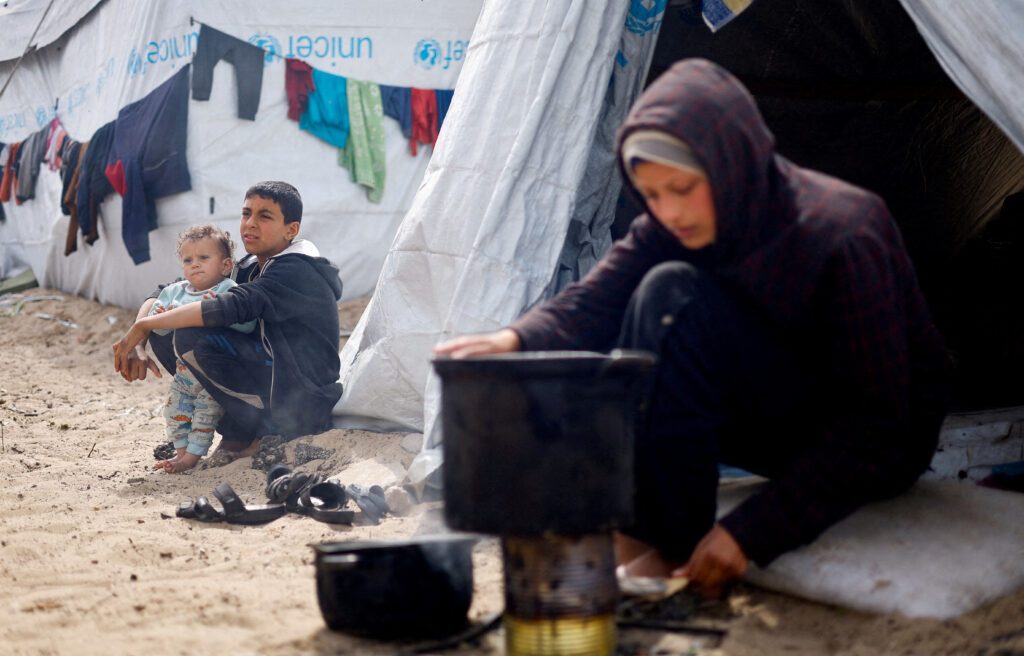
Over 1.5 million people are sheltering in Rafah near the Egyptian border, having been displaced from their homes throughout Gaza due to Israel’s relentless assault on the strip by air, land and sea. Over 34,000 people have been killed and much of the strip has been razed to the ground, which Israeli officials pledged to do after Hamas’ October 7 incursion into Israeli-held territory.
United Nations Secretary General Antonio Guterres appealed on Tuesday to states with influence over Israel "to do everything in their power" to prevent an Israeli assault on Rafah.
"The world has been appealing to the Israeli authorities for weeks to spare Rafah, but a ground operation there is on the immediate horizon," said UN Under Secretary General for Humanitarian Affairs and Emergency Relief Coordinator Martin Griffiths in a statement on Tuesday. "The simplest truth is that a ground operation in Rafah will be nothing short of a tragedy beyond words."
أخبار ذات صلة

Hundreds of Gaza students demonstrate for right to study abroad
Hundreds of university students trapped in the besieged Gaza Strip gathered on Monday outside the Journalists Syndicate’s headquarters in western Gaza City…

In meeting with Board of Peace director-general, Hamas refuses UN disarmament plans until Israel commits to withdrawal
Hamas has refused to commit to the plans proposed by the United Nations for its disarmament, citing lack of advancement in Israel’s…

Israel agrees to limited reopening of Rafah border crossing — details pending
Israeli Prime Minister Benjamin Netanyahu’s office announced on Monday that it has agreed to a “limited reopening” of the Rafah border crossing…

Sisi touts ‘stabilization’ agenda at first Davos appearance in over 10 years
President Abdel Fattah al-Sisi advertised Egypt’s “stabilization” agenda in Davos on Wednesday, saying the country’s focus on steering away from regional conflicts…
Your support is the only way to ensure independent, progressive journalism survives.
You have a right to access accurate information, be stimulated by innovative and nuanced reporting, and be moved by compelling storytelling. Subscribe now to become part of the growing community of members who help us maintain our editorial independence.
Join us