
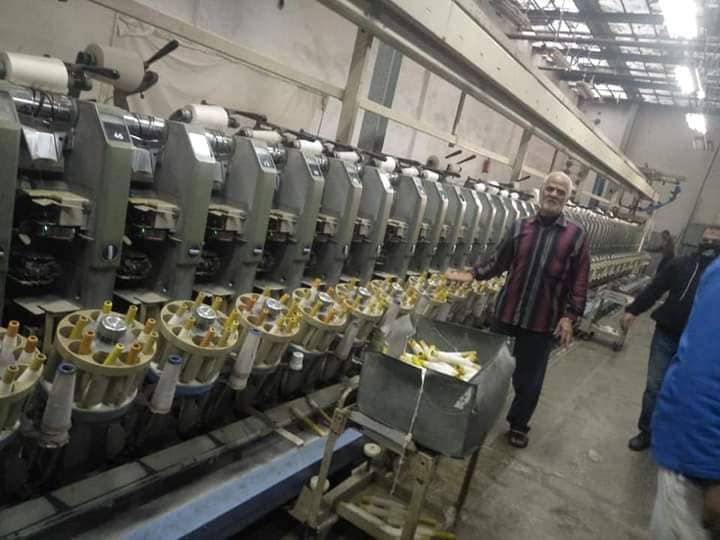
The Kafr al-Dawar textile company: On the road to liquidation
A Damanhour criminal court last month acquitted 19 workers at the Misr Spinning and Weaving Company in Kafr al-Dawar, an industrial city in the Nile Delta who were accused of illegally demonstrating, assaulting a public servant and possessing weapons, among other charges. The ruling overturns earlier sentences of life in prison that were handed down to the workers in absentia.
The case dates back to March 2020 when several workers held a demonstration to protest Chairman of the Board Anwar Obaid’s management policies, which they claimed had exacerbated the company’s losses, prompting fears that management was laying the groundwork to close down the company once and for all, according to several workers who spoke to Mada Masr on condition of anonymity.
The workers’ fears appeared justified in December, when the Public Enterprise Ministry, which owns and manages the Misr Spinning and Weaving Company and its parent holding company, issued a decree to temporarily shut down the factories in Kafr al-Dawar for redevelopment. The news led to workers organizing another protest and sit-in on the factory grounds for several days.
At the time, the Cotton and Textile Industries Holding Company issued a statement saying that the factories at Kafr al-Dawar would be closed for nine months until its new facilities in the nearby village of Beida are completed. Workers would then be transferred to the new site while maintaining the same job and salary, according to the ministry’s statement. The holding company said the decision came as part of a comprehensive development plan that moves the Kafr al-Dawar factories to the site of the Beida Dyers Company, another subsidiary of Misr Spinning and Weaving located three kilometers from the current site.
While the ministry sought to reassure workers that the factory shutdown was temporary, the statement did little to allay fears that the move was a prelude to liquidating the company as part of the Public Enterprise Ministry’s “modernization” plan for the state textiles sector, according to several workers who spoke to Mada Masr. The concerns were sparked by the company’s moves to open the door for early retirement and changing the previously announced development plan that stipulated adding companies to Kafr al-Dawar, not the other way around.
The shutdown also came without any prior warning, which workers pointed out has been a common tactic ahead of the liquidation of public sector companies, such as happened with the National Cement Company and the Egyptian Company for Maritime Transport.
The government’s “development” plan
In April 2019, Presidential Spokesperson Bassam Rady announced the state’s plans to develop the spinning and weaving sector. In a statement, Rady said that the public sector spinning and weaving factories would be developed by upgrading machinery and equipment, as well as increasing the efficiency of existing equipment.
The announcement kicked off the Public Enterprise Ministry’s plan to restructure state-owned spinning and weaving companies, which they had been preparing for since 2017 with the help of Warner Consulting Group, a US consulting firm.
Warner’s plan for public sector spinning and weaving development aims to quadruple current production capacity and to transform industry losses of up to LE40 billion into LE3 billion in net profits within three years. Production would begin in 2022 and the sector would turn a profit by 2025.
The development plan called for industry consolidation, merging nine ginning, trading and pressing companies into one company, and 22 spinning, weaving and dyeing companies into nine companies. It also transforms three companies (Mahala, Kafr al-Dawar and Helwan) into major, integrated industrial hubs as well as centers for export. The remaining six companies will be focused on a specific stage of manufacturing (spinning, weaving, dyeing or processing) or on products targeting a specific category, such as jeans or consumer textiles.
Administrative and technical costs of the mergers will require an investment of around LE21 billion, according to the plan, which includes the modernization of the spinning, weaving and dyeing companies in terms of infrastructure, construction and upgrades to machinery and equipment.
The implementation of the development plan began in June 2019, when contracts worth US$540 million for the first phase were signed to supply modern machines to factories from some specialized companies. This was followed by the hiring of PricewaterhouseCoopers to financially restructure and merge the companies.
In July 2020, the Siouf Spinning and Weaving Company in Alexandria merged with Kafr al-Dawar and 300 workers from the Siouf factory were transferred, according to several workers. Nadia Abdel Sayed, the chair of the Siouf company, was also appointed head of the Kafr al-Dawar board.
“We were taken by surprise,” says Zaher*, a 59-year-old worker at Kafr al-Dawar. He says when Public Enterprise Minister Hisham Tawfiq visited the company at the end of 2019 with the president of the holding company, he assured workers that Kafr al-Dawar would become a major industrial hub as part of the development plan for the sector, promising new equipment and training. “He thrilled us with the potential of real work and told us that a few companies would be joined with ours. Unfortunately, we believed him,” Zaher says.
“Several months passed after the minister’s visit and his promises. There were no new machines, no building restorations, no training courses. We began to have doubts about the development plan. These doubts were suddenly realized with the decision in December to shut down the company for nine months and give workers a vacation until they would be transferred to Beida Dyers,” Zaher says. “This wasn’t the development plan we were told of in the beginning. They said that all production units would be transferred to [Kafr al-Dawar’s] Factory No. 4 at the same company site, that part of the company grounds where the rest of the factories are located would be used, and that the machines would be renewed. The plan was never to take away the entire company.” Zahar believes that the reversal of the plan marks the end of the company and a move towards liquidation under the guise of development.
The declared plan changes
On December 27, workers learned that the company’s trade union committee had been summoned to a meeting with the president of the holding company and the chair of Misr Spinning and Weaving Company in Kafr al-Dawar's board, according to Seif*, a 37-year-old worker at the company.
At the meeting, senior management proposed shutting down the Kafr al-Dawar site, an idea the trade-union committee promptly rejected. With just 1,100 workers at the Beida site compared to over 7,300 at Kaf al-Dawar, fears of an impending liquidation only grew, prompting workers to organize a sit-in, Seif says.
In response to the sit-in, the holding company issued an eight-point decree to address workers’ grievances, pledging to guarantee workers’ rights during the planned nine-month closure period. In the document, which Mada Masr obtained a copy of, the holding company pledged that salaries would be released in a timely fashion, that early retirement regulations would be amended in coordination with the Public Enterprise and Social Solidarity ministries. It also committed to releasing withheld payments to pensioners and future pensioners, to release withheld health benefits payments, and to providing transportation for those who wish to work at the Beida Dyers facility.
“When we learned that the decision to shut down was final because it was coming from a sovereign security agency, and that the [Armed Forces] Engineering Authority was in a hurry to take over the company to demolish it and use its land, this led us to end the sit-in and go home,” says Mina,* a worker at the company.
He says that some of the items in the holding company’s eight-point document in fact confirmed the company’s intention to liquidate the company. According to Mina, the first item in the document about amending early retirement regulations paves the way for workers to retire early. The vast majority of workers are over 50, Mina says, making early retirement a preferable option for them. If the government actually intended to develop the company, as officials have repeatedly stressed, then making it easier for workers to retire would not have been the top agenda item in the holding company’s decree, Mina says.
Towards liquidation under the guise of restructuring
Workers view the government’s moves essentially as a step toward the liquidation of the company through the disposal of assets — such as workers through early retirement as well as buildings, land and machinery. The state has denied it is liquidating the company and says it is merely overseeing a merger with early retirement as a way to reduce expenses along with a restructuring of the corporate entity.
However, legal experts point out that the government does ultimately appear to be moving towards liquidation.
Mahmoud Maher, an appeals attorney who specializes in corporate affairs, says the steps taken at Kafr al-Dawar — with the disposal of assets and downsizing through arbitrary layoffs and early retirement — are not typical features of mergers, which normally combine existing companies into a single corporate entity. He also points out that Kafr al-Dawar’s financial burdens consist of debts, most of which are owed to government agencies and could technically just be written off. He believes that what is actually taking place at Kafr al-Dawar reflects the state’s desire to rid itself of the burden of the public sector instead of managing it.
Yasser Saad, a lawyer at the Legal Collective to Promote Labor Awareness, agrees with Maher that the situation at Misr Spinning and Weaving Company in Kafr al-Dawar is simply a government maneuver to pull out of the sector. Saad says that, according to the Constitution, the state is responsible for protecting the means of production, which does not entail reducing the workforce, who are partners in the production process.
“What has been happening at Kafr al-Dawar is deliberate by the government to remove the burden of management. The reality is there is no development of the company,” Saad says. “It’s a clear policy. We must also understand that a merger is like a marriage whereby two companies move in together with all their assets. It’s about increasing assets, not disposing of them alongside workers.”
The Mahmoudiya Axis — a 21.1 kilometer-long, 16-lane, two-way highway in Alexandria, appears to be a factor in the state’s plans for the Kafr al-Dawar company. According to an official statement released by the holding company, the factory’s lands will be handed over to the Armed Forces Engineering Authority to develop the area.
“In response to development plans undertaken by the state to build housing projects to replace informal areas, the closure of the existing factories at Kafr al-Dawar was considered early on in order to implement these projects, which align with developing the Mahmoudia Axis in the area located in the governorate of Beheira,” the statement said.
The Public Enterprise Minister also confirmed this when he phoned in to a TV program in January saying: “With regard to Kafr al-Dawar, you surely know that it is located on the Mahmoudia Axis … We were planning that within a year or a year and a half, we would shut down the factory and take the new equipment to the Beida Dyers Company six kilometers away.”
A deliberate deterioration
There is a widespread belief among workers that for years, the state’s plans toward the company have been to cause deliberate losses in order to reach a situation that leads to liquidation, not development.
Zaher says that the company, once a leading textile manufacturer, has a history of deliberate losses and squandering public funds, for which no one has been accountable. “Since 1990, all maintenance and upgrades have stopped, Zaher says. “The general direction started moving toward scrapping and sabotaging. In his time as public enterprise and then as prime minister, Atef Ebeid sold some of the company’s subsidiaries such as the Arab-German Company, Kom Hamada Company and others. He also opened applications for early retirement and between 2004 and 2010, 14,000 workers retired early. This caused a shortage of workers and a number of production lines were suspended,” he says. “The period of losses began in 2004. Before that, profits were at least LE170 million and reached 400 million in some years. We were exporting to Europe and East Asia. In parallel with all these measures, the company’s products deteriorated ...We were working with Greek and Sudanese cotton, which is very poor in quality. Materials became poor, so did production.”
The company’s financial statements show the accumulation of losses until the last budget announced in 2020 at over LE8.8 billion. One billion in losses were accumulated in a single year when Anwar Obaid led the company, according to an employee at the company’s financial department who asked to remain anonymous. He says none of the successive management teams tried to reduce losses. On the contrary, the company continued to lose money until revenues could no longer even cover the wages of workers. This led various management teams to periodically borrow from the holding company or lease 100 feddans of the company’s land as right-of-use assets to 70 factories to ensure a steady income. Other managements sold some machinery and equipment, while the previous chairperson of the board, Obaid, turned to selling the factory’s electricity cables last March. This enraged workers and led them to briefly detain him and demand his dismissal. As a result, 19 workers were put on trial.
The accumulation of years of deliberate neglect by successive regulators, governments and management regimes eventually led to the current predicament, with the state claiming it is developing, restructuring or merging the sector while the company’s liquidation appears to be on the horizon.
* pseudonyms
تقارير ذات صلة
Egypt’s 1st hourly minimum wage: An ‘announcement to global markets that our labor is cheap’
Sources express fear that the decision will formalize and entrench an already precarious situation

New labor law, same pro-business bias
A decade after initiating the process to draft a new labor law, the government announced on November 6 that the bill had finally been completed after incorporating several amendments. The…
State of pay: Organizers pushing for higher wages beset by barriers amid skyrocketing inflation
"When we brought up the raises, they told us, ‘you can leave'”
Your support is the only way to ensure independent, progressive journalism survives.
You have a right to access accurate information, be stimulated by innovative and nuanced reporting, and be moved by compelling storytelling. Subscribe now to become part of the growing community of members who help us maintain our editorial independence.
Join us