
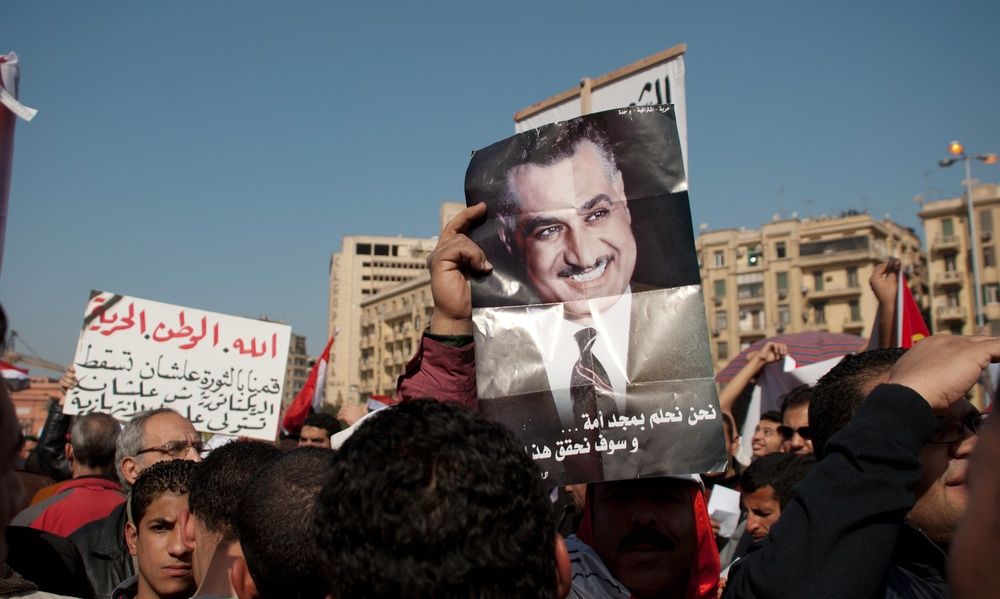
When it boils down to Nasserism
The spectre of Gamal Abdel Nasser is haunting Egypt’s upcoming presidential election. The election has set up a contest between two candidates who both, in different ways, claim Nasser’s legacy.
The prohibitive favorite, former military chief Abdel Fattah al-Sisi is lauded by some of his supporters as something like a reincarnation of Nasser, a military officer responsible for saving the country from Nasser’s historic enemy, the Muslim Brotherhood. The election’s underdog, long-time opposition activist Hamdeen Sabbahi, is the standard-bearer of contemporary political Nasserism.
One of the important subplots of this election is a rift emerging in the camp of avowed Nasserists, the small collection of political parties that champion a version of Nasser’s vision of national glory and social justice. More than calling for a specific set of policies, these groups represent a nostalgic thread in Egyptian politics: A yearning for the cultural and political flourishing of Nasser’s 18 years in power.
As the political leader of principal Nasserist organizations — like the Karama Party and the political coalition Al-Tayyar al-Shaabi that was born around his 2012 presidential candidacy — Sabbahi can count on the support of a portion of the Nasserist forces. But several of the prominent faces of Nasserism, who backed Sabbahi in the 2012 presidential election, are now supporting Sisi. Chief among them is Nasser’s own son, Abdel-Hakim Abdel Nasser, who predicted in September 2013 that Sisi would win the endorsement of the “whole Nasserite current in Egypt,” because “they have found the spirit of my father Gamal Abdel Nasser in him.”
But what elements of Nasser’s vast and controversial legacy are Sisi and Sabbahi drawing on? In the current election, in addition to the split among personalities, there is also an ideological split between Nasserism and what might be called neo-Nasserism. Whereas Sabbahi still adheres to some vague notion of Nasser’s policy of redistributing wealth, there is little indication that Sisi does. Statements from Sisi and people close to him suggest that if he wins, his government will continue to embrace the same economic track pursued under both deposed President Hosni Mubarak and the Muslim Brotherhood: That of slimming down the economic role of the state.
“Sisi, to the extent he’s talked about anything concrete, has spoken in more or less the same kind of neoliberal terms and [about] the need for everybody to work harder,” says Zachary Lockman, a leading Middle East historian at New York University. “In all we’ve heard from Sisi, there’s not much in common, even remotely resembling the kind of ideology Nasser eventually reached in the 1960s. Sabbahi evokes this maybe a little more directly and maybe a little more plausibly, although without much real content.”
The economy, of course, is the meta-issue under girding much of Egypt’s political dilemma. How will any Egyptian government address an economy that is momentarily stabilized by cash from Saudi Arabia and the Emirates, among others, but whose fundamentals are arguably weak?
Sisi is expected to use his personal popularity to ask Egyptians to make economic sacrifices that a less popular government might shy away from. “I cannot perform miracles,” he said in his March 28 speech announcing his candidacy. “Rather, I propose hard work and self-sacrifice.” With talk of restructuring and subsidy reform in the air, the economy would appear to be an easy issue for Sabbahi to derive political profit: Why not assail Sisi over the “sacrifices” that would be expected of Egyptians under his government?
Any consideration of Nasser-nostalgia, including the nostalgia on both sides of the current campaign, raises more contradictions than it resolves. The question, as always, is which version of Nasser’s legacy is being claimed. Joel Gordon, a historian at the University of Arkansas who has spent much of his career studying Nasser and his legacy, said the contradiction has been particularly stark since the 2011 revolution. “You could easily see the Mubarak regime as the inheritor of the Nasserist state and yet at the same time Nasser was not being held responsible for any of it,” he said in an interview.
In his column in the privately owned Al-Shorouk newspaper, political scientist Amr Hamzawy criticizes the romanticization of Nasserism when associating it with the current candidates.
For one, he explains that the claim of Nasser’s military institution breaking off from the subsequent regimes is false, since the institution stayed at the heart of power. It changed its position alongside that of the regime, when it opened up to foreign support and economic liberalization. He adds that while the institution is recognized for its championing of the cause of economic nationalism and standing for foreign interference, it has also been responsible for stifling freedoms and for controlling the state and weakening its institutions through a one man show.
Another question is, if and when Sisi becomes president, how long will the notion of Nasser as an embodiment of Nasser’s spirit last, given the structural challenges facing the Egyptian state and economy?
“The room for manoeuvre that Nasser had is not available to Egypt now,” said Lockman, the NYU historian. “The one place they can turn to for support is Saudi Arabia and the Gulf countries who are not about to support a progressive redistribution of Egyptian resources or any kind of policies they see as threatening.”
“The pressures from below will continue. He [Sisi] will be compelled to repress them,” he added. “This will not do much for his popularity or his ability to claim the mantle of Abdel Nasser, which will leave him in the same position that many of the previous regimes were in.”
In campaigning, neither Sabbahi nor his surrogates are eager to capitalize on this apparent tension between him and Sisi. Heba Yassin, the spokesperson for Al-Tayyar al-Shaabi, demurred from a question on whether they would criticize Sisi on economic issues. At the Karama Party headquarters in Cairo’s Doqqi neighborhood, in a windowless office decorated with portraits of Sisi and Sabbahi, she said, “Currently Sisi hasn’t put forward a program, political or economic, for what he is going to offer the Egyptian people.”
In his recent campaign rhetoric, Sabbahi has shown signs that he realizes that “who’s the bigger Nasserist?” is a game he is likely to lose, on superficial grounds, if he’s playing against a retired field marshal of the Egyptian military. In fact, he and his campaign are attempting to shake the “Nasserist” tag completely. He’s not a Nasserist, he was recently quoted as saying, he’s a “candidate for the majority of the people.”
Yassin echoed Sabbahi’s repudiation of the whole Nasser question. “The question isn’t about Hamdeen Sabbahi and Abdel Nasser or Sisi and Abdel Nasser,” she said. “Abdel Nasser was a champion of the poor, and Hamdeen adopts the same important policies of social justice.”
Neither Sabbahi nor Sisi then wish to make reference to the intramural squabble among Nasserists. Sabbahi is positioning himself as the true champion of the revolution, and Sisi as the nation’s savior. And in some ways, the Nasserist subplot can be regarded a natural side-effect of how history has unfolded since the protests against President Mohamed Morsi began on June 30, 2013: Sisi and Sabbahi are the candidates that remain now that the state has all but eliminated Islamists from political participation, and other potential opponents of Sisi — centrist Abdel Moneim Abouel Fotouh and left-wing activist Khaled Ali — are boycotting the election in protest of the government’s repression.
تقارير ذات صلة

Who controls Egypt’s religious institutions? How the top of the executive, security apparatus loom over the 3 institutional houses of Islam
Objection to the potential selling of endowments has primarily come from Al-Azhar.

Bread subsidies: The history of a ‘red line’
The 1977 bread riots erupted less than 24 hours after the announcement of a bread price increase

Defeat’s possibilities: 3 activists recount 1967 as formative
1967: the moment that fractured the new nationalism; politically formative for generations to follow
Your support is the only way to ensure independent, progressive journalism survives.
You have a right to access accurate information, be stimulated by innovative and nuanced reporting, and be moved by compelling storytelling. Subscribe now to become part of the growing community of members who help us maintain our editorial independence.
Join us