
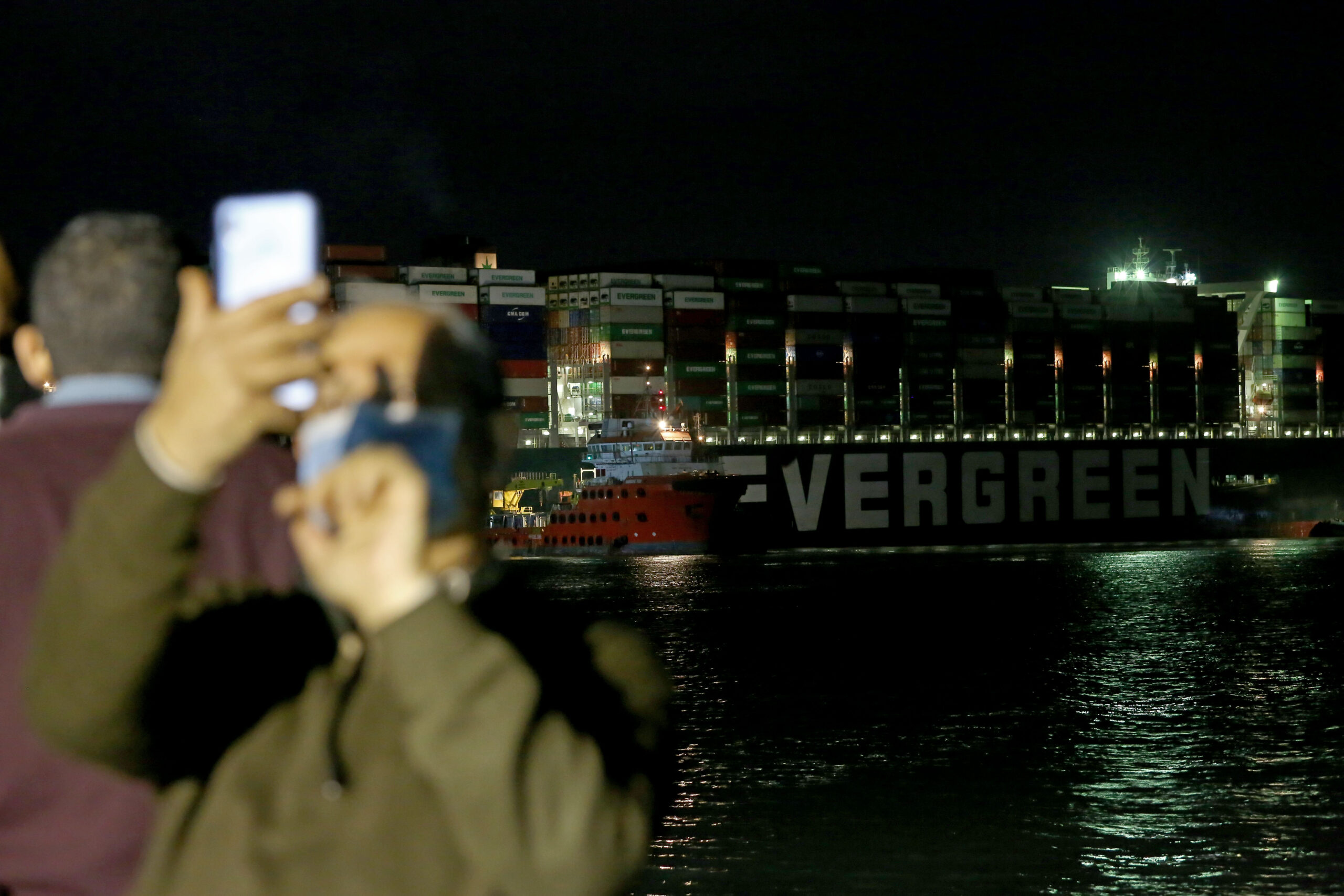
Twice as tough: Behind the scenes of the efforts to refloat the Ever Given
Suez Canal Authority head Osama Rabie announced last Thursday that the government would disburse bonuses to about 800 canal workers who participated in refloating the Japanese-owned container ship Ever Given, which ran aground in the waterway through which 15 percent of global shipping transits and blocked traffic for six days.
The participating crews called in to dislodge the ship worked frantically to unblock the channel. And according to a navigation source at the canal who recounted the events of the “crisis week,” it was the biggest test they had ever faced.
“It was the first time a vessel of that size was grounded, and it was loaded with a lot of cargo,” says the source, who spoke to Mada Masr on condition of anonymity. “It was grounded at both the front and back and it had a huge draft. The bow sunk 11 meters into the ground at the eastern side of the canal and its rear was grounded into the western bank.”
Ships have run aground or gone astray before in the old and new bypasses of the canal, according to the source. However, most times, they said, it takes an hour or two to dislodge them. “And even if a bypass gets blocked, the other ones are still operational. We deal with it incredibly fast, and tugboats take care of it fairly quickly,” the source says. “The Suez Canal Authority is used to this kind of work and has the capabilities and experience. But the magnitude of the crisis, the size of the ship and the way it ran aground is what was so difficult.”
Built in 2018, the Ever Given is one of the world’s biggest container ships, coming in at 400 meters long and 59 meters wide with a weight of about 200,000 tons when empty. The ship can be loaded with up to 20,000 containers.
“It ran aground right after a service station near Suez,” says the navigation source — the narrowest stretch of the canal. The canal narrows to 250 meters wide for 30 kilometers starting from the entrance of the canal until the village of Kebrit in Suez Governorate.
When the vessel ran aground at 830 am on March 23, it was all hands on deck at the authority, according to the source.
“There were mechanical and electrical technicians, engineers, sailors and captains. A typical crew for a single shift on a small tugboat is usually 9 members and 15 on larger tugboats. But due to the crisis, technicians, welders and engineers were called in, as well as all the authority’s directors and its head. They were all there throughout the crisis.”
Canal workers were faced with two options, according to the source: “The first option was to dislodge the vessel. In other words, shake it right and left to get it moving. That task would have fallen to dredgers, who would have to remove the earth.”
The plan was “to rotate the vessel counter-clockwise” by dredging at the bow, while pulling it forward and pushing it from behind. At the same time, they planned to dredge around the rudder at the rear of the ship while pulling from behind and pushing from the front.
The Ever Given had run aground at high tide — the more difficult scenario, the source says, due to the extra force required to free it. “If it had run aground at a low tide, the higher tide would’ve pushed it up and dislodging it would’ve been easier,” the source says.
The other option was to lighten the ship’s load, which could have taken months, according to the source, who says that the authority is unequipped to deal with cargo loads of that size, leaving dislodging the Ever Given as their only viable option.
The source notes that when the crisis began, there were three other vessels traveling behind the Ever Given in the narrowest stretch of the canal, which posed safety concerns. “That stretch of the canal isn’t designed for anchoring vessels. Also, the tide was high. So, there were tugboats securing these vessels to prevent them from running aground as well,” the source says.
But the next day, the canal authority began pulling these vessels into docking areas far off from the Ever Given, where they waited until Friday.
With the first option decided upon, the dredger 10th of Ramadan was the first to arrive at the scene, while the second, larger dredger Mashhour arrived the following day, the source says. The Mashhour was the main dredger that removed the soil from around the vessel in the lead-up to its float. Meanwhile, excavators worked to remove the soil on the same bank.
The canal authority exhausted the full extent of its capabilities to solve the crisis. Aside from dredging ships, the canal authority’s tugboats joined in the effort alongside state and private tugboats from canalside cities, two foreign tugboats and another from the Egyptian Navy, according to the source.
When the Ever Given first ran aground, 12 tugboats tried to free it.The following days saw dredges joining the effort, bringing the total number of dredges participating in the process to 22.
The source explains that bad luck played a role in extending the refloating process. Most of the larger tugboats with greater towing power were in the north side of the canal, while the smaller tugboats were south of the Ever Given. This made it difficult to push and pull from the south side. Things got easier when the Netherlands-registered Alp Guard arrived on March 28, adding a towing power of 285 tons to the effort. A day earlier, the Egypt Navy tugboat Mostafa Mahmoud and the canal authority tugboat Abdel Hamid Youssef joined the effort. It was Abdel Hamid Youssef’s first operation.
“The Dutch tugboat came from the south and freed the rear, which made it easier to dislodge [the vessel],” says the source, explaining that the Dutch tugboat did not free the Ever Given on its own. In fact, it was an important addition to pulling, pushing and dredging efforts that went on for days under Egypt’s management.
The effort to free the vessel came with plenty of risks for the workers. “Pulling a ship of that size has its risks. For example, a cable could break loose, hit someone and kill them. Such accidents have happened before. Someone could also fall into the water while the tugboats were pushing or pulling. But there were the usual safety measures.”
Adding to the stress of the job, workers on the ships were also continuing on under difficult conditions. “There was no time for breaks. We had to free the ship. We worked around the clock. People divided themselves into shifts so someone could nap for an hour or two, then get up to resume. But some didn’t sleep at all. Shifts on tugboats are usually three to four days, and they’re even longer on dredgers — could take up to a week. But work isn’t usually that intense. It was a lot of effort and pressure.”
At 2 am on March 29, the southern end of the vessel was dislodged, and it floated 102 meters away from the western bank. Since the tide was high, according to the source, it moved slightly back to its horizontal position across the waterway. But it did not run aground again, and it continued to adjust its course until the following afternoon.
When the crisis was over, there “was a lot of hoopla. People were congratulating each other. They called their families and friends to inform them of the news and honked the horns of their tugboats in celebration,” says the source, adding the felt an overwhelming sense of pride when the ship had been floated.
But work didn’t stop with the dislodging of the Ever Given. After a week of the canal being blocked, a backlog of 442 ships were awaiting transit through the channel.
“There was still a lot of pressure because of the vessels waiting in line,” the source says. “But pressure from delayed ships is a light kind of pressure. Work is 24 hours, around the clock, normally. But now, the pressure from the convoys is twice and three times as much.”
The tugboats that had freed the Ever Given returned to their usual task of securing the ships transiting the canal’s waterways. Normally, 50 vessels on average take turns passing through this stretch of the waterway. “Vessels coming from Port Said wait at the lakes until vessels coming from Suez arrive, and then they move,” the source says.
When the Ever Given arrived at the Great Bitter Lakes to be docked in preparation for inspection, traffic finally resumed in the canal. In the first 24 hours after the container ship was dislodged, 113 vessels passed through the canal, followed by another 81 vessels the next day.
The Ever Given crisis put a spotlight on the Suez Canal’s need for additional measures to better deal with such incidents, especially in light of the evolution in vessel size, according to Wael Kaddour, a former member of the canal authority board of directors.
Kaddour explains that the capacity of vessels has increased from 11,000 to 24,000 containers in a span of a few years. The canal authority’s tugboat fleet must be upgraded in response, as evidenced by the vital role the Dutch tugboat’s 285-ton tugging power played in the flotation.
Kaddour points to the fact that the Suez Canal had always kept pace with the evolution of ship sizes. In the 1990s, for instance, the canal authority built two tugboats: the Ezzat Adel and the Baraka. They each had a towing power of 160 tons, making them the biggest tugboats in the world at the time.
Canal authority head Osama Rabie revealed last week a plan to upgrade the fleet, saying the authority will contract a Chinese company to build tugboats with towing capacities of 250 and 300 tons. According to Rabie, two of these tugboats will be built in China and another three in Egypt.
Aside from the tugboat fleet, Kaddour thinks that there is a need to review rules of transit across the Suez Canal. The authority should limit the transit of giant vessels when winds reach a certain level, he says, which would protect both the vessels and the canal. Ships should wait for winds to fall back to safe levels that allow for full control of the vessel. Kaddour says such a recommendation is necessary given that vessels expand their cargo load vertically, making them more vulnerable to the wind.
تقارير ذات صلة

How Iran may have found a new deterrence mechanism in its war with Israel
Over the course of two years of regional war, Al Jazeera’s Doha studio has been the epicenter of television coverage on the turbulent events that have touched nearly every country.…
Proposed formulas for new US military Red Sea foothold not acceptable to Egypt
Since March 15, the US has carried out nearly daily strikes on targets in Yemen

Egyptian officials: Sisi’s visit to Djibouti part of East Africa ‘charm offensive’
One of Egypt's chief aims is to counter Ethiopian regional influence
Your support is the only way to ensure independent, progressive journalism survives.
You have a right to access accurate information, be stimulated by innovative and nuanced reporting, and be moved by compelling storytelling. Subscribe now to become part of the growing community of members who help us maintain our editorial independence.
Join us