
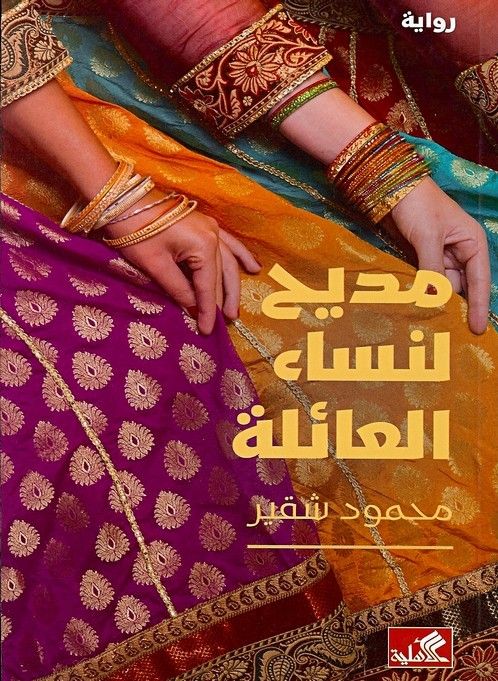
The women of the family draw short straw in Mahmoud Shukair’s second novel
Like his compatriot Rabie al-Madhoun, who won this year’s International Prize for Arabic Fiction (IPAF), Palestinian author Mahmoud Shukair was IPAF-shortlisted for a sequel.
75-year-old Shukair’s Madih le Nissa al-Aela (Praise for the Women of the Family, 2015) continues the saga of the Abd al-Lat clan, which in his Faras al-Aela (Horse of the Family, 2013) had settled in Jerusalem after leaving behind desert Bedouin life. Yet while Horse of the Family was a gripping and original novel, interweaving folklore, individual destinies and historical narrative, Praise for the Women of the Family does not pack the same punch of uniqueness.
Horse of the Family followed the nomadic Abd al-Lat clan from the early 1900s when Palestine was still under Ottoman rule until the invasion by Zionist settlers at the beginning of the 1940s. The clan jocularly claimed descendence from Abu Lahab, the Prophet Mohamed’s uncle and a fierce enemy of Islam, because they bear the name of Al-Lat, a goddess worshipped in pre-Islamic Arabia. In the spacious and desolate desert, life hadn’t changed much in hundreds of years. The head of the clan held the title of al-Mukthar (The chosen one) and took all the decisions, such as abandoning the desert and moving to the village in 1933.
Manan, who inherited this title, has six wives, eighteen sons and nine daughters, and the reader accompanied some of them through Horse of the Family. Dozens of characters swept past, including Manan’s mother Sabha, who preserved the clan’s memory, runaway Turkish soldier Ali Ogul, who sought refuge in the desert and married two women from the clan, and Manan’s uncle Abdel Wedud, who was assigned to kill one of Manan’s daughters after she ran away with her lover.
In an exclusively narrative tradition, Shukair intersected anecdote, myth and mundane episodes with erotic encounters and nomadic traditions — like the marriage rites. (Sitting on stones opposite each other, the man says: “You’re on a stone and I am on another,” whereupon the woman answers: “You’re the man and I am the woman.”)
As Ottomans, British soldiers, Zionists, merchants, false apostles, gypsies and imams appeared and faded away, nomadic life for Al-Lat remained impervious even to wars and revolutions, until Manan moved the clan to the outskirts of Jerusalem in the second part of the book, and the omnipresent narrator embarked on describing their adaptation to modern city life.
While most welcomed the comforts, like electricity, hamams and schools, others longed for the desert. Sabha continued to dream and hear the clan’s horse, which disappeared after Manan’s grandfather was killed by a neighboring tribe. Her horse dreams functioned as good omens, but the novel’s most memorable scene described men and women staging a tribal dance to shield themselves from evil after it was felt that the horse had finally returned, but possessed: “Their legs seemed ready to express the maximum movements they were capable of, representing their forefathers’ heritage of attacking and retreating […] And their body movements, stirred by a multiple set of motives, seemed to lift invisible chains, putting to the test possibilities buried deep down, emerging only in the face of danger.”
Since marriage and family life are the cornerstone of Bedouin life, in Horse of the Family we were whirled from one love story to another. The relationships between Manan’s six wives were marred by jealousy and bickering but not void of friendship, as each came to terms with her lot in a patriarchy. Meanwhile, most male characters in the book led monogamous lives, showing affection and loyalty to their partners.
Though Horse of the Family got tiresome at times, as Shukair exclusively relied on a narrative omnipresent voice, he maintained interest by upholding the narrative thread and interweaving political changes with individual stories.
In the sequel, the 200-page Praise for the Women of the Family (110 pages shorter), he abandons this narration style to experiment with adopting a first-person narration for each of the three main protagonists. First, he introduces Mohamed al-Asghar, one of Manan’s many sons, than Mohamed’s half-brother, Falihan, and Mohamed’s mother Wadha — so that when Shukair switches from one narrator to the other, he begins with: “My brother said…” or “My mother said…”
I can’t fathom why Shukair changed technique. It erodes his singular voice, giving way to characters who cannot carry the narration on their own. His strength in Horse of the Family was the seamless blend of a seeming cacophony of voices into a clustered polyphony, whereas Praise for the Women of the Family exists as a lose and patchy collection of narratives. In the middle of the novel, Shukair evens abandons his threefold narration method and omits the point of view of the mother, which joggles its already wiggly structural frame.
Shukair’s language, skillfully controlled in Horse of the Family, also seems to me less eloquent in Praise for the Women of the Family, so that I found myself wondering why he actually wrote a sequel. Perhaps he was encouraged by the example of Ibrahim Nasrallah, who has written so far eight novels — what he calls the Palestinian comedy, or tragicomedy — an epic documenting 250 years of Palestinian history. Nasrallah’s most famous novel, Time of White Horses (2007, shortlisted for the 2009 IPAF and recently published in English by the AUC Press), also pays homage to horses and their significance in Arab culture, and it covers almost the same era as Shukair’s Horse of the Family.
In Praise for the Women of the Family Shukair continues to let history loom in the background, such as the siege of Beirut and the flight of Yasser Arafat, but dedicates the bulk of the novel to Mohamad al-Asghar’s ambitions to become a literary writer, his marriage, and his relationship to his mother and his siblings. The more interesting character though is Falihan, a drug smuggler and entrepreneur who trades with the Israelis and becomes paralyzed after being shot by an admirer of his wife. In the passages dedicated to Falihan, Shukair retrieves some of his masterful narration style, drawing up an ambiguous and powerful character torn between his ambitions and his auspicious love for his wife. In comparison, Mohamed’s writing endeavors resemble diary or memoir entries that fall short of engaging the reader, since they do not necessitate an existential urgency, consequential to the plot.
A segment of the book is dedicated to the letters the aged Manan receives from his selfish son Atwan, who emigrated to Brazil and married a Brazilian, abandoning his Palestinian wife. These loose letters span more than 20 years but reveal little about the diaspora, while both the reaction of the father to his son’s emigration and the fate of his stranded Palestinian wife are totally omitted.
As the title indicates, the male characters’ treatment of women in Praise for the Women of the Family sharply contrasts with the lecherous misogyny of Manan’s polygamist lifestyle in Horse of the Family. Mohamed al-Asghar refuses to remarry when he discovers that his wife Sanaa cannot bear children. She is an emancipated woman who makes it clear that she would divorce him if he did and is unconcerned that it would be her second divorce, heralding a change of time and lifestyle.
Yet whereas Shukair drew the female characters with empathy and delicacy in Horse of the Family, creating indelible psyches and giving them equal space in the narration, the women in Praise for the Women of the Family draw the short straw, as both brother-narrators are largely occupied with themselves, and the few chapters related by the mother mostly reveal her bitterness with stepson Falihan.
Praise for the Women of the Family is an interesting read nonetheless, and contains episodes that are both amusing and telling. Examples of this include when Mohamed’s wife Sanaa uncovers her legs while bathing on Malaga’s beaches to shock Mohamed’s conservative family, or Manan’s astonishment when his son Mohamed al-Kebir speaks during a family assembly and attendees start to clap, whereupon Mohamed demands that they respect the unfamiliar concept of pluralism.
If Shukair, a former teacher and journalist, who has written innumerable books for young adults and short stories and a memoir, wasn’t already counted among the prolific Palestinian writers, he certainly earned his place with Horse of the Family. While his second novel is not quite of the same caliber, the third, which he is already working on, will hopefully revive the élan of the first.

Sherif Abdel Samad
Sherif Abdel Samad holds a PhD in American Studies from the Free University of Berlin. He wrote his dissertation on "Non-violence in the Civil Rights Movement in the United States…
تقارير ذات صلة
Noor Naga, metafiction and the limits of self-knowledge
Sometimes a story needs three acts
‘Nothing moved but the mirage’: Movement and its absence in Adania Shibli’s Minor Detail
The novel is a contender for the 2020 National Book Awards
What I didn’t tell the officer: a review of Randa Shaath’s The Sand Mountain
"The Sand Mountain? Hmmm … Is this a political novel, Mr. Shady?”
Your support is the only way to ensure independent, progressive journalism survives.
You have a right to access accurate information, be stimulated by innovative and nuanced reporting, and be moved by compelling storytelling. Subscribe now to become part of the growing community of members who help us maintain our editorial independence.
Join us