
The shoot stops for no one: The labor behind the camera in Egyptian film and TV
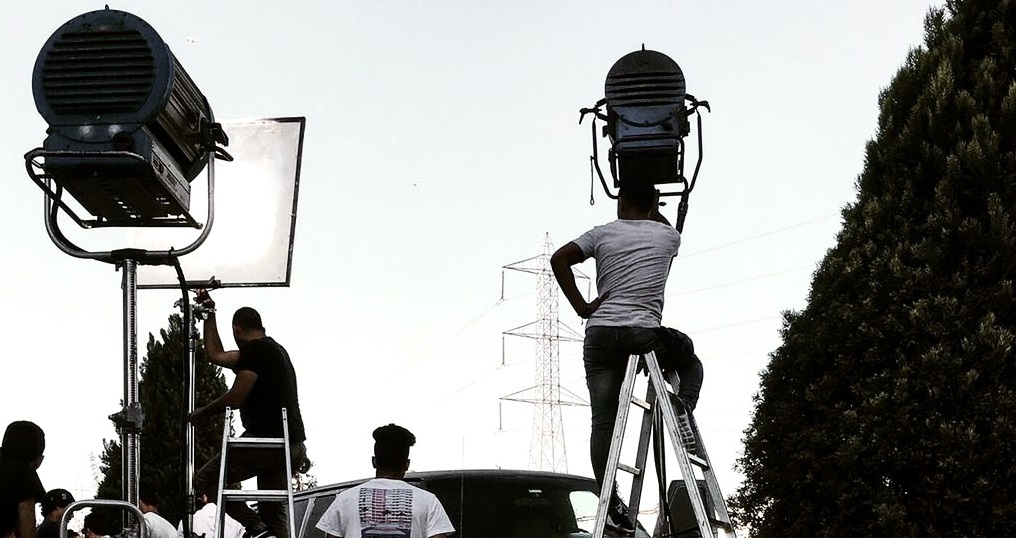
It’s hour 11 of a 12-hour day — a shorter shift than most — on the set of an Egyptian TV series. For a minute-long nighttime scene with three actors, I count 50 people in the 10-meter radius behind the camera, in addition to one nosy intruder taking notes.
Some drink tea in hushed conversations, some scurry back and forth following or dispersing orders. The lighting crew heaves scaffolding, moving people at will to make room for their equipment. Props are passed from hand to hand in quick succession. While the director gives final notes to the actors through a microphone, a second assistant director tries to slice tomatoes as quietly as she can.
Every piece of media created in Egypt has a similar beehive-like world behind the camera, with negotiations, conflicts and dramas that never make their way on screen. As the film and TV industry, in tune with the country at large, faced the upending events of the past decade — including the 2011 revolution, the currency devaluation of 2016, the rise of a functional monopoly in 2018 and a pandemic in 2020 — the lives of thousands of workers hung in the balance. How do they figure, then, into the rapid, catastrophic transformations of Egypt’s entertainment industry, stagnation through resurgence and everything in between?
Nour Elmalt — the second assistant director whose sole focus for the moment is making sure no one can hear her knife hit the prop plate — balances a few jobs on set, one of which is overseeing prop continuity. “We might shoot the same scene today and a week from now, but the cup of coffee on the table needs to be on the same angle, the cigarette in an actor’s hand needs to be smoked to the exact same point,” she explains to me in a quiet corner on location.
“Ensuring continuity, in short, is one among several practices aimed at enchanting the unspoken viewer by erasing traces of the concrete labor invested in film production,” writes Chihab El Khachab, British Academy postdoctoral fellow at the University of Cambridge and author of Making Film in Egypt: How Labor, Technology and Mediation Shape the Industry.
How tea fuels the film industry
Khachab’s book is the first ethnographic study of the Egyptian film industry. One of his most interesting contributions is exploring the distinction between ‘artistic workers” and ‘executive workers.” Those on the artistic side include the director, cinematographer, art director, stylist, sound engineer, editor, and star actors, while the executive workers — everyone else — execute artistic vision into reality. The main characters in Khachab's vividly textured study are the production workers and technicians navigating labor hierarchies and a rapidly changing entertainment landscape.
“We never talk about the film industry like this; it’s always about the films or the stars,” Khachab tells me. In film festivals, in media, and in academia, the thousands who keep the Egyptian film industry running remain hidden from view: the gaffers and grips and boom operators, the production assistants and prop masters, the builders and runners and buffet staff (whom Khachab often credits as “the tea that fuels the film industry”). Khachab’s research is an exercise in retracing the concrete labor that production teams work so hard to keep hidden.

In part due to the inherently informal nature of the industry, and the chronic unavailability of data in Egypt, it’s difficult to get accurate numbers of how many people are working in film, television and advertising production at any given time. In October 2018, for example, when a consolidated market capped TV show budgets, slashing employment opportunities, TV director Kamla Abu Zekri wrote a widely copied Facebook post explaining the impact of the move. Each series employs 300 people, including carpenters and assistants and technicians whose livelihoods will be diminished, she wrote. Khachab himself estimates a total industry size of 10,000–20,000. Mariz Kelada, an anthropology doctoral candidate at Brown University who has worked in the culture sector since 2010, says the country’s technical workers alone number around 4,000, according to the professional syndicate of the cinema and film industry.
“These (technical workers) are at once perceived as the underdogs of the industry and as those that hold the real power... Should they decide that the scene won’t be shot, they have the power to derail the entire production.”
“They’re an entire infrastructure,” Kelada explains, detailing her decision to study precarious laborers in the industry. “They move through every kind of production, from mainstream advertising to mass-market cinema to festival films to Ramadan series to television programs. And they’re the people whose livelihood is impacted most by the economy of the industry.”
These thousands are at once perceived as the underdogs of the industry (khaddam chic, a luxury servant, as one production assistant describes to Khachab), and as those that hold the real power. Should they decide, for any number of reasons including moral qualms, that the scene won’t be shot, they have the power to derail the entire production, as a number of filmmakers remarked to Kelada.
Every Egyptian TV show, every film — good or bad, arthouse or mainstream — every commercial and talk show and music video in the country depends on the skill and labor of this massive pool of people. In turn, the livelihood of these thousands depends on the survival of the industry.
Seasonality and the Sobky Theory
One of the defining qualities of the Egyptian entertainment industry is its seasonality. Peak season is the months before Ramadan, when everyone scrambles to produce the dozens of TV shows that air during the holy month. As year-round film production dropped from 40 Egyptian films in 2008 to a total of 22 in 2019, the number of Ramadan series rose in the 2010s to a peak of 53 shows in 2013, according to elcinema.com. Even in recent years, when the number of TV shows has plateaued to 25–28 a year, the season remains the primary source of income for much of the industry.
For the rest of the year, everyone whose salary isn’t enough to cover several months without work (all but the highest paid artistic workers) has to find a way to make ends meet. The most common is to rustle up as much work as possible in off-season productions, with the biggest paychecks in advertising. A commercial is 10 days of work at most, including pre-production, and you could earn as much in 3–4 ad shoots as you would in an entire multi-month TV series, according to several sources I spoke to.
But a surplus of labor in the industry, particularly in recent years, means that many still need a side hustle. Ahmed Ibrahim, a freefly camera supervisor who’s been in the industry for nine years, tells me that every member of his team has a second job. One moonlights as a waiter, another drives a tuk tuk, and Ibrahim himself will sometimes lean on his background as a tailor and pick up shifts in a clothing factory when work dries up.

“Everyone thinks that media people get paid a lot and don’t work much,” he says. “But the pay really isn’t as people make it out to be, and I work four to five months that I need to live off for the whole year. I try to get commercials when I can, or a film when lucky enough to find one … It helps to have something on the side to make ends meet, but a lot of people don’t.”
These annual cycles — flood and famine, as Khachab describes them — came to a head 10 years ago. Hot off a 2000s high, Egyptian cinema crashed in 2011. (Interestingly, Khachab argues in Making Film in Egypt that the cause of the production drop wasn’t the revolution, as is widely believed, but changing financing trends that would have shrunk the industry regardless.)
“In the years after 2011, the sense of fear that gripped the industry led to the deification of an unlikely hero: El Sobky.”
Whatever the root cause — in all likelihood a mixture of changing production and distribution practices, the delayed impact of the 2008 financial crisis, and the revolution — the industry was thrown into freefall beginning in the 2010–2011 production season. Over the next few years, even as film production gradually found a humbler footing and Ramadan series resurged, the sense of fear that gripped the industry led to the deification of an unlikely hero: El Sobky.
The brothers Sobky, Ahmed and Mohamed, became known for their steady stream of loud, cheap, revenue-driven movies. Often released for the Eid season, these brought the ire of the classed and cultured for portraying the “worst” of Egyptian culture. And yet, these were the movies garnering commercial success.
Love them or hate them, as one theory goes, Sobky films saved the industry at a time that could have killed it. The steady stream of subpar “shaabi” movies, season after season, ensured industry workers’ livelihoods. They could survive long enough that when ‘quality filmmakers’ reemerged, trained crews hadn’t left for greener pastures. In their resurgence, directors and producers didn’t have to train and build crews from scratch.
“This is something I heard a lot,” says Khachab of his time on both mainstream and independent film sets between 2013 and 2015. “Workers were saying ‘God bless Sobky, he’s keeping the industry running.’”
Interestingly, the workers blessing Sobky for continuing production weren’t even working on Sobky productions. The latter were perceived, however, to be preventing a near-certain exodus. No one could know for sure if a producer making a festival-bound film in 2014 would have the funding to make another next year, but Sobky seemed an immovable pillar, providing welcome opportunities.

While some of those I interviewed were inclined to believe the theory, many found it difficult to support. For instance, commercials and television production never stopped, even if the scale decreased in the immediate post-2011 moment. As the film industry slowed, television, advertising, news, talk shows and music videos must have absorbed workers, they say.
“Everyone on set right now—especially the technicians—everyone’s terrified… They’re thinking ‘once I’m done with this job, am I going to find another one, or am I going to stay home?”
“I wouldn’t say he rescued the industry like people say,” Khachab qualifies. “Eventually, other people would have returned to making movies, returning these crews with them. And at the end of the day, Sobky only worked with the same people he had always worked with. He didn’t suddenly employ a lot more people out of the kindness of his heart. He’s a businessman who has a bit of capital, makes an investment and sells the movie, working with the same crew for years at a time.”
Built-In Precarity
The touting of the brothers Sobky as saviors, regardless of whether they were anything of the sort, speaks not necessarily to their actual role, but to the sense of turbulence and employment anxiety in the air. It’s an anxiety that, over the next few years and economic crises, would only get worse.
“Everyone on set right now — especially the technicians — everyone’s terrified,” says Islam Abdrabo, who has been an on-set photographer for 21 years. “They’re thinking ‘once I’m done with this job, am I going to find another one, or am I going to stay home?’ They’re day laborers, they work for six days and get paid at the end of the sixth. And saving is impossible when every pound coming in is spent on the house and kids.”
Even when there is work, there’s a need to finesse around instability, particularly for those further down the paygrade. Any pauses in production — whether it’s actors’ scheduling conflicts, national holidays or unplanned delays — could result in days or weeks without pay. This is assuming the production company itself pays on time, which isn’t true across the board, with some companies pulling the “inshallah” card for weeks at a time.

One way to mitigate this loss of income — in addition to sometimes substituting on-set meals for cash equivalents (badal), for instance—is doubling up shifts. “What some people will do is set up other jobs for the days we’re not shooting,” says Abdrabo. “They’ll pull an all-nighter here then work another shift in a commercial or anything to get their daily rate. We’ll wrap up shooting here at 4 or 5 am, and they’ll report to the other gig at 7 am.” Even further up the ladder, Khachab says he’s known set designers who do the same, padding their schedules with a week’s worth of advertising work during a lull in a film’s production.
The deeply precarious nature of the work — dynamics Khachab presents at length in his research—was put succinctly in one sentence the second assistant director Elmalt whispered on set: “the shoot stops for no one.”
The shoot stops for no one
An hour into the shooting day I attended, before cameras started rolling, a doctor began going around the set, first aid and COVID kits in hand. He quickly made a round of everyone on set, taking temperatures, measuring oxygen levels, and offering medical masks.
Perhaps a quarter of the crew wore masks the entire day, far more donning them during shooting itself, when the bare minimum crew congregated in an apartment to shoot indoor scenes, and even more outside when a larger crew came together. Still, the fear that took hold last year, when the pandemic began spreading in the middle of the Ramadan production cycle, seems to have largely abated, though not without casualties along the way.
“People (get) COVID, and the reaction (is) ‘go home, someone find a replacement’ ... They disappear for 3 weeks and come back. But are they getting paid for these 3 weeks they’re stuck at home? Of course not”
To the natural question of COVID-19 outbreaks on set, director Yousry Nasrallah commented at the time that, COVID or not, working conditions for Egyptian TV production were hardly humane. Screenwriter Mariam Naoum also decried the situation in March 2020, writing in an indignant Facebook post, “TV channels pressure producers to air, and producers pressure artists and technicians to shoot, and the artists and technicians are forced to shoot both because they feel responsible, and because they’re scared there won’t be any work in the future.”
I ask the photographer Abdrabo, who was on location last year for a Ramadan series, to confirm that people around him contracted COVID. He responds with barely a pause: “Who cares? Yes, people got COVID, and the reaction was ‘go home, someone find a replacement.’ We have no way of knowing how many, but people do still get COVID, they disappear for 3 weeks and come back. But are they getting paid for these 3 weeks they’re stuck at home? Of course not.”

An exception to the rule, interestingly, came in the form of an intruder on the Egyptian scene: Netflix’s Paranormal, the streaming service’s first Egyptian production, which aired to much fanfare in November of last year. With 10 days of shooting left by the time the first COVID curfew was put in place in Egypt, as production companies scrambled to obtain permits to continue shooting as normal and meet their contractual obligations to TV channels, Netflix sent everyone home.
While I was on set this May, the Netflix exception was talked about at length. They only worked over 12 hours when everyone consented, one person said. Not even with consent, they stuck to strict 12-hour shifts, another replied. They paid for everyone’s PCR tests, a third chimed in. Everyone got full salaries for the month and a half they were paused, a fourth said.
According to a member of Paranormal’s production team, the entire crew was paid for two weeks’ worth of work. Though the delay extended for many more weeks, the lore that an entire crew can get paid while production is on pause — a unique gesture in an industry where standard practice is the opposite — has been exaggerated through the grapevine to a kind of legend among industry workers.
If you don’t like it, you can leave
Taking a break and ruminating on the notorious stress of the industry, Elmalt asks and answers her own question, “Why are these the prevailing conditions? Because the market allows it.”
“The power to negotiate is always a shifting ground,” Kelada reflects on the last few years. “But leverage definitely declines when the amount of work decreases. There’s so much surplus labor who want to work. And there’s the other cycle, that if you’re marked as bad news on one set, you can’t work anywhere else. The same production company controls 3/4s of the market. You don’t have a chance of working with someone else; there’s no one else.”
In November 2017, top TV channels including CBC and Al Hayah set a cap for purchasing Ramadan TV series, as the market slowly consolidated under the umbrella company Egyptian Media Group (owned by state intelligence-owned investment firm Eagle Capital), later renamed United Media Services. Synergy, United Media Services’ production arm, would within a year rise to become the main producer of Ramadan dramas. Of the 27 series that aired in Ramadan 2019, 19 were produced by Synergy.


The surrounding crisis, which included the cap of budgets to a fraction of their previous levels, slashed employment opportunities. Almost overnight, half of the industry was out of work and “sitting at home,” as the situation is commonly referred to.
As one version of the story goes, this consolidation of the market into a functional monopoly actually saved the industry, according to one producer that Kelada spoke to. In the preceding years, actors’ rates and production costs were skyrocketing, to the extent that ad sales—the main source of revenue—weren’t covering budgets. Both production companies and TV channels were running out of money.
“There’s more than enough labor to go around, and there’s always someone cheaper, someone willing to work longer hours... For most, the competition isn’t quality, it’s price and conformity.”
When the channels were bought up by the Egyptian Media Group, budgets were capped according to anticipated ad sales. “If these channels had kept running out of money, the industry would have collapsed,” Kelada remembers the producer saying.
Combine a growing labor force (one person claims the number of available gaffers, for instance, has swelled from 15 in the mid-2000s to over 90 today), a post-devaluation economy, a global pandemic, and plummeting employment opportunities. The result, inevitably, is an evident resignation to whatever the prevailing conditions are. If you have the chance to work, you don’t want to lose it.
“There’s suddenly been this reduction across the board,” says the photographer Abdrabo. “If you want to say, ‘I can’t work with this rate, I usually get paid much more,’ the easiest response you’ll get is ‘okay then, I’ll find someone else.’”

There’s more than enough labor to go around, and according to Abdrabo, there’s always someone cheaper, someone willing to work longer hours, someone who has no problem adapting to the circumstances. For most, the competition isn’t quality, it’s price and conformity.
As a result, technical workers were encouraged to go after so-called ‘package deals’ with production companies, where they’re paid less than their usual rate per work, but are contracted for three or four TV shows at a time. “Whoever managed to make these deals survived,” says Kelada. “And whoever didn’t, got left behind.”
The power to turn the lights off
During my visit to set, one conversation seemed to rule the day, centered around the fact that everyone gets paid every six days. As it stood, the crew had worked three days before going on break for Eid. The week after only had two shooting days before another break due to a scheduling conflict. If the shooting schedule wasn’t adjusted to include a sixth day that week, the entire crew would have to go a minimum of three weeks without getting paid a pound.
The situation isn’t ideal for anyone. From the buffet manager who needs to pay his workers to the director of photography, it’s better that everyone gets paid. The result, Elmalt tells me, is that every group of workers negotiates with their own rayyis or osta, their representative, who negotiates with their own boss, up the ladder to the photography director, who can speak to the director and together find a solution.
So it goes for the everyday problems that everybody wants to solve, but like Kelada says, negotiation is always a shifting ground, and always a matter of leverage, sometimes to spectacular effect.
Kelada shares a legendary anecdote from the late 2000s, when the old analog shooting process was replaced with digital technology. The new digital cameras were much more easily lit, and therefore needed a much smaller lighting crew. A film director decided to dismiss half the lighting crew, only to find the remaining crew members start working so slowly in protest that he was compelled to bring the rest of the crew back.
“As a producer, the main cost that you can incur is if production is delayed,” Khachab says, telling me about another instance of an osta being pressured to hire fewer people on his crew. “Because then everyone else has to get paid, and it’s a lot of money all of a sudden. All for something that, relatively, is trivial at the end of the day. A lot of production workers — the smart ones I guess — end up learning fairly quickly that there’s actually a lot of leeway to what producers will agree to.”

When it comes to leverage, not all roles are equal. In every conversation I had with scholars, assistant directors and technicians, the consensus was that three teams are set apart: the camera crew, the lighting crew with the gaffer at its head, and the grip crew in charge of the camera’s mounting and support equipment.
“It’s a kind of custom in the industry, that the cameramen, the grip crew, and the gaffers are a kind of coalition,” says gaffer Ayman Hassanein. “You’ll find a lot of the time on set, other crews want you to lobby on their behalf.”
In one story Kelada tells me, a costume assistant was facing a problem on set that no one would deal with. When the problem wasn’t fixed, the gaffer took it upon himself, flipped the electricity switch, and cut the power from the set. He refused to allow the shoot to continue until the assistant’s problem was addressed to her satisfaction.
“At the end of the day, if I tell them I’m not working, the day is ruined,” Hassanein elaborates. “Shooting has to stop. But if anyone else stops working, they can be told to leave. Even if they’re not replaced, anyone else can double up and finish their tasks. But what are you going to do if I turn off the power?”
In their study of the lifeworlds of those most heavily impacted by the challenging dynamics of the entertainment industry, where the shifting grounds of leverage and livelihood often turn into quicksand, both Kelada and Khachab trace productive avenues for coalition-building. “The other side of precarity is solidarity,” explains Khachab. “In an industry where personal connections are everything, and relationships are so layered that you’re often working with cousins on the same set, they’re not going to hang each other out to dry.”
The author would like to thank production manager Sayed Sallam, whose help facilitated much of this piece's reporting.
تقارير ذات صلة

From constitution to law: The legalities of making art in Egypt
Four case studies reveal how cultural producers get penalized or censored

Legally or illegally? How to make a film in Egypt
Many Egyptian filmmakers end up choosing to make films in secret, far from the eyes of the state, except when it’s absolutely necessary to shoot in state-controlled locations, says filmmaker…
Egypt’s 1st hourly minimum wage: An ‘announcement to global markets that our labor is cheap’
Sources express fear that the decision will formalize and entrench an already precarious situation
Your support is the only way to ensure independent, progressive journalism survives.
You have a right to access accurate information, be stimulated by innovative and nuanced reporting, and be moved by compelling storytelling. Subscribe now to become part of the growing community of members who help us maintain our editorial independence.
Join us