
State of pay: Organizers pushing for higher wages beset by barriers amid skyrocketing inflation
Amid rampant rates of inflation, workers and labor activists say that the regulatory environment around wages in Egypt leaves organizers and organizations hamstrung in their battle for higher pay.
Wages for laborers in Egypt are increasing at a snail’s pace, failing to keep up with rising living costs as the pound drops in value and commodity prices soar in the import-dependent economy. Mada Masr has covered a number of labor strikes in the country over the past year, all of which were prompted by concerns around wages: whether too low, overdue for extended periods, or stripped down to the bare minimum.
But the problems, say organizers, are chronic, with a lack of government oversight and the political class keen to grant concessions to actors in the private sector. In such conditions, companies are easily able to evade legally-stipulated bonuses and raises, and business owners are prompt to take punitive action against worker representatives.
Egypt is suffering the effects of a global supply-chain and inflationary crisis triggered by the COVID-19 pandemic and compounded by the impact of Russia’s invasion of Ukraine. A series of fuel price hikes by the government have caused transportation costs to jump, while new regulations effectively restrict imports as the Egyptian pound declines in value, decreasing the public’s purchasing power. As a result, households are embattled by rising living costs, with six consecutive months of inflation hitting a four-year high in August.
On the horizon, with impending debt repayments due, the government is negotiating a new loan deal with the International Monetary Fund that many anticipate could be tied to another round of austerity policies— such as a reduction in social subsidies and further decline in the value of the pound.
But wages are growing at a rate that falls behind the annual rate of commodities inflation. At the start of the year, the monthly public sector minimum wage was increased to LE2,700, while the first-ever private-sector legal minimum wage was implemented at LE2,400. While cost of living data is hard to come by, figures for 2021 published in July by the government statistics body — based on IMF reports — show that while wages rose by less than 3 percent in 2021, inflation rose at a rate of over 4 percent in the same year. The same data shows that private-sector laborers worked 56 hours per week on average during that year — eight hours over the limit dictated by the labor law.
The Private Sector Workers Syndicate has made repeated calls for a higher minimum wage, syndicate chair Shaaban Khalifa tells Mada Masr. Under the current labor law, the National Council for Wages should meet every quarter to readjust the minimum wage in step with living costs. “The text is very clear,” he says, but since the LE2,400 minimum wage for the private sector was set in June 2021, there have been no further increases. There are direct lines of communication between the wages council and the Cabinet, with the ministers of planning and manpower presiding over the council, Khalifa notes, “so they should know beforehand that fuel prices would increase,” and coordinate wage increases accordingly.
“I am calling on the council to convene to discuss two things: a minimum wage of LE3,000 and, based on that, annual raises and bonuses, commensurate with fuel and commodity price increases.” the syndicate head says.
But it seems the private sector syndicate's demand is unlikely to be met soon. The wages council has not yet matched the public sector minimum wage of LE2,700, ordered earlier this year by President Abdel Fattah al-Sisi, council member and ETUF vice chair Magdy al-Badawy tells Mada Masr.
The nearest council meeting — due in October — will be to negotiate with business owners to raise the private sector minimum wage to LE2,700, while the decision itself will come out after the following meeting in January 2023, he says.
“After that,” Badawy adds, “the council will see if there will be another public sector wage increase [to match],” as has been the habit.
Any minimum wage increase would also need to be paired with major changes to enforcement, says Khalifa. Businesses are able to exploit a variety of legal and quasi-legal ways to avoid implementing the current minimum wage of LE2,400 which government agencies make no effort to enforce, he says.
“Over 60 percent of them haven’t implemented it,” according to Khalifa, who notes that 22 commercial sectors in their entirety, employing 7 million workers, were granted an exception from paying minimum wage following demands by the Federation of Egypt Chambers of Commerce.
Many private businesses also regularly avoid a legal requirement to pay out periodic raises and bonuses based on years of service, Khalifa notes. “Minimum wage should be for fresh graduates. How come workers who served for 30 years still get less than LE3,000? These years of experience have a cost,” he says.
Mohamed, a security guard at the Technotex Garment Factory, describes exactly these issues at his workplace. “I have been working here for 12 years, nearly 13, and my salary is still LE1,850” before social insurance and tax deductions, Mohamed tells Mada Masr, noting that he usually works 12 hours a day. “Other workers at the services department are paid LE1,200. Some supervisors have been here for 24 years; their salary is LE2,400. When we brought up the raises, they told us, ‘you can leave.’”
Workers who participated in a strike at Beshay Steel in September told Mada Masr that the company’s management has kept many workers on annual contracts, intentionally ending these contracts each year only to offer them new, one-year contracts. This practice effectively denies the workers the right under the labor law to permanent contracts and annual wage increases after four years of employment. Even workers contracted on a permanent basis face constant pressure to terminate their contracts.
Mohamed, from Technotex, likewise accuses the company of coercing workers into signing resignation letters each year, ensuring that each staff member’s employment is terminated and restarted as if they are a new hire. This means the true duration of their employment is never reflected in social insurance documentation. “We have filed lawsuits against him,” he adds, but claims that insurance employees and government agents accept bribes to ignore the workers’ complaints.
Many private businesses commonly force new hires to sign a form stating they have resigned willingly and received all their dues before they sign their official contracts of employment. Thus, employers have a paper trail to justify ending any worker’s employment at any time without being required to deal with severance pay or other outstanding dues.
Legislators take pride in having placed restrictions on the practice — referred to as “form 6” — in the long-discussed new labor bill, which passed the Senate in February but is yet to make an appearance in the House of Representatives. Yet, serious, regular monitoring from labor offices and social security agents is much needed to fill these loopholes, according to both Khalifa and Hussein al-Masry, a researcher at the Center for Trade Union and Workers Services, a non-governmental labor organization focused on supporting independent trade unions.
Masry also points out that the new draft labor bill would set annual bonuses at 3 percent of the insurance subscription wage, a sum regulated by the social insurance law, according to which various bonuses and compensations are calculated as distinct from the net or basic wages. CTUWS says that this would make the new annual bonuses worth a lot less than they are at present, calculated at 7 percent of the basic wage under the existing labor law. Masry believes the change was likely a compromise with business owners so they would accept the LE2,400 minimum wage.
Under the current labor law, multiple sums contribute to make up the net wage: the basic wage, an annual raise as a percentage of that salary, as well as additional bonuses and compensation payments varying according to the workplace or industrial sector, such as meals, transport or safety compensations, or profit bonuses. Such layers open space for business owners to manipulate what is ultimately paid out to workers.
Even without manipulation, legislators seem eager to provide concessions to business owners. “There’s no more need for trickery,” Masry says, explaining that a business owner needs only to convince the Manpower Ministry that financial troubles prevent them from meeting the minimum wage, and they will receive an exemption for a certain period. Once it ends, they can implement the minimum wage if they choose, or they can seek to renew the exemption.
The Mubarak-era cost-of-living raise, by which private sector workers’ salaries increased commensurate with inflation on a yearly basis, was also eroded by policymakers deferring to businesses.
Under the labor law, says Khalifa, the cost-of-living raise should have been inviolable, but it was nixed in 2018 by the Alliance to Support Egypt coalition, which dominated the House of Representatives at the time. “The labor law is clear that any gains attained by workers for three consecutive years are a guaranteed right,” Khalifa says. But the Alliance to Support Egypt coalition was headed by the Federation of Egyptian Industries chair businessman Mohamed El Sewedy, the syndicate head notes. “To appease his base [in the federation], he deprived 25 million workers of a benefit that was guaranteed for 35 years.”
Khalifa adds that there’s nothing in the current labor law to ensure business owners respect the collective work agreements they reach with workers. This was the case at Universal for Electric Appliances, which has been the site of several rounds of strikes since 2019, most recently triggered last December as management neglected to stick to an agreed-upon schedule for repaying overdue wages mediated by the manpower minister.
And, as Masry says, a host of additional challenges stand in the way of laborers organizing around wages. Besides police repression, which workers face when they try to take their strikes outside the boundaries of the workplace, the trade unions negotiating on behalf of the workers often face legal obstacles and threats from business owners and intimidation by state entities.
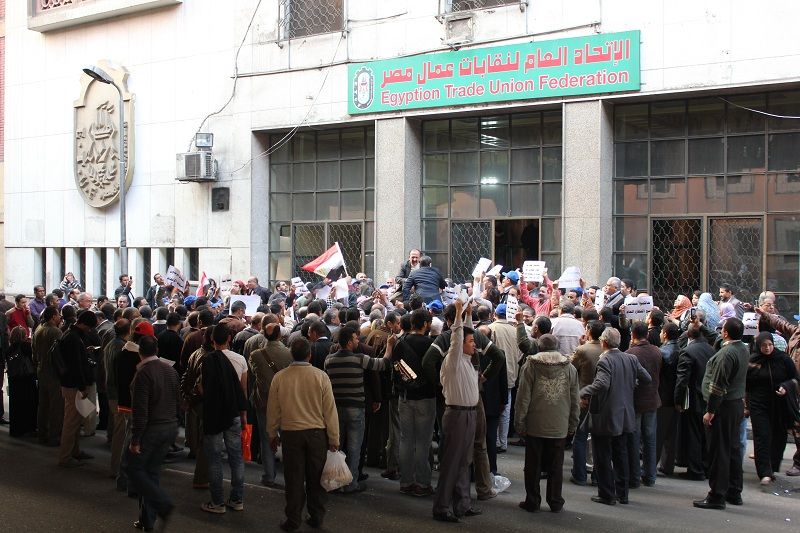
While the Egyptian Trade Union Federation and its general syndicates are dominated by state-adjacent figures, the new unions law introduced in 2017 allowed workers to form unions independently. Yet elections to independent unions have been carefully stage-managed by security bodies, while in many cases, such as Universal Appliances and Nile Company For Insulation Materials, the mere act of forming an independent trade union and demanding late dues can be enough to get all the union members fired, Masry notes.
In these conditions, official labor organizations “acting from above” end up steering campaigns, according to Masry, who believes that these organizations are not sufficiently connected to workplaces to truly represent workers’ demands, pointing again to their abortive attempts to negotiate on behalf of the Universal strike as an example.
This is why, Masry adds, recent labor strikes have only taken place under extreme circumstances: when wages are not only low, but have been withheld or unchanged for a long time.
Strikes at Universal are a chilling example of the extremities to which laborers are exposed: thousands took strike action at the company’s 6th of October factory in February this year after their colleague, Assem Afify, took his own life, becoming the fourth Universal laborer to do so since 2019.
تقارير ذات صلة
North Sinai’s ATM war
“They won’t push you out, but they are daring you to stay.”
Gendered Labor and Structural Violence: The case of women farmworkers in Tunisia
The deaths sparked a national outcry in a country often thought of as a pioneer in women’s rights.
Parliament passes new legislation regulating senior government officials’ pensions
Some pensions are reduced, while those of ACA employees are to be decreed by the president
Your support is the only way to ensure independent, progressive journalism survives.
You have a right to access accurate information, be stimulated by innovative and nuanced reporting, and be moved by compelling storytelling. Subscribe now to become part of the growing community of members who help us maintain our editorial independence.
Join us