
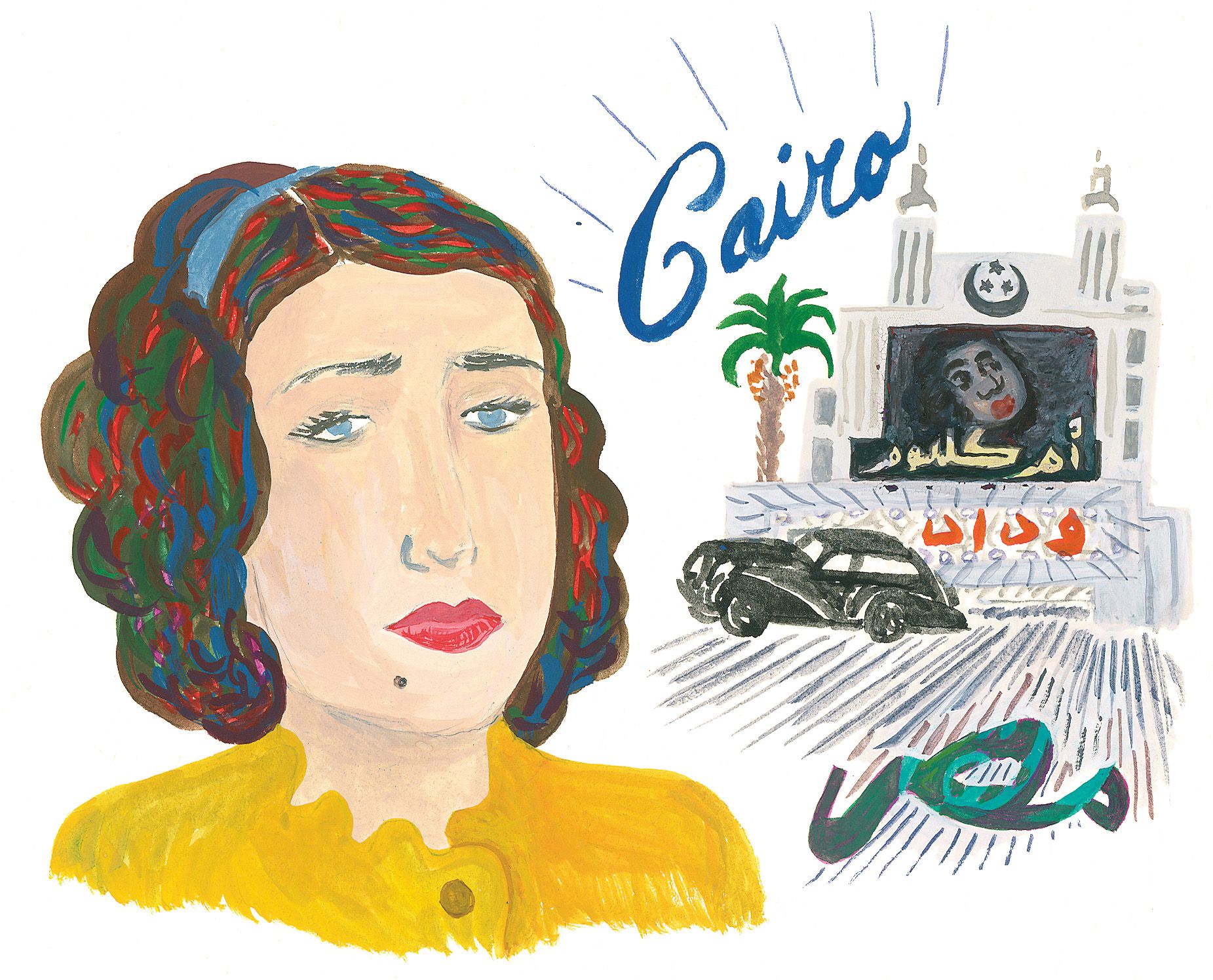
The fantasy of the past: A conversation with graphic novelist Lamia Ziade
Beirut-born, Paris-based Lamia Ziade’s new Francophone graphic novel tells the story of the golden years of Arab song and film through the lives of larger-than-life divas like Oum Kalthoum, Asmahan, and Fayruz.
Along the way, we encounter literary legends like Ahmed Ramy, revolutionary leaders like Gamal Abdel Nasser, and swollen capitalists like Talaat Harb, whose all-Egyptian Studio Misr produced much of the music and film defining an era of soaring cultural self-confidence.

Ziade’s watercolors capture the glamor and style of lives that, even in their own time, were embalmed in a sort of mythicism.
Although O nuit, O mes yeux: Le Caire / Beyrouth / Damas / Jérusalem (P.O.L. éditeur, 2015) is a deeply romantic portrayal of mid-20th-century Arab culture, Ziade has no truck with the arid, self-indulgent nostalgia that, with fantastically rose-tinted glasses, looks back upon these decades as Islamism-free, miniskirt-wearing bliss.
We met on the terrace of Cairo’s Hotel Longchamps, whose shabby old-world charm set the scene for our conversation, translated here from French.
Amir Radjy: Your novel ends with the death of Oum Kalthoum in 1975 and the famous concert of Fairouz in Paris four years later, in the midst of the Lebanese civil war. Both very symbolic events, marking the passing of an era and generation. Has Arab culture witnessed a period of decline since then?

Lamia Ziade: It began earlier, with the defeat in 1967 [to Israel]. This prepared the way for the war in Lebanon in 1975, and it has only gotten worse, until now. But I chose to stop my story in 1979, a very symbolic date — my last book, Bye Bye Babylone [2011], also ends in 1979. It’s the end of an era, a turning point. The 1970s, for singers and Arab music, was when almost all the characters in my book passed away. Farid El Atrache died in 1974, Abdel Halim in 1977, Oum Kalthoum in 1975. Nasser, a political figure but an important character in the story, died in 1970. It’s a funereal decade — its tragedy is captivating really — especially when compared with the 1950s and 1960s, and even before that. Those were, culturally, flourishing, thriving decades in both Cairo and Beirut.
AR: So you would ascribe this cultural and artistic decline to political causes? It’s the end of the pan-Arab dream, of the Arab nationalist movements?
LZ: No, I didn’t say that. I wouldn’t say it’s a cultural decline — there are still great actors and singers at work — but it’s no longer the same thing. There are no longer the major stars, vedettes, which is true in the West, too. They don’t have the same style, the same glamor.

AR: Cairo, Beirut and Jerusalem appear almost like mythical, lost places in your novel and that epoch. Is it nostalgia?
LZ: I detest nostalgia — I don’t like it at all, that sentiment — but I am very nostalgic for this era. It was a golden era. Then again, I am nostalgic for the war years in Lebanon, which were horrible years. Nostalgia isn’t only for those things that were “beautiful”; I am nostalgic for horrible things, too. It’s an emotion I can’t control.
AR: So it’s about childhood, whatever you’ve grown up with —
LZ: In a way. Since coming to Cairo [last week], I have met many people who saw that era, who lived in that era, and are nostalgic for it. They feel that they’ve lost something.
But I adore today’s Cairo, there is so much happening, the entire city trembles with life. Though it’s true: my Cairo is something of a fantasy. Had I come here before, and seen what had become of downtown, Café Groppi, and Emad Eddin, where all the cabarets were, I’m not sure I would have been able to write the book. The city in my book is a dream city, mostly taken from what I’ve read and, above all, seen in old films.
AR: Fantasy, imagination comes before reality in your books?

LZ: Yes. It’s the fantasy of the past.
AR: Today there is a strong nostalgia in Egyptian and Arab culture for this so-called golden era of film, literature, music.
LZ: There is a Lebanese artist, Yazan Halwani, who paints graffiti murals of Asmahan, Sabah, Fairouz, all of those artists, on walls and streets in Beirut. They are icons people find a comfort in.
In Lebanon, there wasn’t any enormous cultural change, it’s as open as ever. But the security and political situation has changed.
AR: A lot of people on Facebook seem to adore pictures of women walking in miniskirts in mid-20th-century Cairo. There’s this notion that this was a time when women were liberated. Isn’t there something false about it?
LZ: That’s really an artificial image of the past. That kind of life was only for a very small part of society, for the bourgeoisie and the entertainment world. Not in the countryside in Egypt. And those in miniskirts, I don’t think they were all so “liberated." In the films of Soad Hosni, she’s in a miniskirt — a mini-mini-miniskirt! — but still if she goes out with a man, it’s the end of the world. In her films, it’s about the men.

AR: At the end of your novel, some of the old stars put the veil on. Do you see this as a symbolic defeat for these women?
LZ: No. First of all they didn’t all do it — actually, I regret having ended my book like that, because everyone asks me about it. For me, it’s not so important. In my book, it’s a detail. Some of them did it really for financial reasons — they didn’t have a penny left. Others did it out of conviction, like Shadia, who became sick, and promised to put on the veil if she recovered. I don’t have a negative or positive view of it.
AR: How do you explain the eroticism of belly dancers like Samia Gamal and others? You write that it was more erotic than anything in Hollywood —
LZ: I say that it was more sensual than anything in the West. Perhaps it’s the legend of Eastern sensuality. I find that the East is nothing but paradoxes: both very conservative and very sensual, very open and fundamentalist. Even today.
AR: What do you mean by Eastern sensuality?
LZ: The dance of Tahya Carioca — more than Samia Gamal — is even more sensual. Carioca’s dance is less inspired by American films, or Pigalle cabarets and so on, than it is by very old forms of Arab dance, because she moves less, she stays in place. Samia Gamal leaps and moves about the stage.
And besides, today, when I see dancing at weddings in Lebanon, in the villages, even a young girl of 16 who hasn’t worked in cinema or music, and who is fat and badly dressed, with pimples and a bad hairdo — truly not sexy physically — as soon as she begins to dance, she has a kind of bizarre grace, a lightness and refinement.
AR: Whose songs do you prefer, Asmahan or Oum Kalthoum?
LZ: I couldn’t say. But I prefer them both to Sabbah. I don’t like Sabbah very much. If I had a favorite, it would be Abdel Wahab. I adore his songs, the lyrics.

AR: I have to ask you. Who killed Asmahan?
LZ: I don’t know. Nobody knows.
AR: There’s no theory that seems more probable to you? Did Oum Kalthoum kill her?
LZ: Really, it doesn’t interest me. The fact that she dies so young and tragically — murdered perhaps — is what interests me. The mystery of it, her novelistic fate, is what interests me. The fact that we don’t know is part of the legend, and the legend is what interests me most. I didn’t even try to find out. With all the singers, I didn’t try find out things we didn’t know already. I write about the legend of these women, as the public saw it in their own time, what people said about them.
AR: You grew up in Beirut, you live in Paris now, and write only in French. I remember that in Bye Bye Babylon, you say that the Lebanese are very proud of the Westernized aspect, “veneer," of their culture.
LZ: Yes, it’s very true! They still are.
AR: How do you identify? Is it important for you, identity, the notion of belonging to one culture?
LZ: I am completely Western in my literary culture. I am very French. I don’t read any novels in Arabic, though I read Arabic newspapers. I went to a French Jesuit school [in Beirut], and learned Arabic as well as French throughout my education.

But how should I say it? …Yes, I am very Westernized, and I regret it — the Arabic language had lost its importance in the schools where I went. In Lebanon, before I came to live in France, I would go see French or American films, not Egyptian films. Now that I live in Paris, I watch as many Egyptian films as possible!
I do think it’s a pity we attach so importance to Western culture, but it’s everywhere. Even those people who oppose Western culture, they’re perfectly happy to wear Nike. It’s the paradox of the East.

AR: Why do you say “regret”?
LZ: Because I feel that my Arab culture is not deep enough for someone who is Arab. At the same time, living in Paris, I am more in touch with what’s happening in the Middle East than some people I know living in Beirut, who are completely focused on what’s happening in Paris.
AR: There’s been a change in how people talk about Eastern culture. We used to talk about “Arab culture," “Arab identity," but now, in the media, the obsession is Islam and “Muslim culture," and explaining everything in terms of religion.
LZ: In the West, yes.
AR: Here too, in the Arab media.
LZ: My book was enormously successful in France and, people said, it finally shows us something else about the Arab world. Especially young people couldn’t even imagine that what I describe existed here.


Amir-Hussein Radjy
Amir-Hussein Radjy is a writer and journalist in Cairo
تقارير ذات صلة
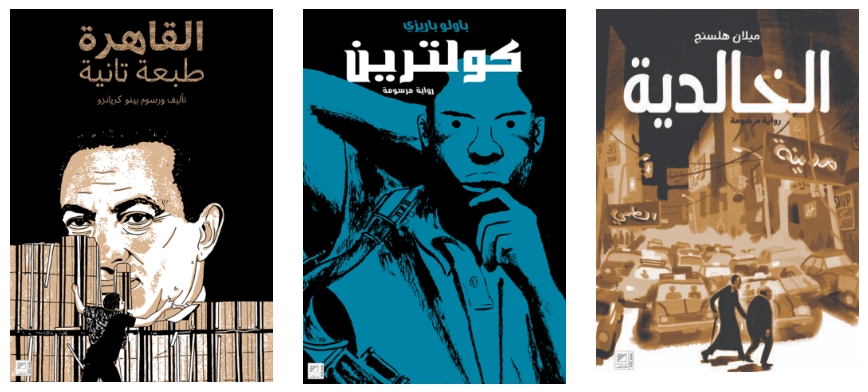
Cairo, Coltrane and a fictional village
Three newly translated graphic novels
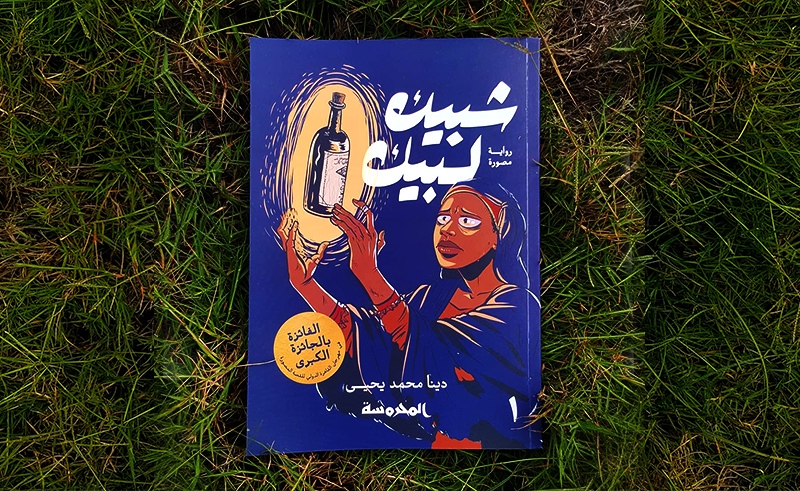
Shubeik Lubeik: An urban fantasy about wishes
In her debut graphic novel Shubeik Lubeik (2018), young graphic novelist Deena Mohamed Yehia (1994) draws a parable that evokes a fantastical present-day Cairo where the dreams and wishes of…
A possible love for homeland: A conversation with Oxana Timofeeva
"There is a moment of negativity in this movement: you think of homeland when you are not there"
Your support is the only way to ensure independent, progressive journalism survives.
You have a right to access accurate information, be stimulated by innovative and nuanced reporting, and be moved by compelling storytelling. Subscribe now to become part of the growing community of members who help us maintain our editorial independence.
Join us