
The Facebook Papers: Saudi and Egyptian companies involved in domestic worker trafficking network
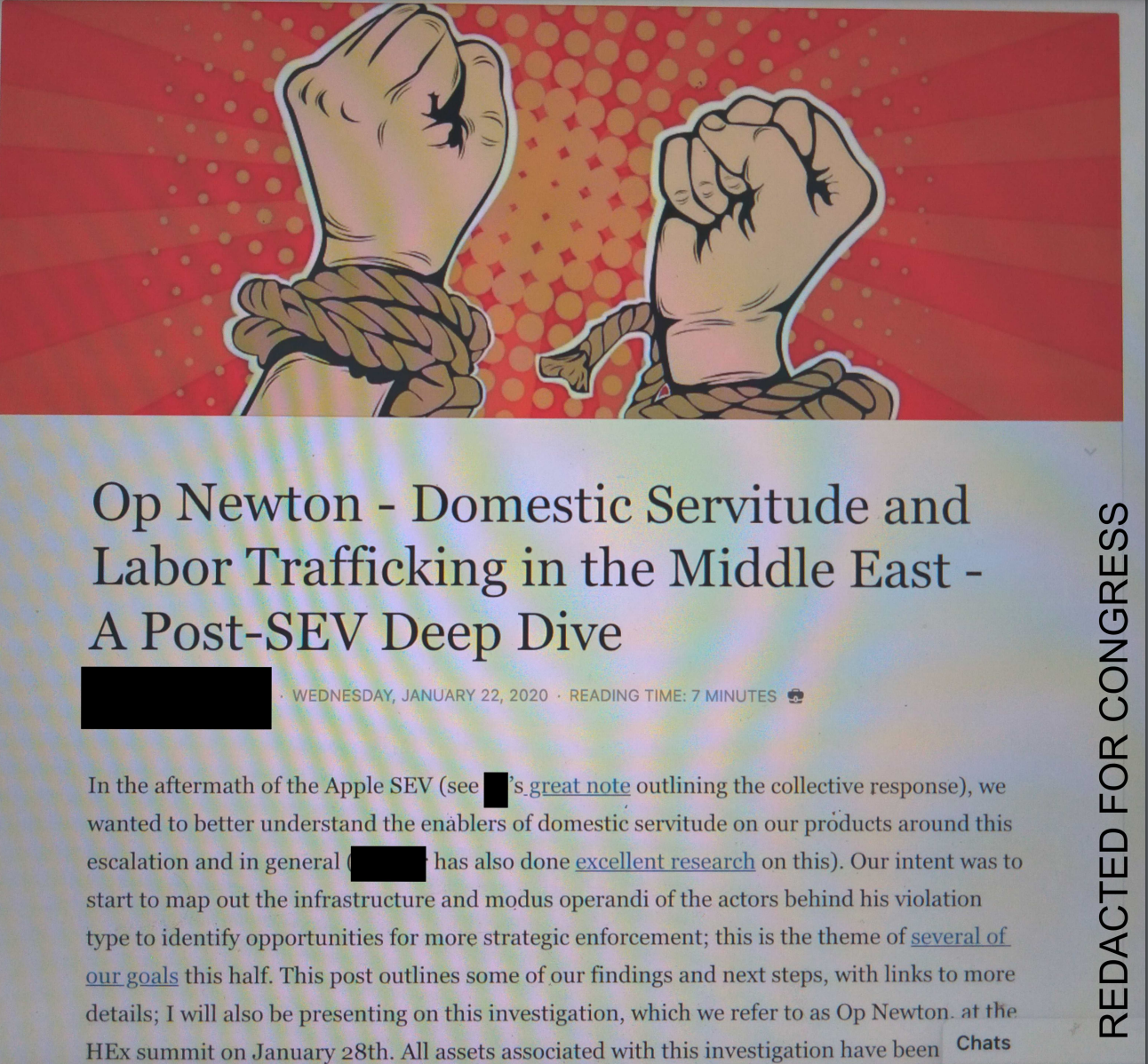
In internal investigations last year, Facebook documented how its platforms were being used by a Saudi recruitment agency in collaboration with an Egyptian marketing company to facilitate a labor trafficking network in the Middle East that exploits women to work as maids, according to documents obtained by Mada Masr.
The research found that Facebook platforms enabled “all three stages of the human exploitation lifecycle (recruitment, facilitation, exploitation) via complex real-world networks.”
According to one internal investigation from January 2020 titled “Op Newton — Domestic Servitude and Labor Trafficking in the Middle East,” a recruitment agency in Riyadh “recruited, coordinated and facilitated” the trafficking of women — mostly from the Philippines, Vietnam, Sri Lanka, Morocco, Egypt, Ghana and Ethiopia — to work as maids in Saudi Arabia.
Last month, the Associated Press reported — also citing internal documents — that Apple had threatened to pull Facebook and Instagram from its app store over concerns about the platform being used to trade and sell maids in the Middle East. The report covered various aspects of the trafficking networks but left out a number of details about how the various actors used the online platforms to operate.
According to the documents, a Riyadh-based "recruitment agency” named Fayez and Al-Waseet Group facilitated the buying of maids from their sponsors under the kafala system (legal guardianship that requires foreign laborers to have an in-country sponsor) and sold agreements with “recruitment agencies” located in other countries, including Egypt and the Philippines. The Saudi “recruitment agency” would take “complete ownership” of the maids by holding their visas, contracts or sponsorships, “to exploit them and sometimes re-sell them again for a much higher price.”
The recruitment agency’s services were promoted by a digital marketing company based in Egypt, mostly using Facebook pages and Instagram accounts. However, the internal documents stress it is unclear whether the digital marketing company was aware of what they were facilitating. “Digital marketing firms…drive traffic or raise awareness of either the business of their ‘goods’ (humans for sale); these marketing firms may or may not be aware of the business of their clients (i.e. trafficking in persons) but we should consider these firms as sources for further investigation and potential enforcement measures,” the documents say, citing multiple internal investigations.
The research found that traffickers, recruiters and facilitators used Facebook and Instagram profiles, as well as Messenger and WhatsApp to exchange the women’s documentation — including passports, airline tickets, visas and working contracts — promote them for sale and arrange buying, selling and fees. Every part of the supply chain was paid a commission in exchange for their services.
The internal probes found that at least 14 individuals were part of the labor trafficking network in more than eight countries, including 11 individuals working at the Saudi recruitment agency and three individuals working at the digital marketing company in Egypt.
A total of 377 Facebook pages identified in the internal investigation in connection to the Saudi-Egyptian network were used to promote, recruit and advertise the maids, often purporting to be ordinary cleaning companies or legal employment agencies. A total of 39 Instagram accounts were also found to advertise and promote the business. All the identified accounts were disabled by Facebook.
In its reports, Facebook defines domestic servitude as “a form of trafficking of people for the purpose of working inside private homes through the use of force, fraud, coercion or deception. Domestic servitude involves performing a range of tasks such as: cooking, cleaning, laundry, child-minding.” One report titled “Domestic Servitude: This shouldn’t happen on FB and how we can fix it” lists some of the abuses domestic workers were subject to: “In our investigation, domestic workers frequently complained to their recruitment agencies of being locked in their homes, starved, forced to extend their contracts indefinitely, unpaid, and repeatedly sold to other employers without their consent.” The report added: “We also found recruitment agencies dismissing more serious crimes, such as physical or sexual assault, rather than helping domestic workers.”
The internal investigations found that users looking for domestic servants did searches on Instagram using derivatives of the word khaddama, Arabic for maid. While the Facebook documents claim that “all assets associated” with the investigation were disabled, a simple Instagram search by Mada Masr found accounts advertising maids that appeared to follow similar patterns identified in the labor trafficking network. One such post features a picture of an Indian woman’s passport, with her name and photograph showing. The Arabic caption reads: “Christian, married, with no children, no experience, and her monthly salary is 60,000 dinars.”
In its probes, Facebook also appears to closely track news coverage on the misuse of its platforms. An internal report from September 2019 cites an article by Moroccan outlet Yabiladi denouncing the use of social media to sell maids in Saudi Arabia “sparking outrage in Morocco.” It also notes a media backlash on the use of Facebook platforms in the trafficking of domestic workers after a BBC Arabic documentary reported on the practice. The report says the documentary “highlights the concerns around the lack of users reporting the content to us and the need to explore proactive strategies.”
According to Human Rights Watch, over 3.7 million domestic workers in Saudi Arabia face “serious abuses, including unpaid and delayed wages, long working hours without a day off, passport confiscations, and on top of that, forced confinement, isolation, and physical and sexual abuse.”
In Egypt, labor laws explicitly exclude domestic workers from protection, leaving them with no legally guaranteed labor rights, according to the Egyptian Initiative for Personal Rights. The US Department of State’s most recent Trafficking in Persons Report finds that foreign domestic workers in Egypt, “primarily from Bangladesh, Eritrea, Ethiopia, Indonesia, the Philippines, Nigeria, Sudan, South Sudan, and Sri Lanka are highly vulnerable to forced labor; employers at times require them to work excessive hours, confiscate their passports, withhold their wages, deny them food and medical care, and subject them to physical, sexual, and psychological abuse.”
Tens of thousands of Facebook documents — a mix of internal presentations, research studies, discussion threads and strategy memos — were leaked earlier this year by Frances Haugen, a former Facebook product manager-turned whistleblower. Known collectively as the “Facebook Papers,” the documents were provided to the US Congress in redacted form by Haugen’s legal counsel. The redacted versions were also provided to a consortium of news organizations, including Mada Masr.

Sharif Abdel Kouddous
Sharif Abdel Kouddous is an independent journalist based in Cairo. He is a correspondent for Democracy Now!, a fellow at the Nation Institute and a member of the media collective Mosireen.
تقارير ذات صلة
17-yr-old convicted of ‘prostitution’ based on social media content used to convict ‘human trafficker’ of sexually exploiting her
On May 31, the appeals circuit of the juvenile court rejected an appeal against the conviction

Is Egypt the new gateway to Europe?
Why have fewer Syrians and more Africans and Egyptians embarked into the sea from the north coast of Egypt?
The difficult transition
Egypt, historically an important transit country in Mediterranean migration, demonstrates how the routes and dynamics involved in migration on the borders of Europe are only becoming more complex.
Your support is the only way to ensure independent, progressive journalism survives.
You have a right to access accurate information, be stimulated by innovative and nuanced reporting, and be moved by compelling storytelling. Subscribe now to become part of the growing community of members who help us maintain our editorial independence.
Join us