
The bargain shopper’s guide to Cairo: Khayameya
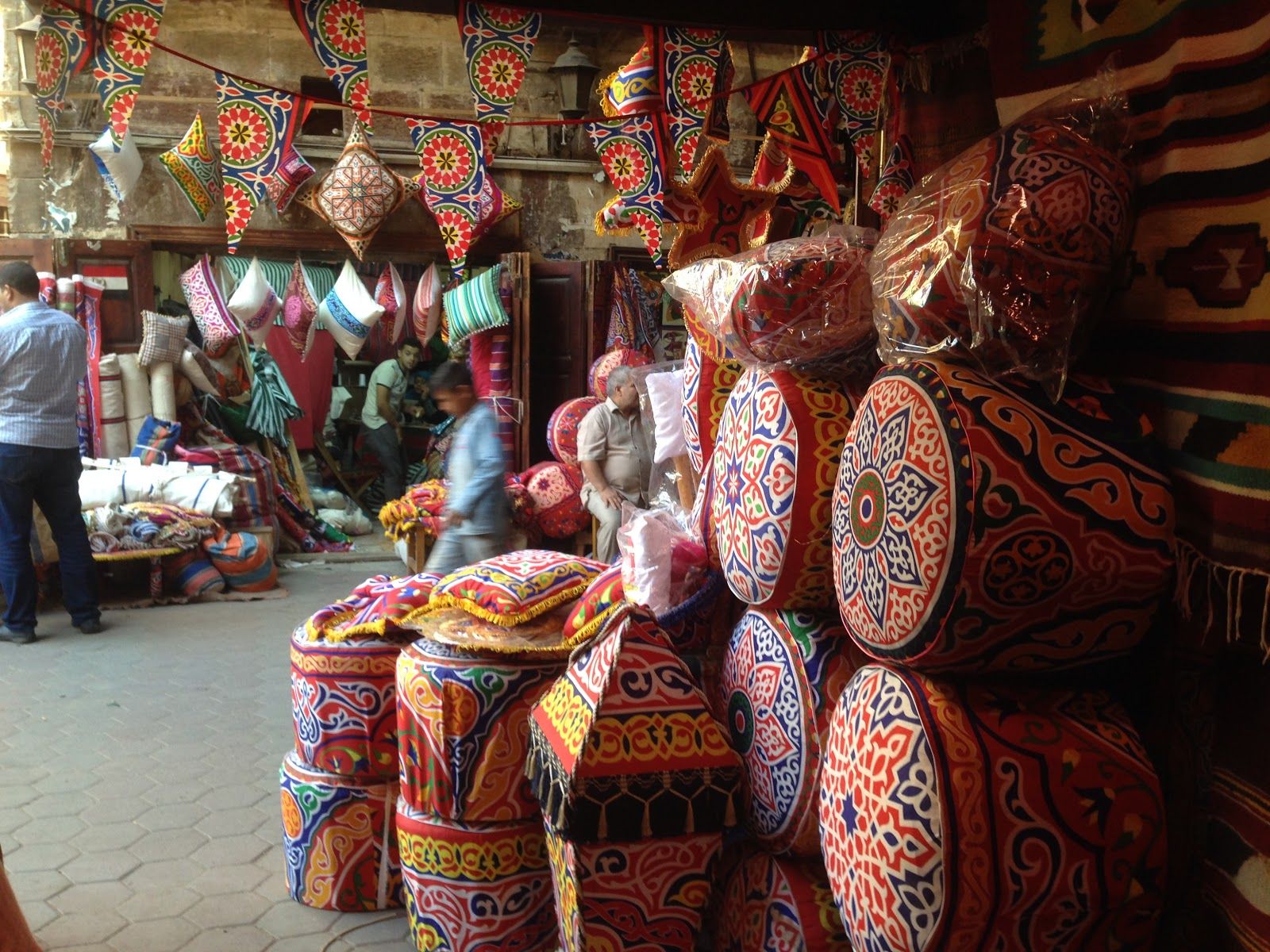
Tucked in the heart of Islamic Cairo, Khayameya (the Tentmakers Market) is the go-to place for the Ramadan decorations that can now be seen all over Cairo. But the popular red-and-blue pattern is only one of the many gems this cozy market has to offer.
As we got to the covered entrance of the Khayameya passageway, marked with traditional wooden webs of mashrabeya windows, we were happy to dive into treasures of carpets, leather products, affordable multi-use cloth and, of course, pieces of the traditional khayameya work for which the market is known.

Khayameya entrance
Getting there
Two of the easiest ways to get to Khayameya are from Al-Azhar through the extension of Moez Street, and from Port Said Street leading to Ahmed Maher. We opted for the Ahmed Maher route, as it’s a short walk from the Mohamed Naguib metro station in downtown Cairo. Here's a map to Khayameya with pins to the best finds:
After passing Bab Zuweila — one of the Fatimid gates of Cairo — on your left, you take a right into the passageway of Khayameya, where you will be met with several shops selling fabric bags.

Khayameya entrance
How to navigate
Khayameya is much less overwhelming than other markets. This is mainly due to its setup of one short passageway — with a wooden covering offering protection from the sun — with boutiques lined up on each side.
Khayameya is a traditional Egyptian handicraft that flourished in the Mamluk era (1250-1517). It consists of stitching small pieces of cloth on a palette into an art piece, which originally was used as a tent, hence the name. Some historians have dated the art of khayameya back to the pharaonic era, as cushions and gowns with cloth patterns were found in ancient Egyptian tombs. However, this art flourished in the Islamic era, especially the Mamluk period, and was used for a multitude of purposes, such as wall decorations and clothes. But along with many other Egyptian crafts, the art started to diminish after this period, and has now become mainly confined to the small Khayameya alley.
Due to its intricate stitching, original khayameya work is pricy compared to other products for sale in the market. The more detailed the design, the higher the price. The printed khayameya designs famously used to set up tents for social occasions in Egypt are a cheaper alternative.

A khayameya artisan at work
But the street’s namesake is not its only offering.
One of our favorite discoveries in khayameya was leather shoes. These shoes, handmade by artisans who stitch them in the shop, are so comfortable that you feel barefoot — not to mention they sell for LE40-60, depending on how hard you bargain. However, sturdiness and long lives are not their strongest traits — their thin soles won’t protect your foot on bumpy terrain, and they wear out within a season. However, we still loved them as a reasonably priced (if relatively short-lived) treat.

Leather shoes at the end of Khayameya Street. Prices range from LE40-70.

Leather shoes at the end of Khayameya Street. Prices range from LE40-70.
The leather bags are another bargain, with skillful artisanship, impressively clean finishing and attractive prices.

Handmade buffalo leather and fabric bags. Prices range from LE85 for the small ones and LE160 for the larger ones.

Another leather workshop working with sheep skin, which produces softer leather. Prices range from LE100-250.

If you’re looking for a cute new purse, these cloth print ones are a cheaper alternative, ranging from LE14-40.
Rugs are another Khayameya staple, which come in quite a range of materials and prices. In the first boutique near the entrance from the Bab Zuweila side, we were met with detailed handwoven wool rugs hung on the wall. The makers of these affordable pieces are scattered across the country, hailing from Arish, Siwa, Kafr al-Sheikh and some Cairo neighborhoods, such as Kerdasa.
The price of the rug depends on its size and on the detail of its stitching.

The prices of medium-sized rugs (approx. 1.5m x 2m) vary from LE185-400.
One of the most popular products you can find in Khayameya are the cotton rugs referred to as kleem, with the multicoloured ones nicknamed salata (salad). These are made of stitched-together pieces of cotton, which are typically industrial leftovers. These rugs are not only affordable, but come in various sizes, colors and designs.

The kleem rugs available in the the shop. Prices start at LE20 for 1m x 2m and go up to LE120 for 2m x 3m. The plain ones are rarer and more expensive than the salata pattern.

Other rugs found in a variety of materials, designs and sizes. Prices vary according to these factors.

The pathway to find the tents and rugs.
In the pathway that you come across near the end of Khayameya, you find cotton rugs (as well as many other kinds) in addition to the tentmakers, who sell camping tents and shoe holders. Ask the salesperson to take you to the storage room to check out the full range of colors.
Here you can also find different products made out of a pattern (pictured below) that has become increasingly popular in the last few years, used in everything from cushions to low sofas. It’s one of the most highly sold patterns in high-end galleries, where they go for several times the price you’ll find at Khayameya. Although it's one of the most popular items, a seller tells us that it’s actually of a lesser quality than the wool work, as it isn’t handwoven and the fabric includes polyester. He says the design was originally imported from Syria three years ago, then started being produced in Egypt due to popular demand.

A big cushion with filling costs LE40 and a low chair sells for LE50.
Star shop
The Dahy Sayed shop, located near the end of the Khayameya alley (pictured below), had the best selection of products. On the high end of the quality scale, this was the nicest shop with the most products and the fairest prices, no haggling needed. Seeing the shock on our faces when he told us the small wool rug we fell in love with was only LE20, the merchant said, “Don’t be surprised. I cut to the chase, all I care about is developing my reputation.” And it works — we found his shop to be the most comfortable in the area. His address is 19 Khayameya Street, and you can reach him at 01.00.52.37.538.

*****
The prices listed in this article were the merchants’ first offer. You could bring the price down if you haggle, but if you can afford to support now-rare artisanal work and still walk away with a bargain, we encourage you to do it.
Before you go, here are a few other handy items you can pick up on your next Khayameya trip:

LE40-50

1m of cloth from LE10-20

LE25-30
*All photographs by Rowan El Shimi

Heba Afify
Heba Afify, known in journalistic circles as H, is a news reporter who traveled between working for local and international newspapers. She covers a variety of topics from high to…

Rowan El Shimi
Rowan El Shimi is a culture journalist from Cairo, but she often finds herself working on stories all over the country, especially Alexandria. She covers a range of topics in culture, mostly…
تقارير ذات صلة
Popular markets without people
Farmers, vendors and buyers struggle to get by amid Covid-19 preventative measures
Corona panic buyers are mostly rich people, grocers say
“My sales are lower than usual,” said Mohamed Hussein, a shop owner in a working class neighborhood.
Flights of Fancy — Pigeon keeping in the Old City
For pigeon fancying aficionados, rising costs do not dull their passion
Your support is the only way to ensure independent, progressive journalism survives.
You have a right to access accurate information, be stimulated by innovative and nuanced reporting, and be moved by compelling storytelling. Subscribe now to become part of the growing community of members who help us maintain our editorial independence.
Join us