
The bargain shopper’s guide to Cairo: Fokhareen and Fustat Market
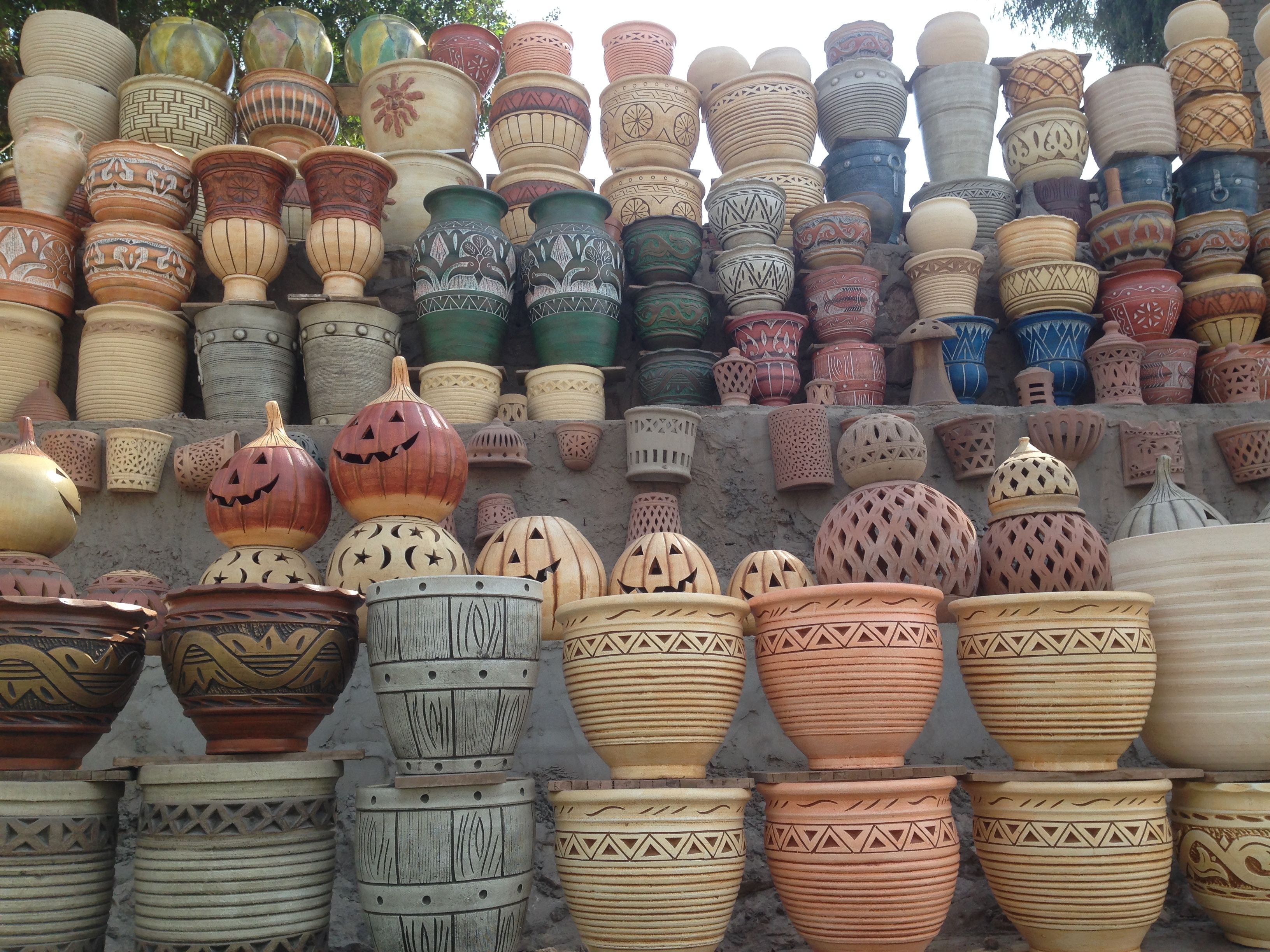
You know you’ve arrived at Fokhareen (pottery makers) market when stacks of pottery start to appear on the side of the road.
Fokhareen is not a market in the typical sense — it is essentially a strip of road with vendors lined up on either side — but it is where you can find the most diverse and affordable selection of pottery in Cairo. There’s also the so-called pottery makers village, created by the authorities to provide a place for workshops.
Fokhareen is located in the historic area of Fustat where, besides enjoying the beauty of Old Cairo — sometimes referred to as Coptic Cairo — you can also visit Fustat market, which is walking distance away.
While it doesn’t live up to its original purpose as a hub for traditional crafts, there is some unique handiwork that is not easy to find elsewhere, or that gets resold in bazaars and boutique shops at higher prices.
Fustat’s historical significance stems from the fact that it was Egypt’s first Islamic capital, and was later absorbed into the Fatimid capital. In 641, Amr Ibn al-Aas, one of the prophet’s companions, took a Muslim Army to conquer Egypt during its Byzantine era. After conquering its then capital Alexandria, he established Fustat as the country’s new capital due to its then proximity to the Nile and the Fortress of Babylon. It is said that the area was named Fustat, meaning tent in Arabic, because its initial inhabitants lived in the army’s tents before they built the original Amr Ibn Al-Aas Mosque in the same location as the new one. Fustat remained the capital of Egypt for around 500 years, on and off, until 1168.
As one of the most historically significant areas of the city, the Ministry of Antiquities, along with the Cairo governorate, collaborated on reviving the ancient city’s monuments — including Egypt’s oldest synagogue, mosque and churches — and its legacy as one of the biggest markets in the region for both ceramics and other artifacts.
And so Fustat Market came to be established in 2001, with authorities predicting that tourists coming to see the monuments would also visit the market. Its small shops with domes surround a shaded courtyard and an adjacent restaurant. Although the plan was that it would host the pottery makers of the area, along with other artisans working on traditional Egyptian handicrafts, Fustat Market quickly transformed into a more modern handmade products market.

Getting there
There are two convenient ways to reach the area where the pottery makers and Fustat Market are located. To drive there, you take the flyover opposite Misr gas station on the Nile Corniche in Old Cairo, and as soon as you hit Fustat road you will find stacks of pottery to your right and left. When you’re done at the pottery makers market, you can take the first U-turn on Fustat Road, then take a right, which will lead you to Fustat Market on your right-hand side.
If you take the metro, you get off at Mar Girgis, taking a right when you come out of the station into Qasr al-Shamea street, where you'll pass the famous Hanging Church and follow the winding road until it reaches Fustat road, where the pottery makers are. To get directly to Fustat Market, you take a left out of the station and the road soon meets the main road where the market is.
How to navigate
If you arrive by car on Fustat Road, you’ll find a gate into the pottery makers' village, housing the workshops where the pottery pieces are made. You can park inside the village. However, the actual pieces are displayed on the main road, usually between 9 am and 10 pm everyday. On Sundays, there are fewer vendors but you will still find some with large displays on the side of the road.
The first vendor you are likely to encounter happens to be one of our two favorites in the area, but more on that in our “star shops” section.
-

Fokhareen, products on the side of the road
As you’d expect, there are plant pots in pretty much any size and shape you could hope for. Their prices range from LE30 to LE120, depending not just on size, but the intricacy and quality of the work. There are some that are plain clay, while others are colored with engraved shapes. A shiny layer marks products of a higher quality that will last longer — after being developed in the clay oven these pieces receive a protective layer and go back into the oven a second time.
-

Cooking pots range from LE10 to LE30
Pottery as a craft originated in Aswan, where the clay comes from, and several of those making and selling their work in Fokhareen have inherited the profession from their parents. The pottery makers soak the clay that arrives in rock form from Aswan in large pools of water and then make their pieces using a traditional pottery maker — operated by a foot wheel, while shaping the rotating piece by hand.
Here you’ll also find the pottery village for the craftsmen’s workshops. The Pottery Syndicate and the craftsmen complain of negligence, as the village, though completed in 2003, has never been officially inaugurated and still doesn’t have gas or electricity.
A major advantage of buying pottery here is that anything can be customized; the craftsmen are always ready to color their work on demand, or to take customised orders. Despite slow business — trade was severely affected in the aftermath of 2011 — and the competition between many shops selling similar merchandise, the vendors are generally pleasant and relaxed, making the walk through the different stands on the side of the road stress-free and enjoyable.
This is the place to come for light fixtures, ranging from simple to more intricate in design.
-

Light fixtures for LE30-50
There are also stalls selling pieces made of a light and transparent material known as Fizon, which have a beautiful diffusion effect and are perfect for outdoor decoration.
-

Collection of three pieces for LE300

Moving on from the Fokhareen to Fustat Market, the products and prices vary from shop to shop, but generally you won't find bargains like at the pottery makers. The market is open from the morning until 5 pm.
Its 47 shops are leased via auction for limited periods of time — a governmental committee assesses the applicant's ability to sustain themselves and the quality of their products. The goods should be handmade using a traditional craft, although this stipulation isn’t upheld for all current shop occupants. The market has no competing businesses selling the same product to ensure diversity.
-

Fustat Market’s empty shops

When we visited the market, there were only around 15 shops open. The rest were either completely unoccupied, or appeared to be functional but closed, even though we visited at 1 pm and the working hours of the market are advertised as being 11 am until 5 pm, apart from Fridays and Sundays when some shops close. Among the closed shops were organic hair and skincare product range Nefertari, a shop selling patchwork and woven products made from recycled materials under the auspices of the Association for the Protection of the Environment, and Omran, a traditional carpet maker. Business appeared to be slow, as sales were dealt a strong blow by the drop in tourists visiting Fustat in the past five years.
The first shop we hit when we got to Fustat Market was Al-Moulid, run by three young Egyptian artists, each selling their own work. Khashaba is a brand developed by Hassan Khaled, who makes wooden portraits of Egyptian cinema icons, as well as wooden jewelry. Shaimaa Esmail, with her brand Zakzouka, designs jewelry as well, while Mariam Raafat makes funky handpainted shoes.
-

Earrings by Khashaba vary from LE35 to LE50

-

Mariam Rafaat’s shoes range from LE75 to LE150

The crochet shop run by Marwa is probably the most diverse collection of crochet we have encountered in Egypt. The conversation we had with the shop owner, who is invested in the development of handicrafts, makes the experience even more enjoyable. While we can’t say that the products are cheap, they are reasonable compared to other options, especially given the high quality and care with which they are made. There are also unique pieces, like small-stitch crochet knit into fabric, made by women on the island of Shardaweel in Upper Egypt.
-

Cushions cost LE150, a bath mat two-piece set costs LE270

Our next stop was Amal Sherbini’s wooden furniture, which, while expertly-crafted and unique, is by no means what you’re looking for if you’re here for bargain shopping. But apart from wooden furniture with a hefty price tag, Sherbini also stocks a range of miscellaneous smaller items that are affordable and unique. There are Palestinian embroidered bags, distinguishable from similar work by Bedouins in Egypt by their small stitches. The shop also contains decorative plates from Iran and Palestine, priced between LE60 and LE125.
-

Embroidered bags from Palestine, priced between LE120 and LE150

-

Small mugs LE25, big mugs LE50, and plates LE70
Star shops
While no one shop stood out as a particularly great find in Fustat Market, these two vendors in Fokhareen had uniquely diverse and high quality collections.
In the heart of Fokhareen village, after you cross the gate, you will find Samir’s stall. While his collection of pots is not so different from what everyone else offers, he distinguishes himself with an impressive collection of decorative pieces that mix the authenticity of the trade with a fresh modern spin. The pigeon tower in the photo below, which usually sells for LE400 despite the LE600 tag placed on it, caught our eye with its warm colors. This large piece would work perfectly as an entrance decoration. Samir also has pieces shaped after the traditional “olla” (drinking pot), with intricate designs carved into the clay and a colorful finish.
-

This pigeon tower would work well as an entrance decoration

-

Samir's stand
The last in the line of vendors before the market subsides and gives way to empty sidewalks again is Nasser Mahmoud’s stand. This vendor has a particularly versatile collection of pots of different sizes and colors that will stop you in your tracks as you walk by. They range from LE50 to LE120 depending on their size. The shop also has a delightful collection of small statues that could be perfect unique gifts, for as little as LE20. The statues include the legendary singer Om Kolthoum, several music players, among others. We were also amused to find that some of the shop’s beautifully engraved olla designs include a kissing couple.
-

Several of the shop’s beautiful engraved olla designs include a kissing couple


Heba Afify
Heba Afify, known in journalistic circles as H, is a news reporter who traveled between working for local and international newspapers. She covers a variety of topics from high to…

Rowan El Shimi
Rowan El Shimi is a culture journalist from Cairo, but she often finds herself working on stories all over the country, especially Alexandria. She covers a range of topics in culture, mostly…
تقارير ذات صلة
Popular markets without people
Farmers, vendors and buyers struggle to get by amid Covid-19 preventative measures
Corona panic buyers are mostly rich people, grocers say
“My sales are lower than usual,” said Mohamed Hussein, a shop owner in a working class neighborhood.
Flights of Fancy — Pigeon keeping in the Old City
For pigeon fancying aficionados, rising costs do not dull their passion
Your support is the only way to ensure independent, progressive journalism survives.
You have a right to access accurate information, be stimulated by innovative and nuanced reporting, and be moved by compelling storytelling. Subscribe now to become part of the growing community of members who help us maintain our editorial independence.
Join us