
Thank you for your order. Your strike is on its way: On Talabat drivers’ unprecedented April labor action
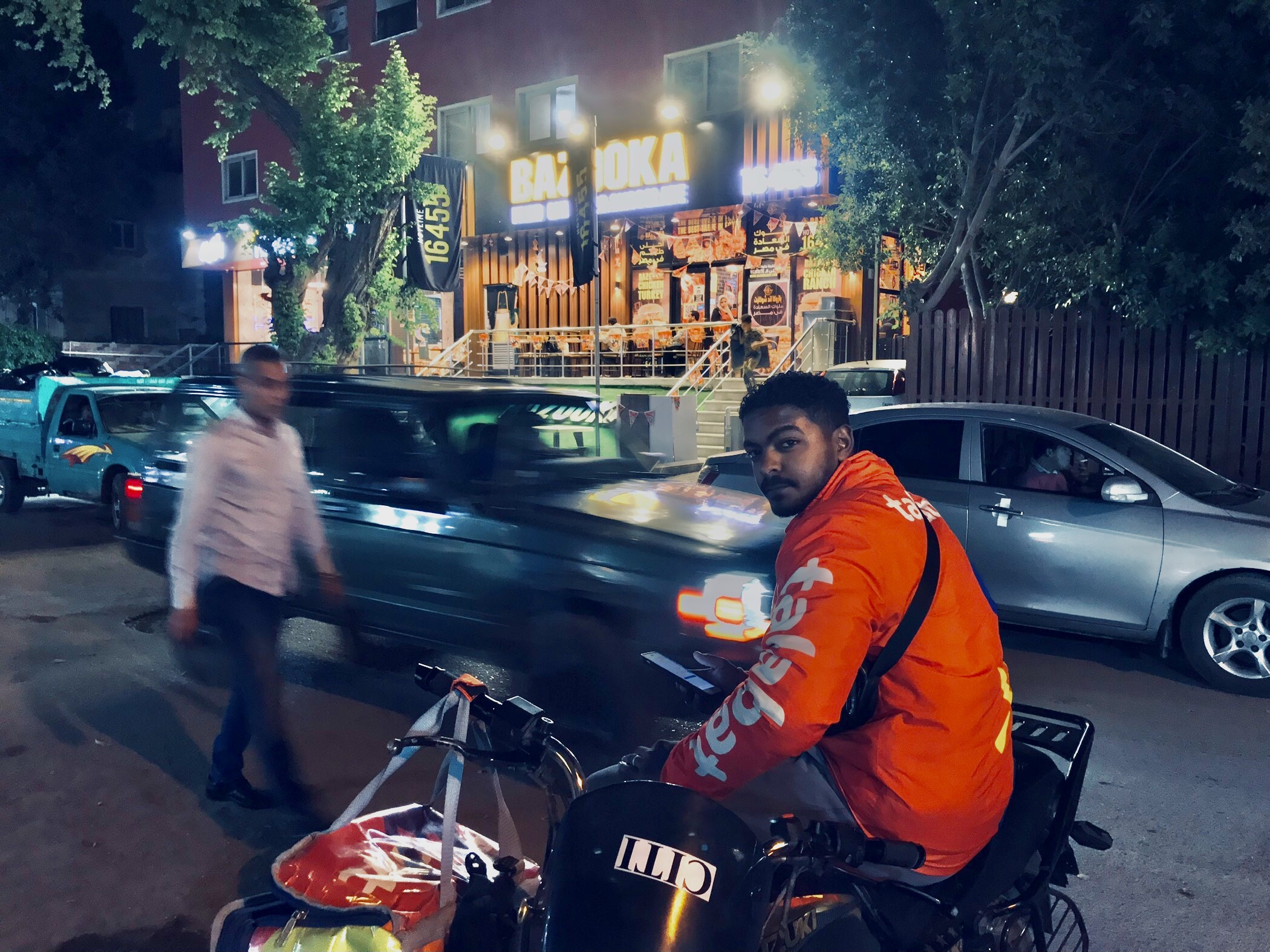
Fitted in Talabat’s vest, Omar is straddling his 2020 Boxer motorcycle. He keeps himself busy by biting his nails and watching passersby stroll down Maadi’s Street 9. Mahraganat music is playing from the small screen fixed to the motorcycle’s handlebars. From time to time, he looks down to check the clock. It is 8:50 pm. He has an estimated 14-minute wait before the fried chicken he is to deliver is ready, the application tells him.
Omar is back to work now, April 9, but, just a day earlier, he and about 3,000 other Talabat drivers who have become an important conduit for the transport of food and goods across Cairo had been in the midst of a strike.
Despite this increasing dependence on delivery services, drivers receive little compensation while shouldering the weight of workplace risks and capital investment needed to enter into the workforce for a company in Talabat that reaps a significant portion of the profits and has next to no competition.
The strike — the first collective action by workers employed by app-based delivery companies in Egypt — came and went over the course of three days.
To get the drivers back to work, Talabat’s management gave them Ramadan bonuses for hours worked per week: LE250 (around US$13.66) for 45 hours, LE400 for 60 hours, and LE600 for 80 hours. For Omar, the settlement was just a way to back the drivers into a corner and forestall broader demands, as the company paid out the bonuses but refused to make any promises regarding drivers’ demand for a meager LE4 pay increase on delivery commissions.
The commission increase was a demand because, while those placing orders on Talabat pay variable delivery fees depending on the price and the distance between the restaurant and the delivery location, the drivers’ pay remains largely the same before bonuses: LE15 for drivers that have a “good" rating or LE12 and LE13 for drivers whose ratings are below the “good” threshold.
With a LE15 commission rate as a “good” driver, Omar earns a total of LE300 from the 20 deliveries he makes on average during his 10-hour-and-35-minute shift — a nonnegotiable Talabat policy for all drivers. Usually, LE30 goes to gas and an average LE20 goes to maintenance and emergency mechanic visits, leaving him with a net pay of LE250.
But holding onto a “good” rating is often beyond a drivers’ control, as Omar experienced.
Drivers often face difficulties finding delivery locations. Sometimes, the street name is different from what the application’s map shows. In such cases, Talabat advises drivers to review the client’s data with the company’s technical assistance service. However, according to Omar, the technical assistance team does not provide enough help, another issue that the strike demanded be addressed.
Two weeks before the strike, Omar was out on a delivery in the Dar al-Salam neighborhood. He picked up the order from Ahmed Zaki Street and drove toward Dar al-Salam Bridge. But something was wrong with the delivery address. He contacted technical assistance, but, instead of helping him, they canceled the order and his rating on the app dropped as a result. And with the drop, the delivery commission fell from LE15 to LE13.
What's more, a driver does not have the freedom to accept an order or reject the other. So if a location is not clear, or goes beyond the Maadi area, where many drivers are based, it will mean that a driver either has to navigate into an unknown area or burn considerably more fuel and lose out on more deliveries to head into Dar al-Salam, Tora, Kotsika, and neighborhoods extending between the Corniche and autostrad.
A driver can also see their rating drop if the restaurant is delayed in finishing an order or if they contact the client to inquire about the address. Furthermore, drivers are not allowed to take a shift break or conclude before the 10 hours and 35 minutes are up. If that happens, they will be considered late or absent and the app automatically drops their rating.
During Ramadan, Omar and other drivers were forced to have iftar and suhour on the street because of the strict shift times. And with having to purchase his daily meals during the whole month, the cost of work increased. By having to take his daily meals on the street, his LE250 per day net pay fell to LE150.
The Ramadan working conditions angered the drivers and were a galvanizing force to demand an increase in their delivery fees.
This was Omar’s first strike experience. He only decided to join after careful consideration, for not participating in the strike would have caused him material losses. Without his fellow drivers to meet demand, he would have had to cover deliveries all over the southern neighborhoods of Cairo Governorate. Having to cover a larger service area would have meant that, instead of delivering two orders per hour, he would have ended up with one order per hour.
“I would have been screwed if I worked on my own on the ground. I could be delivering an order in Misr-Helwan Agricultural Road and then receive an order in Saqr Quraish. I would head out empty handed and just burn gas,” he says.
For Omar, the strike came together somewhat spontaneously over the WhatsApp group that brings together Talabat’s drivers. “I was on my way to deliver two orders on Misr-Helwan road. I found the guys coming together and asked them to wait for me to deliver the orders I have so that I could go with them. We kicked off from the Misr-Helwan road and gathered pilots from Zahraa al-Maadi and Lasilky Street and headed to the company’s headquarters in Zahraa al-Maadi.”
***
Four minutes have now passed. Omar has ten more to go before the order comes out. He does not receive the delivery location until he receives the order from the restaurant. This is the app’s way of doing things. He has on him LE967 in cash from the deliveries he has made in the last two hours. When that figure surpasses LE1,000 after making the delivery he is waiting for, the app will put a halt on receiving new delivery requests. Omar will have to submit the collected cash to either Fawry services or through one of Talabat’s offices in Maadi. While the company collects its money on a daily basis, Omar is paid for card-purchased deliveries on a weekly basis, which can extend out to ten days.
Beyond meeting their daily needs, this delay in liquidity presents a litany of problems for drivers.
Omar was only able to join Talabat after saving money renting an Interior Ministry-owned kiosk that he used to buy an iPhone 7 Plus and the Indian-make motorcycle. Talabat does not provide workers with any equipment, and as such it also does not help repair or replace anything lost or stolen. The company also does not cover medical expenses in the event of an accident, nor does it provide paid leave for any days missed due to necessary medical care.
That something bad might happen is a constant source of anxiety for Omar, as he knows he would be on the hook to replace or repair any of the things that are vital to his work. This is most intense when he parks his bike to make a delivery, knowing that he might return to find his bike stolen when he gets out.
In lieu of any support from Talabat, the drivers have tried to support one another.
Omar has attended several fundraisers for fellow drivers whose bikes were stolen or to help with the medical care costs for drivers who have been injured in accidents. It is an ethos that carried him into the strike.
“The pilots’ strike is in the interest of all of us,” he tells Mada Masr.
And rather than trying to provide their own safety net, the strike was a place to make demands on Talabat. One of the chief demands of the recent strike was for accident insurance. It was not met.
As careful as Omar is, sometimes accidents happen. Two weeks before the strike, while making a delivery in Zahraa al-Maadi, his phone slipped out of his pocket and the screen broke. The repairs set him back LE600, roughly two days of work.
***
Cairo is one of the largest markets in the Middle East in terms of consumption rates and purchasing power, according to Talabat’s former managing director. Egypt also boasts a variety of clientele that allows for any company entering the Egyptian market a series of expansion pathways, especially given Cairo’s large youth population tethered to online consumption and a relatively small geographic footprint.
Despite the market potential, Talabat has next to no competition, with the exception of El Menus, a fact that allows them to set the terms for both consumers and the labor market.
This was not always the case, however.
In 2018, the Spanish company Glovo emerged as a new competitor to Talabat. The company, headquartered in Barcelona, grew to become the third largest Spanish tech company touting an estimated value exceeding US$1 billion.
Delivery Hero Group, a Berlin-based company that owns Talabat, also owned 16 percent of Glovo’s stock. In January 2022, Delivery Hero raised its stake in Glovo to exceed 80 percent.
Within 18 months of kicking off operations in Egypt, Glovo’s delivery workforce swelled to over 3,000 drivers. It began to recruit delivery drivers of bicycles and skaters. Bicycle deliveries exceeded 70 percent of the total share of officially registered delivery drivers. The majority of those bicyclists were university students from south and central Cairo. It was not an unusual sight to see teenagers roller skating through Cairo’s streets wearing the company’s yellow vest to deliver food. As an incentive to expand its network of delivery workers, the company was mulling signing contracts with bicycle shops to sell bikes at discounted rates to young people looking for work. In contrast, the share of bicycle owners in Talabat’s delivery workforce dropped significantly as it expanded the geographical area that delivery workers now usually cover.
In May 2019, Glovo announced it was exiting the Egyptian market as part of a larger plan to exit four markets. This plan came as the company pursued 150 million euros in venture capital. Delivery Hero, which owned 16 percent of Glovo at that time and had important voting power, also owned Glovo’s major competitor Talabat in full, using its voting power on Glovo’s board to condition its agreement on the capital increase on Glovo exiting the Egyptian and Chilean markets. When this information spread through Egyptian press at that time, the Egyptian Competition Authority waded in. At the close of May, 2019, the agency ordered Delivery Hero and Glovo to exclude Egypt from their agreements and negotiations and to reinstate the market arrangement as it had been before the announcement. Glovo was ordered to remain in the Egyptian market and not liquidate on grounds that it was the only competition to Talabat.
However, the issue was obviously bigger than the agency. In January 2020, Glovo announced it was exiting Cairo and Alexandria among eight of the 306 cities, mostly in Latin America, it operated in across the world in 2019. These eight cities represented 1.7 percent of the company’s total sales in 2019.
At the same time, Marsool, a Saudi delivery of things company, began operations in Egypt. For Glovo’s delivery workers, the majority joined either Talabat or Uber Scooter, one of the ridesharing options provided by Uber, which had failed in expanding its food delivery service in Egypt through Uber Eats. In total, Talabat recruited around 2,000 former Glovo delivery workers.
Bolstered with an even greater labor market share. There was no looking back for Talabat. No one could stand in their way, that is, until early April.
***
It is exactly 9:03 pm. Omar dismounts from his motorbike, crosses Street 9 and enters the restaurant through the side door designated for delivery pickups. Less than 30 seconds later, Omar emerges through the doors with the order in hand. Time is precious. He puts the bag in the food storage box, opens the Talabat app and kickstarts the bike into life. Omar presses “order received” on the app, which then reveals the delivery address. It is on Degla Street in Maadi. Omar is thrilled. This delivery will only take 11 minutes. He smiles in relief as he pulls away from the restaurant and gets back to work for now.
تقارير ذات صلة
Hundreds stage sit-in at Workers Cultural Foundation, call on Sisi to intervene amid trade union federation mismanagement
"Workers are hungry, and the administration couldn't care less about them”
Labor Day 2017: Cooperation under another name
What does the cooperation Sisi called for in his Labor Day address mean amid a marked deterioration in labor conditions?
Public transport workers: Dissidents across different regimes
Public transport workers have been antagonized by consecutive regimes
Your support is the only way to ensure independent, progressive journalism survives.
You have a right to access accurate information, be stimulated by innovative and nuanced reporting, and be moved by compelling storytelling. Subscribe now to become part of the growing community of members who help us maintain our editorial independence.
Join us