
Tenant vs. landlord: Decades of tension, from rent-control to deregulation
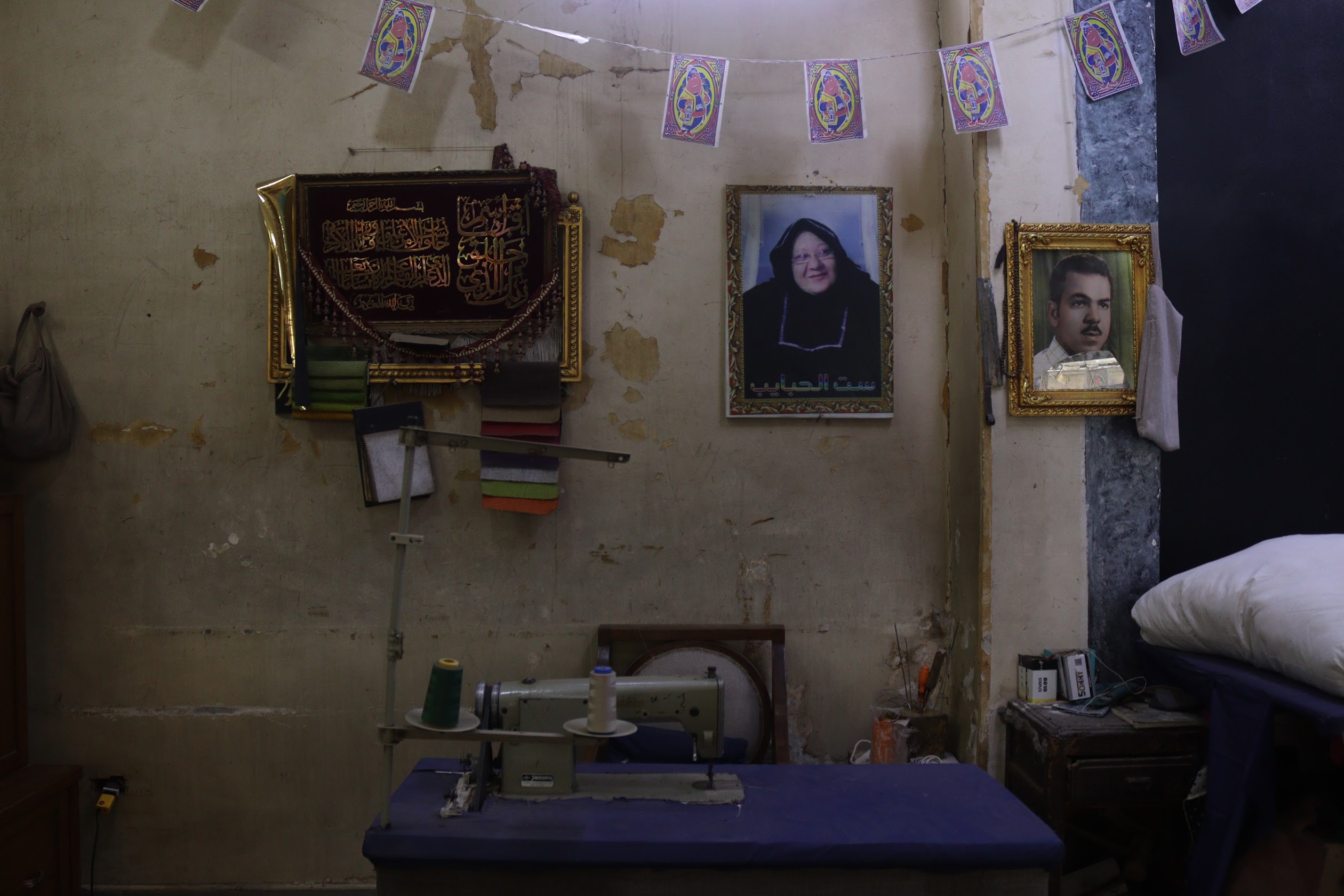
Imam is an upholsterer whose family has been renting their old rent shop in a narrow alley between the central Giza neighborhoods of Agouza and Mohandiseen for 40 years.
Imam feels abandoned by the state, as it rolls out a set of steps that will ultimately abolish old rent and, he expects, push him out of the shop.

Osman is a landlord in Sayeda Zeinab who owns multiple old rental properties that he inherited from his family.
Osman feels like the state’s old rent controls have left him subsidizing the tenants’ rent out of his pocket for decades, as the restrictions on leases have barred him from cashing-in on the lucrative, liberalized housing market whose growth he watches from afar.

Governments since the 1920s have used rent control as a way of stabilizing urban living conditions against the violence of rapid social and economic change. Rent-control became, for a while, part of the government’s promise to provide affordable housing, a bulwark against the shortcomings of various state-built housing strategies.
This was to the displeasure of landlords and private builders, who increasingly worked to circumvent frozen rent values and other tenant protections over the years, pushing governments to introduce increasingly liberal market reforms.
The result since the 1990s was a dual rent system: a declining segment of cheap, capped ‘old rent’ housing on the one hand, and a slowly growing segment of completely unregulated market-based ‘new rent’ on the other.
The divide has fueled growing tensions between old rent tenants and landlords, which burst into view this year with the introduction of the new old rent law, a set of provisions through which the government pledges to deregulate old rental properties within five to seven years.
Now, tenants like Imam feel the state is stepping back from protecting them, leaving them fearing for their fates in a carnivorous real estate market.
Landlords like Osman, meanwhile, eye the staged transition cautiously, nursing resentment against the state and legal system they view as having put the burden of the housing crisis on them for years, and against the tenants they view as barriers to their enrichment.
***
Imam welcomes us into his shop warmly, ready to tell his story, though with the tone of someone who has pleaded his case many times and is losing hope. “It is what the government wants,” he says.
He speaks of the shop with a strong sense of belonging, highlighting the investments his family has made over the years in the place. “We did the finishing and made it like this, it was just red bricks when we received it. We connected the electricity,” he recalls.

The investment was built on a decades-old state promise of stability, based on rent control.
Rent controls in Giza and other cities date back to the interwar years, when rapid economic and demographic shifts threatened urban stability. The state took measures modeled on British wartime policies: temporary protections against tenant evictions, obligations for landlords to lease vacant units, and a freeze on rent hikes were introduced between 1920 and 1942, before ultimately being formalized into law.
Urban researcher and author of Egypt’s Housing Crisis Yahia Shawkat explains to Mada Masr that while formalized rent was not the mode of living for the majority of Egyptians at the time, the rent controls protected a growing urban class of state employees and workers from the rent hikes prompted by the influx of European soldiers to Cairo neighborhoods during the world wars.
The wartime promise of stability via rent control was later redoubled under former President Gamal Abdel Nasser’s Arab socialism. “Since the Egyptian Revolution of July 23, 1952, the government has given full attention to the housing problem and has taken various measures to provide suitable and hygienic housing for low-income families,” Nasser said in his first address on the housing crisis in 1955. The housing was provided, the president continued, by “making it accessible to them either through affordable ownership schemes with easy payment plans, or through low-cost rental options.”
But the government was slow to build affordable housing. To supplement the gap, Nasser instead maintained and expanded the existing rent control regime, all in the name of stabilizing the growing urban class. By the time of Nasser’s death in 1970, CAPMAS figures show that almost two million families, or around two-thirds of urban households, were old rent tenants.
Imam’s father had the same expectation of stability when he began renting the Mohandiseen shop a decade later to build a family business around his craft. Along with the shop, Imam inherited the profession and local clientele from his father.
Now that new legal steps will phase out old rent, Imam fears the threat of eviction could destabilize his life completely.
Tenant groups and their representatives have criticized the new law for failing to protect against uprooting residents and tradespeople from their neighborhoods — the network of living they have been connected to for decades, where they work and send their children to school.
In today’s economic reality, upholstery has become a luxury, Imam tells us, as the craft is fast outpaced by rising costs of materials and cheaper mass-produced alternatives.
“If the place closes, there will be no customers at all. The customer wants the place they see right in front of them,” he says.
But Osman feels that it's he who pays out of pocket for the old rent laws that protect people like Imam. He greets us outside one of his shops by getting right down to business, voicing his sense of being robbed by the Nasserite tenant protections.
“The old rent system has been a great injustice to the landlord,” Osman tells us in his old office, where he keeps paperwork for the multiple lawsuits he has filed against several of his tenants. “You can consider it nationalization without compensation, a full subsidy for the resident. Could the resident endure subsidizing me for 60 years?”

Osman is preceded by generations of old rent property owners who felt similarly, and who represented a challenge to successive governments, which simultaneously sought the contradictory goals of getting landlords to cooperate with rent controls to maintain an existing segment of affordable housing while also seeking to economically empower them to grow the housing market further.
Nasser voiced the balancing act ahead of the rental law of 1969. “Can we as a government build today? We can’t,” he acknowledged. “Do we want the private sector to build? Yes, we do. Therefore we must encourage whoever constructs buildings. We don’t want exploitation, we don’t want key money or furnished apartments, but [the landlord] really needs to generate a return to motivate him and anyone who wants to build.”
Still, the 1969 law would introduce the strongest set of tenant protections yet, even extending the inheritance of rental leases to third-degree family members. The inheritance clause was the nail in the coffin that led to the unraveling of the old rent system, in Shawkat’s eyes.
The laws sought to contain the large land-owning class, the urban researcher says, but they also effectively hindered the rise of a new class of potential landlords in the 1960s: workers and professionals who were able to gain ownership of housing units through projects sponsored by state companies or professional associations, and informal groups of self-builders who filled the gaps in state housing policy.
Landlords of old rent properties felt increasingly aggrieved. With rate caps consistent despite inflation and the new inheritance rules, the state-enforced old rent model was all but equivalent to selling the unit — and both landlords and tenants acted accordingly.
Landlords demanded higher and higher sums in khlew rigl, or key money, a large one-off sum, paid upfront by the tenant in exchange for the property lease that was criminalized under Nasser.
As a result, the apartments were increasingly more available to tenants based on wealth, rather than on income, a direction Shawkat says distorted the rental relationship. “I know a friend who was getting married in the early 1990s,” he recalls. “The amount he had would either buy him a public housing apartment in May 15 City, or cover the up-front payment for the old rent lease on an apartment in Sayeda Zeinab. He ended up choosing the old rent lease.”
Governments, meanwhile, fought harder to placate the landlords, and effectively decriminalized khlew rigl in the 1980s, allowing landlords to request “an advance” on rent.
While it soothed landlord opposition, the prevalence of khlew rigl became a central factor in rising friction between landlords and tenants. Who was responsible for the property? The tenant who paid an up-front sum, perhaps equal to the property’s value? Or to the landlord who demanded the sum to hedge the asset’s value against frozen rents and lease inheritance?
Disputes played out informally or in the courts, though Shawkat notes court proceedings are an exhausting mechanism for conflict resolution that was unable to entirely disperse the social tension, pointing to violence that sometimes burst to the surface with landlords killing tenants or vice versa, or units intentionally sabotaged.
This became widespread during the 1970s and 1980s, as many landlords left old rent buildings to deteriorate — their collapse a cheap way to evade paying to maintain a rent controlled property. The number of available old rental buildings began to shrink considerably.
Some tenants, like Imam and his family, substituted maintenance fees themselves, furthering the state of confusion over who was responsible for the property.
The distortion remains a thorny issue under the new law. Osman, protective of his own finances, dismisses the question of compensating tenants when we raise it, saying that expenses were part of the cost of living in the place, and the landlord owes nothing.
He recalls that when one of his tenants was arranging to hand back a property, the tenant requested that Osman repay him for both the khlew rigl and expenditure during the lease on fixtures, fittings and other maintenance. Osman agreed to pay for the latter, but refused to return the key money.
Tenant groups have criticized the new old rent law for failing to provide a clear solution to khlew rigl and other expenses.
The government says it will compensate tenants who may face eviction under the new law in order to support them to buy state-constructed affordable housing, but Imam is skeptical that the rate will be fair. “How much does LE20,000 then equal today?” he ponders, recalling the sum his father paid in khlew rigl. “Maybe LE2 million? Who will compensate us for that? Will the government’s compensation cover the same value of the shop?”
Even the most affordable social housing available today requires a LE50,000 advance payment and comes with an eight percent interest rate — with the national poverty rate estimated at 34 percent.
And though the gradual liberalization of the housing market since the 1990s boosted the number of rental properties available, inflation has quickly pushed prices out of most people’s reach as incomes stagnate. The rent to income ratio rose from 14 percent in 2008 to 39 percent in 2017.
“The liberalization was good and bad,” says Shawkat. “It revived the market from 1996 to 2006 and about a million new tenants entered the market, which didn’t happen in the previous two decades.”
“But then new rentals grew only slightly between 2006 and 2017, while the number of old tenants dropped by about a million following the 2002 court decision on inheritance.”

At the same time, liberalization “divided owners into old landlords who sometimes could be poorer than their tenants, and new landlords who bring in income they couldn’t have dreamed of,” Shawkat explains.
It’s this dual system that has left Imam feeling wronged by old rent’s abolition, and Osman feeling wronged by its continuation.
Now, with old rent being phased out under a legislative step taken in response to another constitutional court ruling in 2024 that ordered the state to exit the rental relationship, the fears of old tenants like Imam have doubled.
The new law promises that current old contracts will end within five to seven years and, in the meantime, rent will increase 10 to 20 times its current value and according to its location, with a minimum of LE250 per month in low-income neighborhoods.
Landlords will be entitled to end contracts or offer market-based rental rates to the tenants. The landlord can also easily obtain an urgent eviction notice under the new law, while tenants have to take a longer path to appeal the ruling.
Shawkat is critical of these blanket changes. The 1.5 million units governed by old rent are complicated in their nature and history, he argues, and require an area-by-area study. “You might have someone in Zamalek who has been renting for LE10 since the forties or fifties, and someone in Dar El Salam who rents for LE100 since the eighties. It is not reasonable for both to increase tenfold.”
Imam and Osman share their expectations about what happens next.
Osman places faith in the market, predicting that prices will balance themselves and people will find housing according to their ability. “Prices might change after all these empty apartments are vacant. If the prices are around LE5,000 today, they might go back to LE3,000, maybe LE2,000.”
He says he does not want to have to evict anyone and that he’ll let tenants stay “for the sake of society" and the current economic circumstances, but still, “the rent would change; they would stay at a different price.”
“I'll let them stay until they hate the place or they cannot afford the rent and there's a cheaper alternative. Thus, there will be a market balance, and they'll know the price,” he continues.
If there’s any social fallout, he says, it’s for the state to step in. “Why do you place all this responsibility on the landlord? A man who works in an investment company or does any other business, why would I support his rent?” he says.
Addressing the state, he adds: “You interfered in the relationship between landlord and tenant in the 1960s, you should resolve it in 2025. You can give me the rent yourself.”
For Imam, who already struggles to pay LE400 per month, the minimum hike to LE1,000 in ‘prime’ areas could include his shop in Mohandiseen. He anticipates he will be ousted and voices doubt that the new law will support him in finding an alternative way of living.
“Will the government’s compensation cover the same value of the shop? I'm here, now, in Mohandiseen. If we leave in five years like the president wants, would they be able to get me a place in the same location, the same space, and the same everything? Impossible,” he says.
He has seen other inner city residents relocate to small government housing projects on the outskirts of Cairo like Asmarat and fears facing the same fate. “Would we go to the desert?” he says. “Would I find someone to work with in the desert? We can barely find them here!”
With a bleak housing market in view, Imam nevertheless makes a final appeal to the state to reverse the new old rent law.
“Many people will be harmed or displaced. Where do we go? What is the alternative? How are we going to raise our children?” he says.
“I appeal to the president to reverse this decision. This is not a Quranic text that we must follow. It can be stopped.”
تقارير ذات صلة

After first ‘old rent’ hikes, tenants fear next rent rise will be worse
The hike was the first concession permitted to landlords by the new law passed earlier this year

Brandishing the military trial stick: The govt’s price control bluff
Another wave of inflation is crashing in. On March 10, and for the third time in the course of a year, the government raised fuel prices again, justifying the decision…

What’s up tomatoes?
During Saturday’s press conference, Prime Minister Mostafa Madbuly addressed the recent surge in tomato prices, following a tour of the Obour Wholesale Fruit and Vegetable Market. “There was a problem…
Your support is the only way to ensure independent, progressive journalism survives.
You have a right to access accurate information, be stimulated by innovative and nuanced reporting, and be moved by compelling storytelling. Subscribe now to become part of the growing community of members who help us maintain our editorial independence.
Join us