
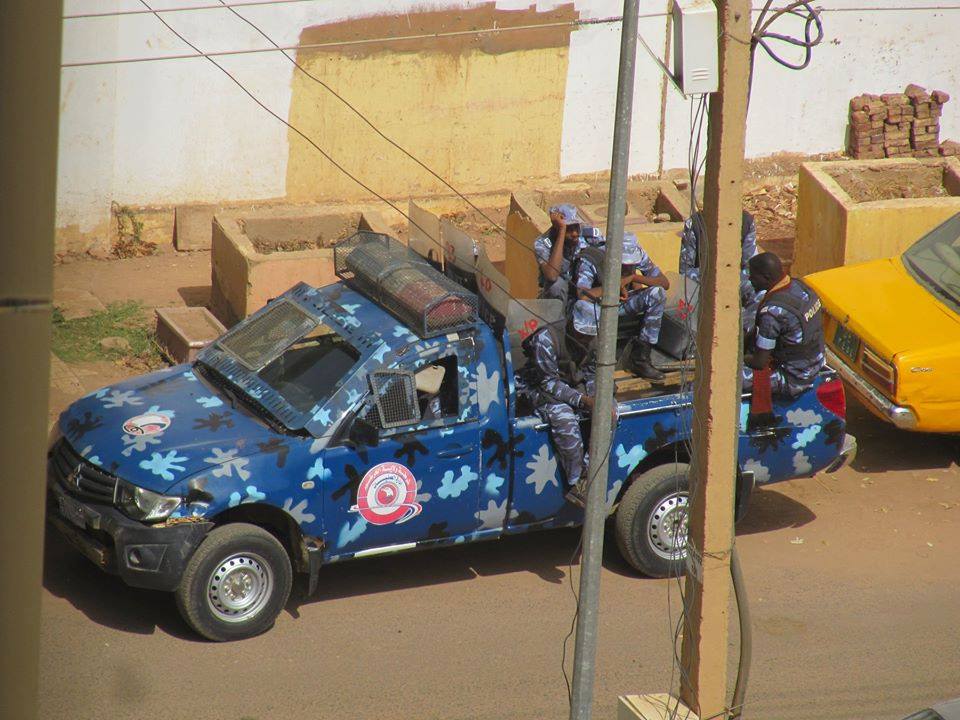
Sudan anti-government protests spread to Darfur amid extensive security crackdown
Speaking from the South Darfur capital of Nyala on Monday, Sudanese President Omar al-Bashir insisted that he would not step down from office despite widespread protests calling for his resignation, which had spread to the war-torn region of Darfur for the first time just one day earlier.
In a speech broadcast on state television, Bashir told thousands of supporters that “protests would not result in the fall of the regime,” stressing that a transition of power in Sudan could only take place through elections and that the upcoming vote in 2020 would be free and fair.
Ahead of Bashir’s visit to the region, security forces launched a widespread crackdown on Saturday, arresting dozens of lawyers, activists and doctors, according to an activist in the North Darfur capital of Fasher. Nonetheless, eyewitnesses and activists told Mada Masr that hundreds of protesters demonstrated against Bashir in both Nyala and Fasher on Sunday, joining widespread protests that have swept across the entire country for almost a month.
“At least 300 protesters gathered in Nyala’s downtown area [on Sunday] chanting against the president, but security forces have responded with massive violence, assaulting them with batons and arresting more than 40 activists,” protester Ahmed Adam tells Mada Masr. “Security forces and government militias have also pursued protesters in streets and residential areas.”
In Fasher, dozens of protesters staged a march that was quickly dispersed by security forces, eyewitnesses tell Mada Masr.
The demonstrations spilled over to Monday when protesters in Nyala came out to challenge Bashir’s visit to the city. However, security forces quickly moved in with teargas to disperse them.
Bashir’s speech and the demonstrations in Darfur over the last two days have shifted attention to a new arena in the nationwide protests that have swept across Sudan since December 19, challenging the president’s nearly 30-year-rule and often facing violent repression on the part of security forces.
The Sudanese government has attempted to bring the region under complete government control using Rapid Support Forces (RSF) and other Janjaweed militias, in order to show that the ongoing violence in Darfur, which has drawn widespread international condemnation over the last decade, has settled.
Bashir — who was indicted by the International Criminal Court (ICC) in 2008 for committing crimes against humanity, war crimes and genocide in Darfur and who became the first incumbent head of state to be wanted by an international court, with two outstanding ICC-issued arrest warrants against him— has repeatedly called on UN peacekeeping missions deployed to the region since 2008 to exit Darfur, claiming that it has been stabilized.
Activists in Nyala, who spoke to Mada Masr on condition of anonymity, say that Bashir’s visit to the South Darfur capital is provocative, as Nyala’s residents are among the victims of the nearly 16-year-long conflict in the region.
“Bashir is coming to visit Darfur with blood on his hands. We won’t let him visit Nyala without protesting against him,” one of the activists told Mada Masr on Sunday.
Bashir’s last visit to Darfur in September 2018 turned bloody when three people were killed and more than 20 injured at a refugee camp in South Darfur, after Sudanese troops clashed with refugees protesting against the president’s visit.
The protests in Sudan, which are approaching their fourth week, first erupted in the northeastern city of Atbara in Sudan’s River Nile State against food and fuel shortages, as well as soaring prices. They quickly spread across the entire country, with demands escalating to include calls for Bashir, who has been in power since 1989, to step down.
By January 10, rights watchdog Amnesty International reported that over 40 people had been killed since protests first broke out, with over 1,000 arrested.
On Sunday, thousands of protesters also turned out for demonstrations launched by opposition groups in several other cities across the country.
In the Khartoum North region of the national capital of Khartoum, hundreds of demonstrators gathered near a security cordon barricading off the location for a planned protest at the central railway station. About an hour before the scheduled 1 pm march, security forces began firing tear gas at pockets of demonstrators in the area.
Demonstrators also gathered in neighborhoods close to the protest location and most neighborhoods of Khartoum North, one of three regions comprising the Sudanese capital, which also includes sister cities Khartoum and Omdurman, both of which saw similar protests in recent days.
Mada Masr’s correspondents saw security forces, which have been heavily deployed in Khartoum North since early Sunday morning, use excessive force — including live ammunition and tear gas — against demonstrators, who set car tires on fire and chanted: “Freedom, justice, equality,” and, “The revolution is the will of the people.”
The security services chased down and apprehended young demonstrators, some of whom hid in residential buildings. Mada Masr’s correspondents also witnessed detainees being transferred to a security headquarters near the protest location in military vehicles.
In the Shambat neighborhood of Khartoum North, hundreds gathered on a main street near a public square brandishing photos of neighborhood residents killed in the September 2013 protests against inflation and high fuel prices. Around 200 demonstrators were killed in those protests, according to international organizations.
A number of armed men were also seen on the rooftops of high-rise buildings close to the demonstration. Mada Masr’s correspondents witnessed live ammunition being fired from the rooftop of Alzaiem Alazhari University onto demonstrators, who had blocked the road opposite the university. Protesters chanted slogans calling for the downfall of Bashir, before they were attacked by a seven-vehicle strong security force composed of police and military personnel.
“Since the morning, these gunmen have been deployed to high-rise buildings and residential rooftops close to major road junctions in most of North Khartoum,” one of the demonstrators, Khair Ahmed, who lives in a neighborhood near the protest location, tells Mada Masr.
“Some of the gunmen on these buildings are dressed in civilian clothing and others are wearing in police and military uniforms,” he adds.
The protests also saw arrests and direct attacks on journalists covering the demonstrations. Two journalists, Mohamed Abdel Majed and Youssef al-Jalal, were arrested at the demonstrations before the latter was released, according to members of the Sudanese Journalists’ Network, an independent syndicate body. According to journalist Maha al-Talb, masked security agents stopped the car he and several other journalists were driving and assaulted her colleague, Mohamed Salman, for carrying a camera.
Independent newspapers in the country face an organized security crackdown, which includes direct oversight and censorship of stories by security officers who visit newspapers’ headquarters every evening. The Sunday issue of Al-Jarida newspaper was banned from publication for the third time in a row and the 15th in total since the outbreak of protests.
On Monday, journalists arranged a demonstration outside the Sudanese National Intelligence and Security Service (NISS) media administration building to protest the repeated obstructions in the publication of Al-Jarida newspaper.
However, nearly 20 journalists were arrested when security forces moved to prevent the protest from taking place.
“Security forces surrounded the publication’s headquarters this morning, shortly after it announced a silent protest in front of the media administration building,” journalist Abdel Hady al-Hajj tells Mada Masr.
As a large group journalists were making their way to the NISS media administration building ahead of the planned protest, security forces cut them off, arrested them and transported them to an unknown location, according to Hajj.
“As of now, there are around 17 confirmed detainees, but the number is much larger, as there are others who were arrested in the vicinity of the paper’s office in downtown Khartoum,” Hajj says.
Outside of the capital in the city of Wad Madani in the Gezira State, mass demonstrations emerged out of the main hospital’s courtyard. The demonstrators raised banners demanding Bashir’s resignation, and others soon flocked to join them.
Witnesses tell Mada Masr that demonstrators intended to reach the headquarters of the local government in three separate marches that took different paths. However, security forces dispersed the processions before they reached their destination using tear gas and batons, apprehending a number of protesters.

تقارير ذات صلة

The return to Sudan: Redrawing politics from square one
After more than a year and a half in Cairo, Um Mohamed is back to her home in Khartoum. But like many of the hundreds of thousands who have heeded…
The fall of Fasher: ‘Darfur’s old wound that has never healed’
The fall of Fasher to the RSF marks a turning point that may reshape the future of Sudan itself
Concealed sieges: Sexual violence in Sudan’s war
Obtaining clear information about the sexual violations committed against women in Sudan’s current war was not easy. Many stories remain trapped beneath the rubble of Khartoum’s destroyed buildings, mingled with…
Your support is the only way to ensure independent, progressive journalism survives.
You have a right to access accurate information, be stimulated by innovative and nuanced reporting, and be moved by compelling storytelling. Subscribe now to become part of the growing community of members who help us maintain our editorial independence.
Join us