
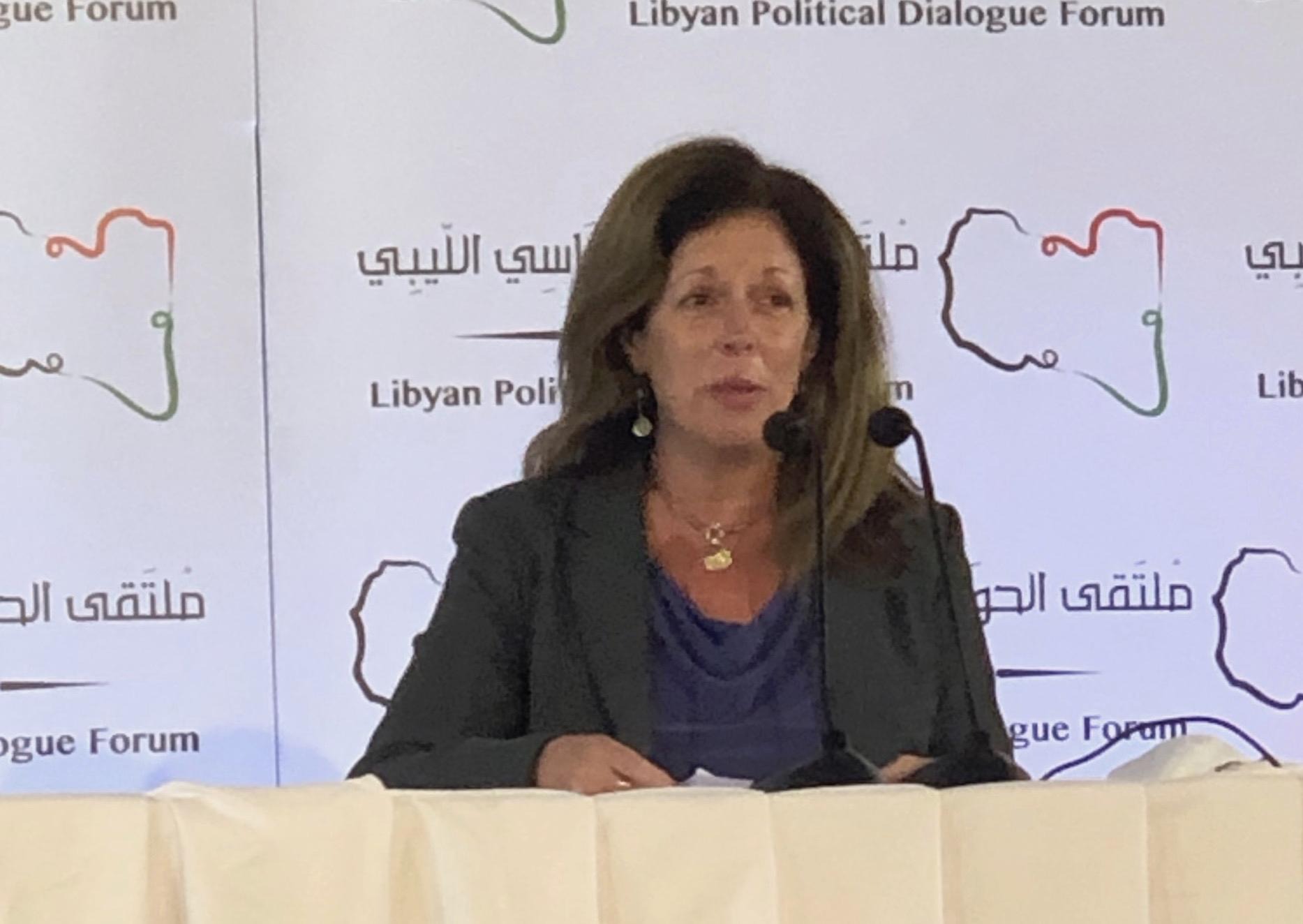
Stephanie Williams appointed UN special adviser on Libya amid international disagreement over UN role
United Nations Secretary-General António Guterres has appointed former acting head of the UN Support Mission in Libya Stephanie Williams as special adviser to the UN on Libya.
The appointment of Williams, a former US diplomat, to the advisory role comes after Russia opposed her filling the more permanent role of leading the UNSMIL, a diplomatic source told Mada Masr on condition of anonymity.
Ghassan Salamé, who stepped down from heading the UNSMIL in March 2020, congratulated Williams on the new appointment on Monday night.
Williams’ return to the fold in the UN’s Libya offices comes as mounting friction over the legitimacy of the elections, organized under a UNSMIL-designed framework, threatens to derail the scheduled opening of the ballot due in just over two weeks.
After Salame resigned from his post “for health reasons” and due to frustration with increasing foreign interference in Libya, Williams was appointed acting head until mid-February.
The role was then taken on by Jan Kubis, who resigned suddenly in late November and will leave his post on December 10. A successor is expected to be appointed early next year to fill the post.
Guterres wishes to enlist the help of Williams, a former US diplomat, in the UN-facilitated negotiation process between the local parties in Libya, the source told Mada Masr before Williams’ appointment was made public.
Russia has asked Guterres to provide a legal clarification regarding Williams' new position and the limits of her expected role in the Libyan situation, according to the diplomatic source. Moscow is concerned, the source said, about the impact of this appointment on the performance of the incoming head of the UN support mission, who is yet to be named.
Disagreement between the major powers on the Security Council over Libya and the role of the UN mission there may have led Guterres to attempt to bypass the difficult choice of naming a new head of the mission in Libya by appointing Williams to the advisory role, the source said.
Williams' appointment comes at a time when the electoral process in Libya faces procedural and technical obstacles that may prevent it from being held on schedule. The legal framework regulating elections to both the presidency and parliament has proved divisive in the political and legislative arenas, and the elections commission has not met key steps in the timetable laid out for the different stages of the electoral process.
The UN mission’s mandate in Libya is scheduled to come to an end in weeks on January 30, 2022. It was due to end sooner, though the Security Council extended the term and restructured the mission in September.
Foreign Policy quoted diplomats on Wednesday saying that Russia prevented the appointment of British diplomat Nicholas Kay to head the UNSMIL, as Moscow protests an increase in the number of Britons appointed to influential positions in the UN, standing in the way of many UN sanctions experts having their terms of service extended.
The US magazine indicated that the British-Russian dispute over the appointment of the new UN official to Libya also comes less than a week after the sudden resignation of Kubis from his post, following a clash with Guterres over the UN’s handling of Libya’s pre-election preparations.
Obstacles looming before the UN-proscribed due date for elections have multiplied.
Over 70 Libyan MPs demanded on Sunday that the head of the election commission, Imad al-Sayeh, and the head of the Supreme Judicial Council, Mohamed al-Hafi, be held accountable for “failures and violations of the laws and the electoral process.”
The MPs called on the commission to postpone the announcement of the final electoral lists until after the accountability session, the date of which has not yet been determined.
Sayeh headed to Tobruk on Monday to meet with Parliament Speaker Aguila Saleh — who has been criticized for seeking to run for president in violation of the law.
The presidential council, meanwhile, has frequently expressed its readiness to intervene in order to resolve the controversy around the legal framework for the elections. Its head, Mohamed Manfi, told Reuters in September that it was imperative for controversial candidates and figures to be distanced from the elections in order to achieve consensus. However, candidates such as Saif al-Islam al-Gaddafi, a son of former ousted President Muammar Ghaddafi, Field Marshal Khalifa Haftar, and current Prime Minister Abdul Hamid Dbaiba have all put their names down for the presidential role, with courts processing the legitimacy of their bids in recent weeks.
Days earlier, the National Unity Government’s Interior Minister Major General Khaled Mazen flagged attempts to undermine the ministry's plan to secure the elections, after an increase in the number of security breaches in several regions. Mazen said during a joint press conference with the justice minister on November 30 that “the situation is no longer acceptable for the electoral process to be conducted normally.”

تقارير ذات صلة
Après le déluge, the Haftars
It is the evening of September 10, and rain has been falling on the city of Derna in northeastern Libya all day. But this isn’t normal rain. This is the…
Turkish backing for emboldened Dbaiba prompts Egypt protest at Arab League meeting
Cairo and Ankara discussed the pursuit of an alternative government after recent clashes in Tripoli
Backdoor deals leave Haftar as Libya’s kingmaker in new Bashagha government
In the seventh go-around to form a unified Libyan government since the 2011 revolution, 92 House of Representatives members voted on Tuesday to grant confidence to the Cabinet of Prime…
Your support is the only way to ensure independent, progressive journalism survives.
You have a right to access accurate information, be stimulated by innovative and nuanced reporting, and be moved by compelling storytelling. Subscribe now to become part of the growing community of members who help us maintain our editorial independence.
Join us