
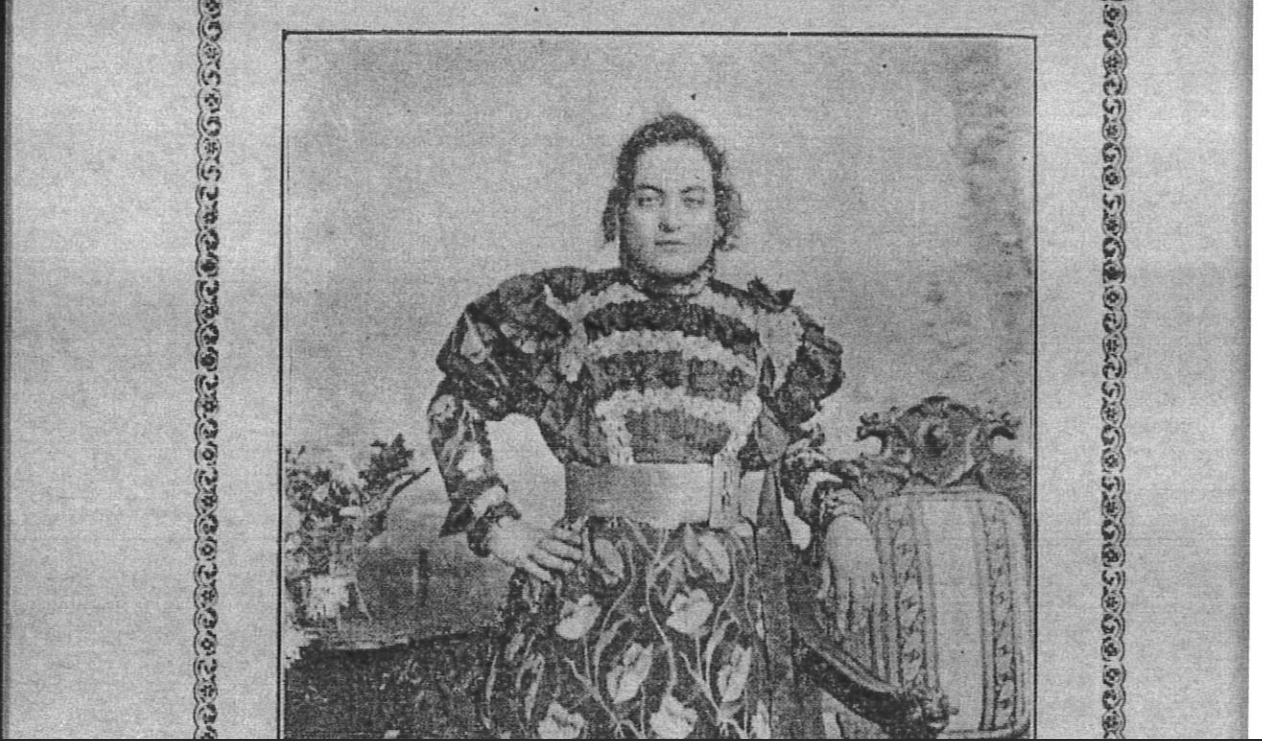
Shafiqa al-Qibtiyya: The Blueprint for Egyptian Celebrity
This article is an adapted extract from Midnight in Cairo: The Female Stars of Egypt’s Roaring ‘20s by Raphael Cormack, published by Saqi Books in May 2021 and now published in Egypt by the American University in Cairo Press. You can read our earlier conversation with Cormack about the process of writing the book, historical storytelling and more here.

The 1920s in Cairo was the age of the female celebrity, from Mounira al-Mahdiyya to Oum Kalthoum, Fatima Rushdy to Badia Masabni, women filled the newspapers, magazines, and billboards of the city. But before all these women, there was an earlier model: Shafiqa al-Qibtiyya. To tell her story we must go back to the music hall stages of Ezbekiyya in the 1890s. In the late 19th century, this area of downtown Cairo teemed with different venues including the Old Eldorado, the Thousand and One Nights, the Alcazar Parisien and the Café Égyptien, which had an all-female band of musicians brought in from Europe.
These music halls stayed open much later at night than the theatres did. Each night would include a succession of different singers and dancers, who mixed with the audience after their shows. The performers were paid according to how many drinks they could get the clients to buy, whether beer, cognac or champagne, so the levels of drunkenness in the clubs were very high. The debauchery on display here soon ignited the ire of Cairo’s respectable bourgeoisie but attracted pleasure seekers from across the city.
Like the 1920s, this period had many stars of its own but Shafiqa was, without question, the queen of the music hall stages. She ran her own popular nightclub, had a reputation for seducing Egypt’s upper crust, and made enough money to buy several grand houses. In the early twentieth century, she was immortalised by the singer Bahiyya al-Mahallawiyya in a parody record called Raqs Shafiqa (Shafiqa’s dance). Now an obscure collectors’ item, the record was a huge hit when it was released; at least three different versions were produced, each with subtly different lyrics and its own B-side, including one evocatively titled ‘Come on Baby, Let’s Get Drunk.’
For three minutes, the singer gently mocks Shafiqa, portraying her as a coquettish, hiccupping, flirtatious drunk. The different recorded versions of this song always begin with the same scene: Shafiqa is having a conversation with a customer in her nightclub and, already noticeably intoxicated, she asks him to buy her another drink before she goes onstage. In one version she asks for beer, and in another she asks for champagne and hashish. Unfortunately for her, before the waiter can bring over the order, she is thrust onstage and forced to start a haphazard performance, accompanied by a flute, an oud and the clapping of hands. Feeling the effects of the smoking and drinking, she interrupts her singing and dancing with frequent giggles and apologies of, ‘Pardon me, I’m drunk,’ or ‘I can’t!’
Shafiqa al-Qibtiyya’s life, often shrouded in myth and subject to later embellishment, is a blueprint for the careers of women who came after her. In part this is because she has, in recent decades, become an archetype, partially divorced from reality. Her case is strange, because unlike the women of the 1920s, she only really gained a modern celebrity status after her death. Thanks to a steadily accumulated series of fables, which culminated in the 1963 eponymous film Shafiqa al-Qibtiyya, her name is now a byword for the glamorous decadence of late-nineteenth-century Cairo’s nightlife. It was this film, above all, that turned Shafiqa into something of a myth, making her a magnet for stories of enormous talent coupled with extreme personal flamboyance and rendering the task of prising apart the fact and fiction of her life almost impossible.
Her own side of her story has not survived but there is enough material to build a rough picture of the historical woman. She was born, it is usually said, in 1851 to a Christian family in Cairo. According to one article published in the Egyptian press in the mid-twentieth century, her big break came in 1871. A dancer called Shawq had come to perform at a wedding that Shafiqa was attending in the neighbourhood. Shawq was performing for the women, who were gathered together in a different place from the men — as was usual for weddings of that time — and everyone started to dance. Shafiqa showed off some of her own moves, and Shawq was so impressed with the girl’s natural talent that she offered to train her to become a professional dancer. Shafiqa’s worried mother, who was very religious, overheard this proposal and immediately forbade any more talk of dancing. The family could not countenance her entering this shameful profession.
Shafiqa would not be dissuaded so easily. She started to take secret dance classes with Shawq on Sundays, telling her parents she was going to pray at the local church. One day, after showing progress in her lessons, she decided that she wanted to work as a dancer full time. To do this, she knew, would mean running away from home. She fled to the Mediterranean coast and started performing at moulids there. After this brief apprenticeship in the countryside, she moved back to join Shawq’s troupe in Cairo, where they performed together at weddings and private parties. Her distraught parents were still trying to bring her back home. They sent a priest to talk with her; he begged Shafiqa to come back and give up this immoral life, but she refused. She had been dancing with Shawq for only six months when her teacher and mentor died. Shafiqa was now forced to make it alone, so she headed for the dance halls of Ezbekiyya, where she became a star.
A completely different story also circulates about her first forays into the dance world. She was married, it is said, to a ticket inspector on the Egyptian railways. The man was a lazy drunk and spent a lot of time boozing at home with his friends. When he saw that Shafiqa could dance, he first made her perform for his friends and then, eventually, forced her to work in Cairo’s cabarets to earn money and support his destructive lifestyle.
The truth may be something entirely different. If Shafiqa’s early life remains a little obscure, more detailed stories about her began to proliferate once she reached the dance halls clustered around Ezbekiyya Gardens. Known for her skill and innovative choreography, she was credited with inventing two different dances. The first, the ‘candlestick dance’, involved dancing with a large candelabrum balanced on her head. The second required her to balance several full glasses of liquid on her stomach, while lying backwards and making them rattle against each other. In some accounts, these two dances are combined into one gravity-defying performance in which the performer had to balance the candelabrum on her head and the glasses on her belly at the same time.
Her show attracted the Egyptian elite of wealthy landowners and politicians, who showered her with money and gifts. Many of the tales about Shafiqa involve different creative uses of champagne. Her wealthy admirers washed her feet with the drink. One man was said to be so infatuated with her that he gave it to her horses. Pictures of nightclubs at the time show tables piled high with bottles of it. Her reputation for lavish spending was as famous as her colourful lifestyle. She dressed in clothes threaded with gold, wore diamond-encrusted, golden-soled shoes, and lived in a large villa just south of Ezbekiyya, not far from the royal Abdeen Palace. At a time when only nobles and the aristocracy rode around in their own private carriages, she had two made for herself — a white one pulled by white horses for the day, and a black one pulled by black horses for the night. In another apparent dig at the Egyptian upper class, who overwhelmingly relied on Sudanese and Nubian domestic labour, she hired a staff of Italians and dressed them in the finest tailored suits. She is also remembered for her wild generosity with money, especially towards Cairo’s poorer residents. If people could not afford to pay for her to dance at their wedding, she would do so for free, and give them enough money to pay for a luxurious honeymoon.
In the 1960s an Egyptian writer, Galil al-Bindari, developed a small obsession with Shafiqa, writing not only the script for the 1963 film but also a stage play and a novelisation of her life. His version of events solidified a particular image of Shafiqa in the Egyptian consciousness. Many of the tales about her have a feeling of poetic exaggeration. The tales of champagne, elegance and excess were a familiar trope across the world and could be applied to almost any performer. Some of the stories also seem to drift into the realms of metaphor. It is hard not to imagine that her fabled golden-soled shoes, for example, represented the vast wealth that was cast at her feet.
No matter which mythologised version of Shafiqa’s biography you hear, there is invariably a tragic ending. Her popularity waned in the early twentieth century, and in the final years before her death (sometime between 1926 and 1935), she lived penniless and alone. In the words of one obituary, “She died in a tiny room in Darb al-Barqi, one of the winding alleys off Clot Bey Street, poor and miserable . . . None of those who enjoyed her dancing and knew the beguiling secret of her art attended her funeral.”
But there is another way to tell the story of the dance-hall queen, Shafiqa al-Qibtiyya. It can be found, if you look hard enough, in contemporary sources about her life, before such a powerful legend had been born. In later stories she is portrayed as a unique woman, a star who rose above everyone else; but earlier reports show her as a participant in a larger world of female dancers and singers, not just as a woman on her own. This story still has many of the same features — the dancing, the late nights, the opulence — but it shows her in a different light.
These traces and echoes of Shafiqa’s life are found in some unusual places. Browsing through the catalogue of the National Library of Egypt, I found some 78 rpm records that she made with the Gramophone Company in the early twentieth century, after the pinnacle of her career. These records have not yet been added to the digital system, so it is not possible to hear them. Like most cabaret singers at the time, she sang about love or the sad loss of it.
Shafiqa’s name also turns up in a different kind of record: secret police records. She and her nightclub feature prominently in a set of covert reports that were sent to Abbas Hilmi II, the khedive in the 1890s, by a network of spies. Even at that early date, the authorities were becoming concerned about the nocturnal revels of Ezbekiyya. If people were drinking and carousing until the early hours of the morning, it was felt that the khedive ought to know the details. So, a censorious police officer called Muhammad Said Shimi set up a team to investigate. From 1894 onwards, Shimi and his team of spies compiled several years of reports for the khedive.
These communiqués give a vivid account of nights of excessive drinking, dancing and parties. Groups of men moved between bars, getting drunk and starting fights over their favourite singers and dancers. The police spy was outraged by much of what he saw. He was particularly worried about the corruption of the Egyptian upper class. A list was kept of the elite Egyptians — particularly government and army employees — who went to the dance halls, bars and gambling dens.
The reports show a world in which the normal rules of society did not apply — sometimes in a very appealing way. One thing that particularly annoyed Muhammad Shimi was the free mixing between religions that went on in these bars. He reported seeing well-educated Muslim men drinking with foreigners, Jews and Christians. He told the khedive that in these places, ‘You see a Muslim drink a glass to the health of some Christian as if the Noble Qur’an had allowed him to drink wine just like the Christian religion does.’ The Ottoman system of government gave religious minorities much freedom, safety and power; but, in the eyes of traditionalists, it also required these groups to keep largely to themselves and concern themselves with their own communal interests. Ezbekiyya, with its blurring of the old boundaries of faith and sect, was a sign of things to come. For some this was inspiring, but for others, like Muhammad Said Shimi, it was deeply worrying.
Shafiqa al-Qibtiyya herself was a repeated target of this surveillance because she ran one of the most popular dance halls in Ezbekiyya at the time. Gratifyingly, the stories about her high-ranking admirers are confirmed in these flustered reports sent back to the palace. Shimi’s lists of perceived undesirables going to Shafiqa’s cabaret included several military officers and upper-class patrons bearing the noble titles of pasha or bey. One such elite customer, Ahmed Nashaat Pasha, was reported in 1894 to have spent a large number of his nights and evenings in Shafiqa’s dance hall with a group of people described as being ‘in an immoral state of raucous drunkenness.’ He had previously held a number of government posts, including the prestigious role of director of the Daira Sanieh, which put him in charge of the khedive’s vast landholdings. After the 1890s, though, Nashaat seems to have held no significant positions — perhaps, in part, because of his fondness for Cairo’s nightlife.
These secret reports show another side to Shafiqa: not just a charismatic performer but also a savvy operator, manipulating the authorities to her own advantage. During the 1890s, as well as running a music hall, she was also conducting a love affair with Ellis Mansfield, the British assistant to the commandant of Cairo Police. He was an influential friend to have and was later promoted to commandant himself. Mansfield was said to have been besotted with Shafiqa, and she convinced him to put a number of his own men at her disposal, serving as a private mini-police force. The local spies frequently saw her walking into the Ezbekiyya police station and spending all day there. It must have been useful for the owner of a potentially suspect dance hall to walk in and out of the local police station as if she owned it.
Mansfield was not Shafiqa’s only contact within the police. The area police superintendent, Muhammad Abaza, was also a regular customer at her dance hall, and she made good use of this relationship too. The secret police reports suggest that he used to go around other dance halls (the popular Thousand and One Nights was a particular target) and arrest dancers for minor infractions, thus eliminating Shafiqa’s competition. Plagued with corruption at all levels, the Ezbekiyya police force was ripe for her exploitation. Some of the more minor officers caused a scandal in 1895 by running their own quasi-brothel, in which they held parties and provided prostitutes for the guests.
In 1900, Shafiqa’s name appeared in another unexpected place — not in Egypt this time, but in France. At the Théâtre Égyptien in the 1900 Paris Exposition Universelle, a group of dancers performed: ‘Their stomachs rolled, rocked, and turned as their bodies stayed immobile, just as eyes move in a stationary face; their stomachs whirled around liked animals in a cage.’ Among the performers was a woman called Chafika (the French spelling of Shafiqa). The ‘tireless’ dancer had, according to one observer, ‘a profound gaze’, and her contortions ‘gave you vertigo’. Reports of the show described the same dances that Shafiqa was famous for in Egypt. One newspaper printed a picture of a woman dancing with a candelabrum on her head, just as Shafiqa was said to have done. Other publications showed pictures of dancers smoking shisha pipes that were balanced on their heads. Another report was illustrated with images of that hard-to-visualise dance of the teetering glasses. A dancer named Samha was shown lying on her back, lifting her belly off the ground as she balanced four or five glasses on it. According to one observer, “the rhythm of her belly made them tremble with a harmonious jangle.”
In later stories about Shafiqa’s life, the trip to Paris took on huge importance as being the moment her act went global. But the tale, even if based on some truth, has probably gained in exaggeration with every telling. If she really was the dancer called Chafika (likely, but still only an assumption), she was there as part of a larger group of dancers and her role was not as central or influential as some have claimed.
Now, however, Shafiqa has come to represent a whole generation of Cairo’s dancers who graced the stages of Egypt’s nightclubs in the 1890s. Midnight in Cairo is focused on the stories of the women who came after Shafiqa, who dominated Ezbekiyya and Emad al-Din street in the 1920s. However, these stars did not spring out of nothing. The entertainment scene in Cairo’s roaring ‘20s owed a lot to the late 19th century and to women like Shafiqa al-Qibtiyya.
Further Reading
The novelization of Shafiqa’s life, by Galil al-Bindari, is Shafiqa al-Qibtiyya (Cairo: Author, 1962).
Muhammad Duwarah also includes a detailed entry on her life in Da‘irat Ma‘arif al-Sha‘b (People’s encyclopaedia), Vol. 3 (Cairo: Matabi‘ al-Sha‘b, 1959), 220–24.
Tawfiq al-Habib (al-Sahafi al-ʿAjuz) also wrote a short biography of her in al-Ahram 17th February 1935 p. 9, 14.
Two versions of Raqs Shafiqa are available here (from 3:16) and here. There is another version in Dar al-Kutub’s record collection, which has been digitised and can be heard on site.
For more on the 1890s in general, see the work of the AMAR foundation and also Frédéric Lagrange.
تقارير ذات صلة
Reading turath in Ahmed Sadiq Saad’s texts
Tanmiya and turath: a dehistoricized tradition is the effect and pivot of a dehistoricized present
Q & A with Elise Burton: On genetics and nationalist projects
Genetic data collected from individuals only becomes meaningful in relation to the data of others.
Forever is now, on the art of Art D’Égypte
A new contemporary art scene dominated by public and private stakeholders is emerging
Your support is the only way to ensure independent, progressive journalism survives.
You have a right to access accurate information, be stimulated by innovative and nuanced reporting, and be moved by compelling storytelling. Subscribe now to become part of the growing community of members who help us maintain our editorial independence.
Join us