
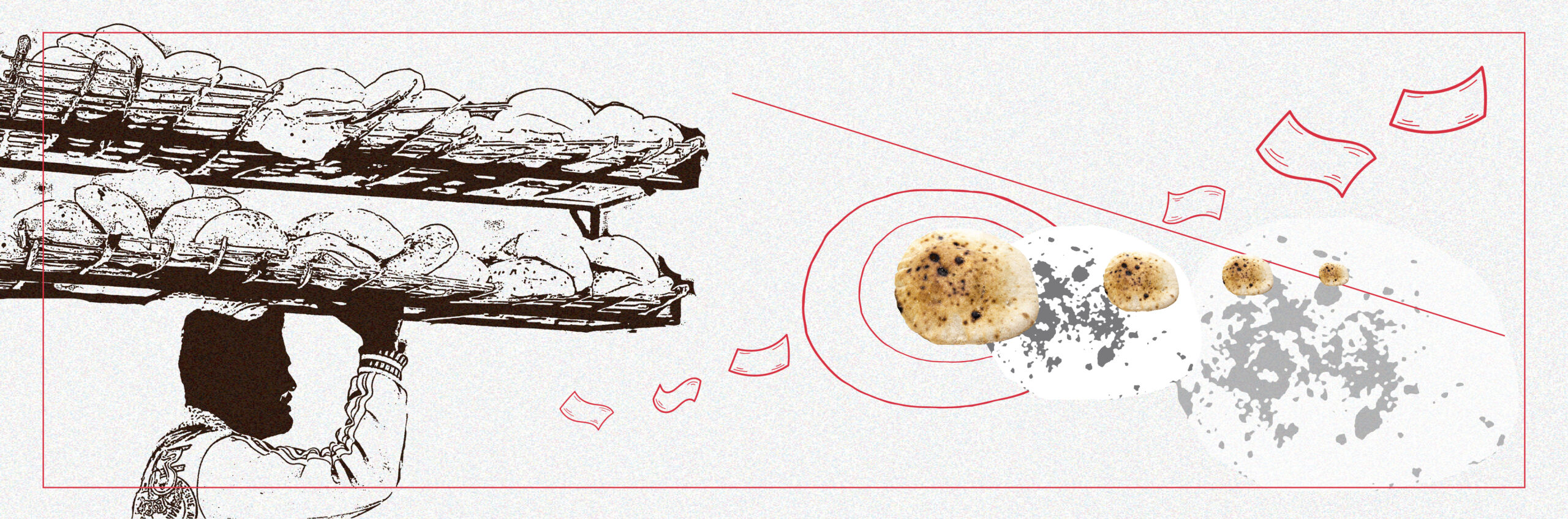
Seven years of tinkering with the subsidy system
President Abdel Fattah al-Sisi’s recently announced plans to reduce bread subsidies could provoke an outcry when implemented from the more than two-thirds of Egyptians who rely on the program. At the same time, the change may not come as a surprise given the changes to the bread subsidy system that have been implemented over the past several years.
The planned increase in subsidized bread prices — which have stood at 5 piasters per loaf for decades — represents only one part of a larger series of transformations that the food subsidy system has been undergoing since 2014. Over the past several years, the government has gradually moved away from a commodity subsidization system towards a cash support system. At the same time, the total amount of subsidies allocated for food, which includes bread and food rations, has been reduced as an expenditure in the state budget. A hike in subsidized bread prices would further consolidate these trends.
The transformation can be traced back to 2014, when what was once a strict commodity subsidization system was replaced by a “cash support system based on food stamps and ration cards,” according to Sherine al-Shawarby, an economics professor at Cairo University and the former deputy minister for economic justice at the Finance Ministry.
The transformation to cash support excluded bread subsidies, which continued to operate under the old commodity subsidization system. Over the years , the government gradually raised the cash subsidy per person from LE15 to LE18 to LE21, and finally to LE50 in 2017. At the same time, rising production costs have doubled the cost of bread subsidization borne by the government.
The following graph shows the ratio of commodity-based subsidies (bread subsidy) to cash support (food ration system) per beneficiary in 2014 versus today:

In 2014, the food ration system provided LE15 in cash per individual per month, while the bread subsidy allowed each individual to purchase a maximum of 150 loaves of subsidized bread per month. At the time, the cost of the bread subsidy to the government — the difference between the cost of production and the selling price — stood at 30 piasters per loaf, or LE45 per individual per month.
Currently, cash support stands at LE50 per individual per month, while the cost of the bread subsidy rose to 60 piasters per loaf, or LE90 per for 150 loaves per individual per month,
Once Sisi officially issues the decision to increase bread prices by a determined amount, the cost to the government will be less than 60 piasters per loaf, which also means that the ratio of commodity subsidies received by citizens will decrease in relation to cash support.
The calculated ratio between cash support and the commodity subsidy assumes that an individual will purchase their full monthly quota without exchanging any of it for what are known as “bread points.” However, if an individual decides to exchange any number of loaves for bread points, that would amount to a decrease in the ratio of the commodity subsidy received by the individual in relation to cash support. And the government is working to incentivize this practice.
The bread points system is one of the key factors in transforming the commodity-based subsidy system to a cash support system. First introduced in 2014 as part of a set of changes to food subsidies, the bread points system allows people to forgo a subsidized bread loaf in exchange for 10 piasters to be added to their cash support credit, which can be used to buy other subsidized food commodities.
The new system allows beneficiaries a degree of freedom to choose between the different food commodities they need by exchanging subsidized bread for credit —but not vice versa.
To further incentivize people to exchange their bread subsidies, the government allows them to buy subsidized goods at a cheaper price if they use bread points than if they use their regular ration cards.
Mai, a woman in her twenties with a husband and baby daughter, and a total family income of around LE2,000 per month, told Mada Masr that her family consumes very little of the government’s subsidized bread, which she considers to be of “poor” quality, so that they can save up points to buy ghee at a cheaper price.
Shawarby believes the state is more willing to increase its spending on cash support programs and cut down on commodity subsidies because the latter requires the state to provide specific goods — many of which are imported — that can fluctuate in cost. Meanwhile, the cash support system allows the government “a degree of prediction about its expenditures and control over its subsidy spending over the next few years,” Shawarby says.
Osama Diab, a researcher on development and economic rights, says the Egyptian state’s stance on food rations versus bread subsidies is primarily ideological. “Cash support, as opposed to commodity subsidies, has always been preferred by neoliberalism as a mode of subsidization, and the IMF has always stressed the importance of switching to a cash support-oriented system.”
According to the neoliberal viewpoint, cash support is capable of revitalizing the market by providing more liquidity, which is more likely to boost consumption, Diab says. “This is obvious with the current subsidy system, which promotes sales in the private sector, whose commodities are extensively prevalent among the subsidized goods being offered now.”
The new system is one whereby subsidy beneficiaries are, for the first time, turned into market consumers who make choices according to their needs and preferences, claims a 2017 World Bank report co-authored by Shawarby and Mostafa Abdallah, a health consultant at the World Bank.
Apart from the move to greater cash support, the bread subsidy system also underwent a number of other changes over the past several years with the goal of reducing its overall cost. One of the most significant changes was a 2014 decision to limit the maximum share of bread to 5 loaves per day per individual. Previously there was no limit on the number of subsidized loaves an individual could buy.
“The decision was based on a previous study that argued that the average individual consumption of subsidized bread is just 3.7 loaves [per day],” Shawarby says. “Khaled Hanafy, [the then-supply minister], saw that limiting the individual’s entitlement to five loaves allowed an additional margin for bread subsidy recipients to convert some into bread points.”
Yet Shabrawi says that using average subsidized bread consumption to cap the number of subsidized loaves was a mistake. “In reality, relying on the average subsidized bread consumption in Egypt was entirely unfair,” she says. “This number combines relatively well-to-do households that consume little or very little bread to begin with, and low-income families that consume way more bread. Saying that the general average is representative of poor families translates, in practice, to reducing the subsidized bread consumption of those families.”
The study of the consumption of subsidized bread by Egyptians was also conducted at a time when a subsidized loaf weighed 130 grams, meaning an average individual consumption of 481 grams per day. Yet the government has gradually reduced the weight of one loaf over the years, until it reached 90 grams in 2020, meaning that the maximum limit of 5 loaves now equals just 450 grams. In other words, the maximum number of subsidized bread loaves allowed per individual is less than the average consumption calculated at the time of the study.
Furthermore, the bread points system had not yet been launched when the study was conducted, and there was no option to exchange subsidized bread for more food ration credit.
The following graph shows the decrease in the weight of subsidized bread from 2014 to 2020:

Despite the size of a loaf decreasing by 30 percent, bread production costs nevertheless rose, primarily as a result of increased energy costs brought on by cuts to energy subsidies, which the state implemented as part of a financial reform package to secure a US$12 billion IMF loan in 2016, according to Hania Sholkamy, an anthropology professor and member of the Social Studies Research Center at the American University of Cairo.
Therefore, what may appear to be additional spending on bread subsidies is in fact a reduction in energy subsidies.
The government was also able to reduce the overall cost of food subsidies by reducing the number of beneficiaries through an eligibility vetting process announced at the end of 2016 and based on criteria set by the Supply Ministry.
The following graph traces the number of beneficiaries of subsidized bread and food items over the past few years:

In total, nearly 6 million people have been excluded from the bread subsidy program since 2017, while 6.4 million were excluded from other food subsidies. In 2019, Sisi was compelled to acknowledge the widespread effect of the cuts, saying he “understands the frustrations” of those who had been “negatively impacted.”
Heba al-Laithy, an adviser to the state statistics agency CAPMAS and supervisor of its Household Income, Expenditure and Consumption report, says that the main goal of removing millions from the subsidy rolls was to reduce the budget deficit, not achieve economic justice. “Excluding those masses, even if they were indeed ineligible, should have been followed by a redistribution of the resources that were made available after this exclusion within the same food subsidy system by, for example, allowing families to add newborns onto their food ration cards,” Laithy told Mada Masr.
Despite the massive changes in the new food subsidy system, the government nevertheless has maintained an antiquated, decades-long policy that allows authorities to suspend the addition of newborns to family ration cards until an administrative decision is passed to allow it again, which the state can take at its discretion and usually after extremely prolonged periods. Consequently, millions of people are denied access to subsidies for many years without clear justification.
While the Supply Ministry has made several announcements over the past few years that the registration of newborns was open, this did not actually result in newborns being added to the subsidy lists. “It was only a call for people to register newborns … we did not add them,” Supply Ministry spokesperson Ahmed Kamal told Mada Masr, adding that the youngest beneficiaries of food subsidies were born in 2005.
In addition to the gradual switch to cash support and the overall reduction in spending on food subsidies through austerity measures, the state has worked to reduce losses due to corruption and squandering in the food subsidy system since 2014, according to Wael Abbas, the deputy supply minister for logistical affairs.
Abbas told Mada Masr that two main factors have led to a decline in corruption and squandering: the storage of local wheat and the role of local bakeries within the system.
To tackle issues of wheat storage, which precedes the process of milling, the government carried out maintenance procedures in the silos and ended the practice of storing wheat in what are known as “dirt silos” — poorly maintained storage facilities that harbor insects and rodents and often cause about 25 percent loss in the wheat crops stored inside.
Meanwhile, the new system stipulates that flour is sold to bakeries at market price. The bakeries then sell the bread at the subsidized price and receive financial compensation from the Supply Ministry (the actual cost plus a profit margin) for the number of loaves they sell. The process is done through a system that links bakeries with the ministry through smart cards that record how much flour each baker receives.
This new system was built in the wake of an old arrangement whereby flour was distributed at a subsidized cost to bakeries, which then sold the bread to consumers at a subsidized price. That meant that bakeries’ profits were generated from the difference between the subsidized production cost and the subsidized selling price. In practice, this often led to bakeries selling the subsidized flour on the black market atat market price, netting them a much higher profit and leading to an absence of subsidized bread at many bakeries.
In other words, the Supply Ministry used to subsidize the penultimate phase in the distribution — the flour — while the new system subsidizes the final phase, thus eliminating the leakage of subsidized flour onto the black market.
تقارير ذات صلة
Bread politics
An eight-part series that takes an in-depth look at bread subsidies in Egypt
Q&A: How to save LE8 bn without raising subsidized bread prices
"This problem must be resolved within a framework of social justice"
The state and subsidized bread: Stuck between a strained budget and public anger
The government appears to be tight-lipped about any potential changes to the subsidy system for now
Your support is the only way to ensure independent, progressive journalism survives.
You have a right to access accurate information, be stimulated by innovative and nuanced reporting, and be moved by compelling storytelling. Subscribe now to become part of the growing community of members who help us maintain our editorial independence.
Join us