
Safety by any means: Egyptians in Sudan try to make their way home with or without government help
On the morning of April 15, residents of Greater Khartoum woke to the sound of gunfire and airstrikes.
Beyond the world of their beds, a war had broken out in the Sudanese capital. The writing had been on the wall in the days prior, when the Rapid Support Forces, the paramilitary group that has ascended to the top ranks of Sudanese political and security governance in the aftermath of the ouster of former President Omar al-Bashir, deployed thousands of troops to Merowe Air Base on the outskirts of Khartoum. But now, the long-simmering tension between the Sudanese Armed Forces and the RSF was out in the open, with the two sides clashing on the streets of the capital and throughout the country.
The war, which remains ongoing a month later despite several ineffective ceasefire declarations, has caused massive displacement of those living in Sudan. According to the International Organization for Migration, 1.3 million people have been displaced so far, 320,000 of whom have fled across Sudan’s borders to Egypt, Chad, Ethiopia and South Sudan.
Among those seeking safe haven in the conflict have been the thousands of Egyptian nationals, living, working or studying in Sudan. The Emigration Ministry estimated that around 10,000 Egyptians live in Sudan, including 5,000 students, whereas the Foreign Ministry said the numbers exceeded 10,000.
The official response to ensuring the safe return of Egyptian nationals was slow to roll out as the Foreign Ministry’s communications were mostly focused on updates on the 27 Egyptian soldiers who had been captured at Merowe Air Base by the RSF on the first day of fighting. The soldiers were eventually handed over to the International Committee of the Red Cross on April 20.
But on April 21, the Foreign Ministry published several telephone numbers for Egyptian nationals to contact in order to facilitate their safe return.
Another statement issued on April 23 released new contact numbers and requested that Egyptians living outside of Khartoum head to the nearest ministry-designated assembly point in preparation for evacuation. The statement set two assembly points: the Egyptian consulate in Port Sudan (around 660 km northeast of Khartoum) and the consular office in Wadi Halfa (around 800 km north of Khartoum). The ministry asked those living in Khartoum to remain in their homes until the security situation improved and the possibility of evacuation could be reassessed through coordination with the Sudanese authorities.
And from that point on, the ministry began issuing status updates on the number of those evacuated, whether by air or over land crossings, through what it called the “Evacuation Plan.”
The seamless presentation of this evacuation plan is more complicated. In recent weeks, Mada Masr has reached out to a number of those who turned to social media groups to try to find a way out of Sudan. Some were able to secure help from Egyptian officials, while others had to take matters into their own hands as the official response fell prey to disarray and mismanagement.
*
Shortly after the ministry published its first hotline, Omar Abdel Hady, an Egyptian third-year dentistry student studying in Khartoum, tried to get in touch with the Egyptian diplomatic mission in Sudan through the numbers provided by the Foreign Ministry on its Facebook page. However, the hotline did not work.
But when the ministry updated the contact information for the Wadi Halfa diplomatic mission, Abdel Hady finally got through. But the phone call provided him with little help beyond what he already knew. “We are located in Wadi Halfa. You can come to us and we can facilitate your exit through the border,” a Foreign Ministry employee told him. This would mean that he and his friends would have to travel 800 km through airstrikes and conflict zones to get to the Qastal crossing. They all refused.
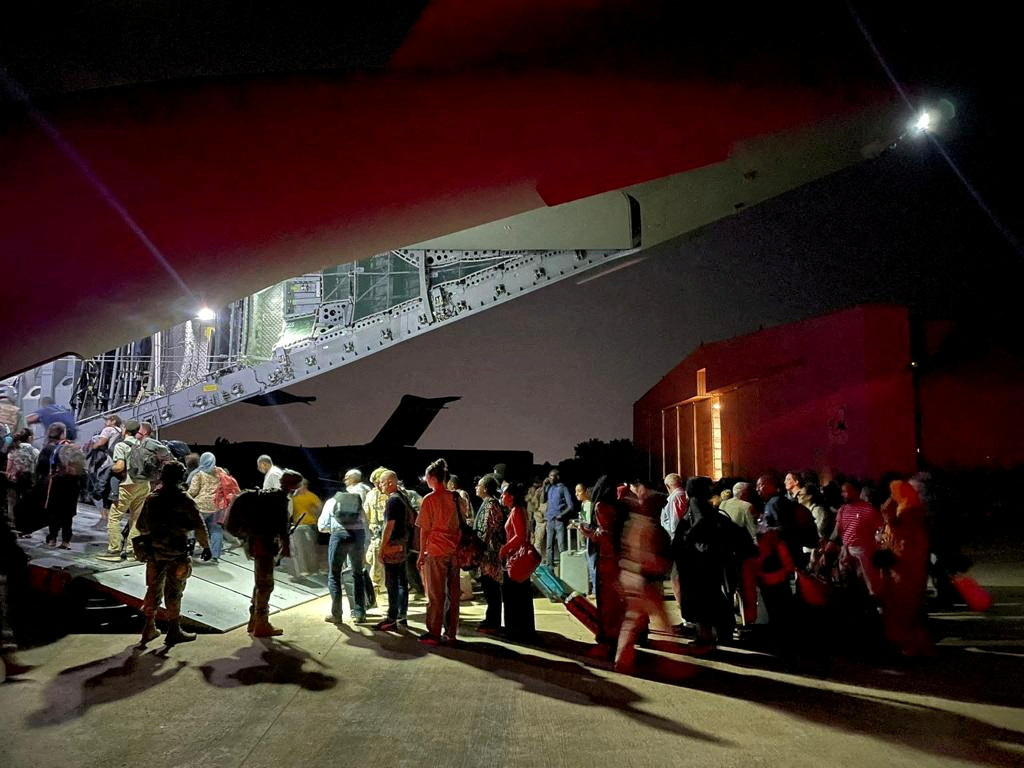
Abdel Hady and his friends prepared to remain in Khartoum. But a day later, on April 24, he saw the ministry statement noting the assembly points the government would use to evacuate its citizens. One of these points was the Wadi Seidna Air Base, around 45 km away from Khartoum. Abdel Hady and his friends did not wait long before making the decision to move toward Wadi Seidna. They found transportation in the form of a pickup truck.
“We were in the back of a pick-up truck, and we went around other neighborhoods in Khartoum to pick up other Egyptians,” Abdel Hady tells Mada Masr.
They made it to the base at noon and joined others who had gathered to wait for evacuation. But the wait wasn’t easy, as they were sitting in an exposed area under the hot April sun. The first two days of waiting were manageable as Abdelhady and his friends had food and water with them. But on the third day, their provision ran out.
With the sun beating down, some people began to feint.
Relief came on the evening of April 27, when a plane carrying food supplies for those waiting to be evacuated arrived at the base. Meals were handed out to everyone.
This same plane would eventually take Abdel Hady and his friend back to Egypt.
Shortly after the dentistry student and his friends left, Egypt halted evacuations from Wadi Seidna due to “security issues.” The ministry specified assembly and evacuation points in the Egyptian consulate in Port Sudan, the Qastal and Arqeen border crossings and those remaining at the air base were forced to make their way there of their own accord.
*
Hala Mohamed, a young Egyptian woman, arrived in Sudan on April 10 to visit her friend in what was supposed to be a leisurely visit in the upscale Kafouri neighborhood in Khartoum. But the visit turned into a nightmare when the war broke out, given that Kafouri is located close to the presidential palace, a key site in clashes between the RSF and the Sudanese Armed Forces. Mohamed and her friend’s family expected the clashes to be over soon, but when they saw the dead in the streets and the rising casualties, they knew that “this was serious and would last a while.”
Electricity, water and internet were gradually cut off from the area due to the power station being hit by shelling. In order to conserve their phone batteries, Hala and her friend’s family kept their phones off, only turning them on every five minutes to check the internet for updates. As for water, they tried to ration, only eating off disposable plates, but despite their efforts, water ran out on the fifth day.
They tried to get water from the nearby supermarket, but they could only find two bottles. The owner said that “people took everything.”
Fearing for their lives, they began sleeping underneath their beds in the rooms farther away from the street out of a belief that they would be safer from the shrapnel and bullets. This sense of safety dissipated when the anti-aircraft missiles arrived. “We would see them go up like red dots in the sky, then they would fall on houses all around us,” Mohamed told Mada Masr.
Mohamed and her Sudanese friend’s family decided to try to escape the conflict zone and the deteriorating conditions. They took their car and set out on the road.
Mohamed tells Mada Masr that the car as the car made its way away from the presidential palace, they passed through five RSF checkpoints. Her Sudanese friend suggested she cover her face in a style common among Sudanese women, as Mohamed’s friend feared that the RSF would target her if they knew she was Egyptian, given there were rumors going around they were targeting Egyptians.
When they made it to the transport hub, they found that all the buses were at full capacity and the only method of transportation was pickup trucks. Mohamed and her friend’s family found the cramped quarters in the trucks to be too risky with their children, so they decided to finish the trip in their own car.
They set out on the road and made it to Shendi, around 300 km away. They stayed there for three days looking for gasoline, but they decided not to buy it from the black market given the high prices. A gallon of gasoline had reached 10,000 Sudanese pounds, meaning that the 5 gallons they would need for the trip would cost about 50,000 Sudanese pounds(around US$83). They came to regret this decision when they made it to Atbara where they stayed another three days, unable to find gas. But in Atbara the price of five gallons of gas had doubled. An Egyptian man living in Atbara pointed them to a bus stop where they were able to get three tickets on a bus to Port Sudan. On the bus, Mohamed met dozens of Egyptian students who were also fleeing the conflict.
Mohamed and her friend’s family stayed another three days in Port Sudan inside a house under construction in the city. As she browsed Facebook groups made to coordinate Egyptian efforts to seek help in Sudan, she saw a comment a woman made claiming her husband was evacuated by air from Port Sudan airport. Mohamed reached out to the Egyptian consulate with her passport and information. She was asked to come back the next day at 9 am, which she did. After reviewing her details, she was told she would be returned to Cairo on a plane that was to arrive at 1 pm, and they moved her to the airport with other Egyptians.
Mohamed said that consulate staff was cooperative with Egyptians trying to leave. They facilitated the paperwork even for those whose passports had expired and issued them a document allowing them to get on the plane. At 1 pm, Hala got on the plane with 139 other Egyptians.
*
However, air evacuation was not available to everyone.
Hussein al-Sheikh, a young man working in construction who had arrived in Sudan three months prior to the conflict’s start, contacted the Foreign Ministry more than once around the Eid al-Fitr period. The ministry’s response was that it would be difficult to extract him and that he would have to wait. The Egyptian Embassy in Khartoum told him that all he could do was conserve some water and food items but that coordinating his return to Egypt was currently untenable and asked him to wait several days.
Therefore, Sheikh decided to travel back to Egypt via the land crossing, realizing that his safety was in his hands alone. Through the airstrikes and the conflict, Sheikh and 50 other Egyptians, most of them women who had been students in Khartoum, made their way toward the border in a bus that was barely moving because of the heavy cargo of bags and gasoline it was carrying. It was also leaning to one side, which they later found out was the result of it toppling over on a previous trip days ago to the Egyptian border.
Sheikh tells Mada Masr that the students — those who had been there the longest and had the most experience — had taken the lead in coordinating with the Sudanese transport company to secure the bus that took them on the nearly 1,000 km journey from Khartoum to the Arqeen crossing on the southern Egyptian border.
The students negotiated a price of 110,000 Sudanese pounds($183) with the transport company. Sheikh pointed out that the price of the trip normally would have cost 23,000 Sudanese pounds ($38) and said that other Egyptians who later crossed the same way had to pay 350,000 Sudanese pounds($583)because it was the only way out from Khartoum to Egypt.
The bus moved left the Maamoura neighborhood of Khartoum and moved toward Omdurman at 10 am on April 22. Because the RSF had closed many of the roads, they had to take an indirect 50 km route to get to the Kandahar area at around 1 pm. There, the driver decided to change the agreement and raise the price to 120,000 Sudanese pounds($200). Most students did not have the difference so they collected all the money they had to pay the difference and still found it would not be enough. After arguments and pleas that lasted several hours, they convinced the driver to complete the trip on the condition they pay the rest after crossing into Egypt.
At 5 pm, they moved from Kandahar, but the trip did not go smoothly. The bus broke down 40 km into a desolate mountainous area. Six hours later, they fixed the problem and started to move again. Their only sustenance throughout the trip was dates and water. They could no longer communicate with their families after their phones’ batteries ran out. They could not sleep for more than a few minutes at a time. And inside the bus, the children of two families who were with them would not stop crying.
They made it to Arqeen on April 23 at 6 pm. They turned in their passports and waited in line until 5 am the next day them due the significant crowding at the border.
*
While there were those who were able to secure help from the government and those who were able to take matters into their own hands, there were plenty of Egyptians who remained stuck in the fighting.
On Saturday, April 15, Sayed Abdel Fattah, an Egyptian medical student in Khartoum, and six other Egyptians in an apartment in the Amarat neighborhood awoke to the sounds of gunfire and artillery units on the street below. When he looked out the window, he saw an SUV and an armored vehicle carrying dozens of RSF members just below his building. The situation escalated shortly afterward when the Sudanese Air Force began targeting the RSF units near his building. Abdel Fattah told Mada Masr that the heavy shelling took down the walls of his apartment.
With the conflict outside blocking the ability to leave the house, a food crisis started brewing inside the apartment. Abdelfattah and another friend took the risk of going out to find food: “We saw people dead on the street,” he said. Everything was closed: bakeries and supermarkets. But he managed to find two water bottles. “We are living in a real famine. The only food we have is the remains from fava bean and tuna cans,” he said.
Feeling desperate, Abdel Fattah decided to resort to the Egyptian embassy in Khartoum, risking his life to make his way there. But when he arrived at the embassy, an official told him: “There is fighting everywhere and we can’t do anything for you.”
Abdel Fattah also said he had sent calls for help to Egyptian media websites in the form of video testimonies, but the videos were deleted shortly after they were published.
Mahmoud Khalaf, an Egyptian merchant living in the Jabra area of Khartoum, was also trapped. He told Mada Masr that he was able to secure the number of the Egyptian emigration minister and sent her a plea for help. He insisted that she had seen the messages on WhatsApp but had not responded. All his attempts to contact the embassy failed and he could not get a response.
Khalaf thought about joining a group of eight others, including three students and five trade workers, who had organized a bus to take them back to Egypt for 120,000 Sudanese pounds($200), but his attempts to reach them failed. They disappeared under mysterious circumstances and became unreachable.
Despite all this, Khalaf decided to take the risk and coordinate with a transport company to head toward the Egyptian border, but the assembly point was hit in an airstrike before the bus arrived and everyone ran.
Since then, all his attempts to return to Egypt have failed due to the intensity of the fighting in Jabra where he resides. Khalaf told Mada Masr: “I’m in Jabra, if there was a bus that could come and take me even if I die on the road, I would do it. We can’t even leave the house.”
تقارير ذات صلة

The return to Sudan: Redrawing politics from square one
After more than a year and a half in Cairo, Um Mohamed is back to her home in Khartoum. But like many of the hundreds of thousands who have heeded…

The Quad War
After the fall of Fasher, Egypt turned to Turkey to find a way to deter the growing Emirati threat
‘Unable to erase the sight of the dead from our minds’: Scenes from Fasher’s fall
Survivors of the RSF's massacres in Fasher recount the harrowing scenes of the city's capture.
Your support is the only way to ensure independent, progressive journalism survives.
You have a right to access accurate information, be stimulated by innovative and nuanced reporting, and be moved by compelling storytelling. Subscribe now to become part of the growing community of members who help us maintain our editorial independence.
Join us