
Right Where the Soul Breaks: The story of unlived dreams
When Nehad Selaiha attends a play, it’s quite the event for an entire cast and crew. She arrives on time, sits in the first row and quietly leaves right after the performance. Despite her apparently peaceful appearances, she’s the bogeyman of the theatrical community.
Last year the renowned critic wrote that she aims not just to analyze theatrical productions but present the political, economical and socio-political contexts that come with it.
If she turned up at Right Where the Soul Breaks, shown at Falaki Theater last week and co-organized by the US Embassy, Karna for Arts and Culture Management and teatro4m, it would probably suit her approach: It formulates a take on poverty, desperation and racism through five characters coming from a third world to a first world country, looking for a better life but somehow doing everything wrong.
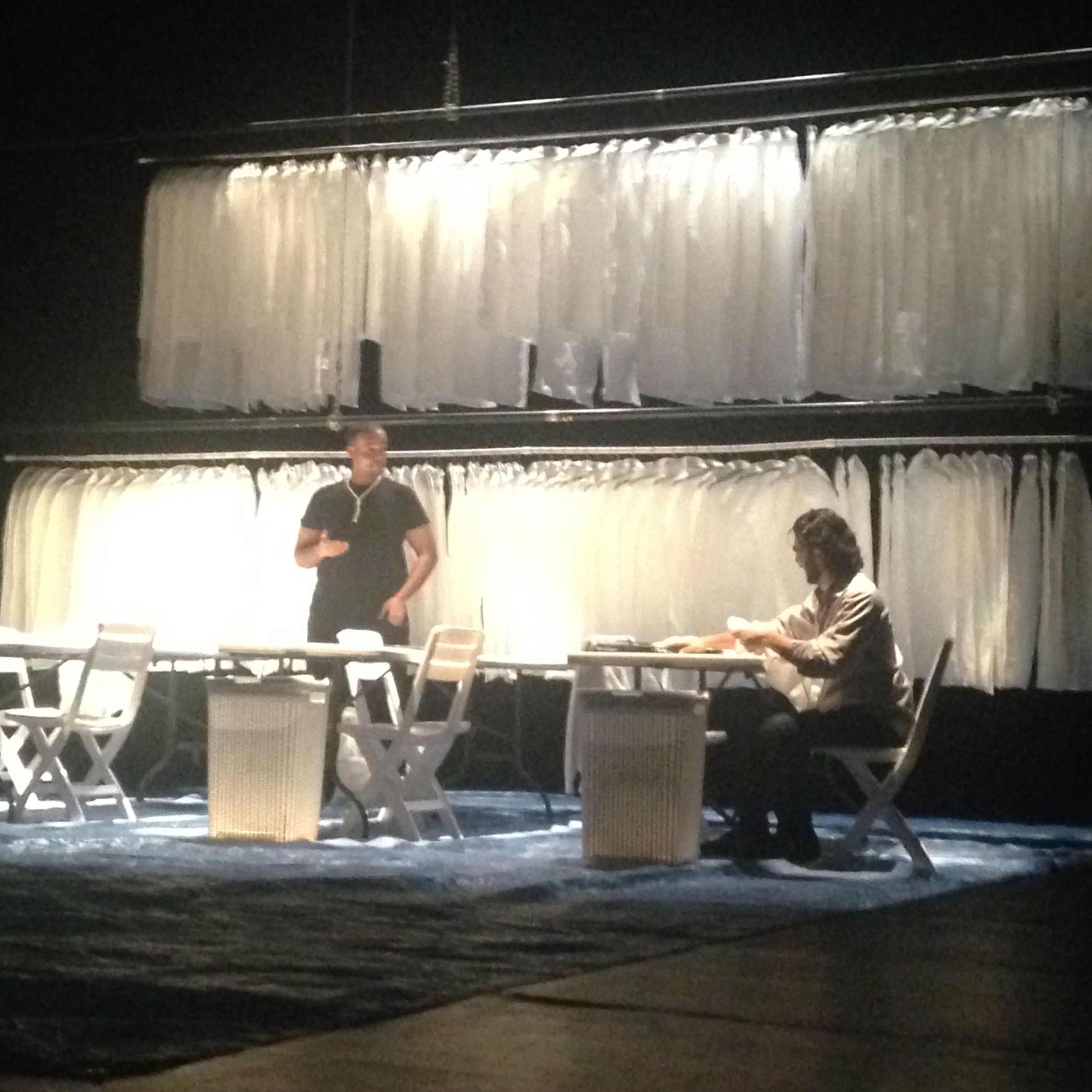
Adapted into Egyptian Arabic by Khalil and Azza Kalfat from an original English script by Cairo-based Spanish playwright Marco Magoa, who is also the director, it is the story of five Dominican Americans during a cold winter in New York. The events take place in the Museum of Modern Art, which exhibits contemporary art from around the world, a place where lots of cultures are meant to meet and merge to form a different reality.
The two-hour play is constructed as a series of five dialogues between the five characters. Through a rape survivor, a gay drug dealer, an illegal immigrant, a depressed mistress and an abuser of women, Magoa presents life with its sorrows, disappointments, dreams, nightmares, struggles, loving sentiments and hatred.
It starts in front of Henri Matisse's celebrated oil painting Dance 1 (1909), an exuberant childlike work that emits freedom and happiness, depicting five naked women dancing in a circle. Like the painting, the play suggests a world of fantasy where things, events and people could be true or fictional; a world where Altagracia, Juana, Aurelio, Ramon and Julio Cesar may really exist, as Dominicans residing in New York, Egyptians living in Milan, Moroccans in Paris, or anyone anywhere having to live simply to see a dream fade away, a mask fall, a loved one die or a happiness escape. It’s an intimate yet universal production, and the set is accordingly minimal.
Yet Khalil and Azza Kalfat, in their translation, attempt to make the script partially Egyptian by referring to street children sniffing “kolla” and getting high on hash, references which sadly fall short and seem misplaced. Perhaps the script would have made more sense, or be slightly more believable, if it were performed in its original language.
Magoa strives to create tension, and each scene reveals a disappointment, an evil deed, a crushed dream, or a wishful smile. Each dialogue ends with an awe-inspiring revelation, which sometimes fails to stir the expected emotion among the audience due to the lack of energy between actors on stage. But the play’s strongest scenes are those that are almost monologues. This reflects a technically strong performance by each actor yet signals a weak energy between them.
The recreation her rape by Juana (Dalia Kholeif) to an absolute stranger at the museum, Altagracia (Sara Salah), is a scene loaded with anger and wretchedness. Aurelio’s (Amr Gamal) confession to Ramon (Islam al-Hussiney) of his abusive nature toward women exudes anger and antipathy.
At Falaki, a dialogue between Julio Cesar (Raouf Agha) and his lover on the phone created a vibe of unrest and discomfort among male audience members, which released itself through occasional nervous and misplaced laughter.
Teatro4m, Magoa’s theater company, designed the costumes. Each reflects something about the character. Juana's posh, colorful dress with a little bow on the back speaks to her social condition, as a Dominican mistress for an American rich man who won't marry her – she’s a present that he refuses to open. Julio Cesar's vest contradicts with his profession as a drug dealer, which suggests that there is more to him, a soft desperate lover trying to conceal a weakness behind a preppy look.
According Magoa’s play, his sixth to be shown in Egypt and his ninth overall, the Museum of Modern Art, the drycleaner, New York and the entire world are the same – an interconnected circle of people and their dreams and sorrows.
On October 28 and 29, Right Where the Soul Breaks shows at The Garage at the Jesuits Cultural Center in Alexandria, at 8 pm. Entrance is free.

Amany Ali Shawky
Amany is a Lifestyle and Society Reporter with Mada. With 10 years in journalism and publishing, she has written for everything from news to culture, environment and fashion, street politics…
تقارير ذات صلة
In conversation: On 2B Continued and performing arts in Egypt
How long do we coddle for? When do we decide that the audience is ready to see something a little less direct?
Dance like a monkey, a fish and a wet zombie
I stand stiffened like the 1980s Barbie, watching others gracefully glide across the glinting black floors of Downtown Cairo’s Falaki Theater. “Don't dance,” says choreographer and artistic director Mohamed Shafik.…
The banalities of The Last Supper
The Last Supper hits home with its shrewd and darkly comedic take on all that is wrong with Egyptian society today.
Your support is the only way to ensure independent, progressive journalism survives.
You have a right to access accurate information, be stimulated by innovative and nuanced reporting, and be moved by compelling storytelling. Subscribe now to become part of the growing community of members who help us maintain our editorial independence.
Join us