
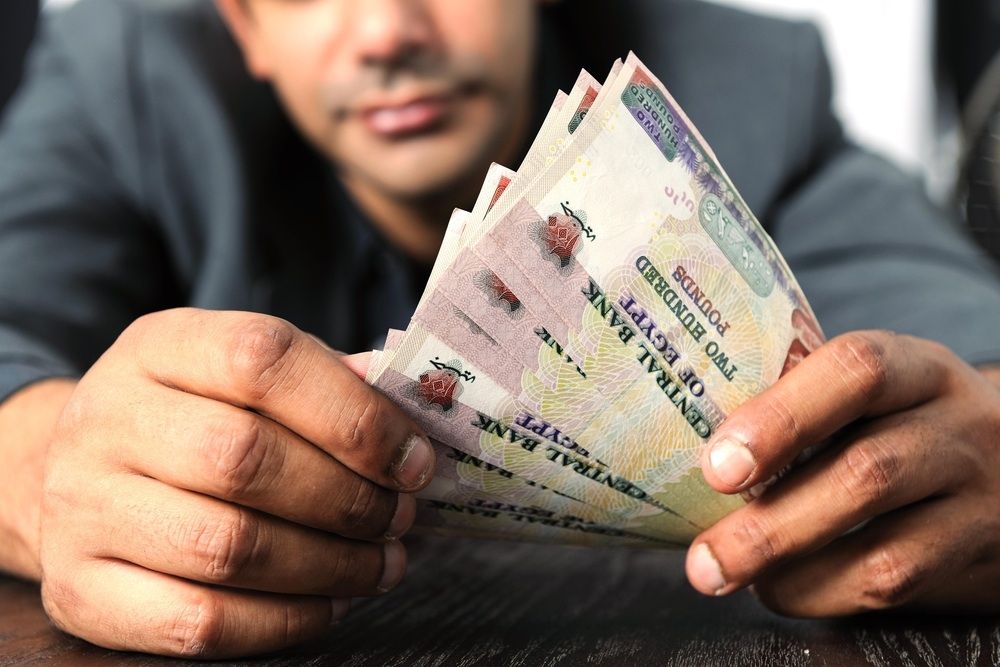
Predatory, for-profit loans dominate Egypt’s microfinancing sector
Zahya, a 50-year-old widow from Fayoum, did not think twice when she heard about microfinancing from a woman at the market where she sells vegetables grown on her 175-square-meter plot of land. She needed money for her daughter’s wedding, and her options to find surplus cash were very limited.
But sitting in the microfinancing office in Fayoum with her son, one of five children who was to act as the guarantor, there was one problem.
To qualify for the financing, Zahya had to have a “productive enterprise,” a stipulation set out by the Financial Regulatory Authority, the lending agent told her.
From her monthly harvest, Zahya took home LE400 from sales at the market. Her son, Ahmed, made about LE700 per month working at a grill in Fayoum. Her daughter, the bride-to-be, worked as a seasonal farmer, taking home a pittance in wages.
There was no productive enterprise in sight. However, this didn’t deter the lending agent.
Like many women in rural areas, Zahya raises chickens in front of her house. The lending agent recorded Zahya’s meager coup of eight chickens as a “poultry project” in the loan accreditation documents, and she was given a LE10,000 loan upon putting her fingerprint on the deed of trust. She could pay for her daughter’s marriage, but the repayment plan was steep: fixed monthly payments of LE1,185 per month for a year with 42 percent interest on the premium.
Microfinancing is a tenant of the Central Bank of Egypt’s “financial inclusion” strategy, which aims to bring more of the public into the banking sector and reduce the size of the informal economy. According to comments made by Tarek al-Khouly, the deputy governor of the central bank, at a 2017 conference for “financial inclusion,”only about 33 percent of adults in Egypt have bank accounts at financial institutions.
The government has billed microloans as a kind of magic wand: wave it once and the incomes of the poorest families will increase; wave it twice and you can have savings to weather a crisis without dipping into your regular income.
The project was initially a major success. Before the onset of the coronavirus pandemic, microloans were growing at a rate of 62 percent. That figure dropped, however, to 17 percent with the onset of the pandemic, as a wave of defaults hit the microfinancing market. Institutions refrained from offering new loans and instead focused their efforts on collecting loan installments.
A Mada Masr investigation into the microfinancing market found that women like Zahya — and according to official figures, women represent a majority of microloan recipients at 60 percent — have faced systematic predatory lending practices by agents who are incentivized to grant high-interest, high-risk loans to earn commission without ensuring a candidates’ ability to make monthly payments. In the face of the pandemic, many of these borrowers have defaulted on their microloans and faced the threat of imprisonment as a result.
Zahya was not the only one to receive a loan so easily. Mada Masr applied for a LE5,000 microloan at five companies operating in different governorates. We explained that we did not have an actual existing project, but the response of loan officers to our request was always the same. They all confirmed that we would receive the money by heading to the company’s branch with our national ID and the guarantor’s national ID along with an electricity bill as proof of residency.
The loan officers did not ask how we would pay the installments over 12 months at interest rates between 30 and 50 percent.
And no matter where they were located, the lending agents all resorted to the same tactic: a chicken coop could constitute the missing “productive enterprise” to complete the paperwork.
Nine companies, along with some 1,000 civil society associations, work in the field of microfinancing in Egypt. Combined, they have about 3.5 million customers with a microfinance portfolio of LE23 billion as of September 2019, according to the Egyptian Microfinance Federation’s website. They all work under the umbrella of the law regulating microfinancing activities issued in 2014.
According to the law, the Financial Regulatory Authority supervises and monitors the sector and sets the rules governing it to provide protections for borrowers. The authority specified in Decree 158/2014 that lending companies can only finance economic activities, not consumer purchases, that can provide an income. The authority also created an independent unit to inspect and monitor institutions.
In 2017, microfinancing was brought under the central bank’s larger LE200 billion 2015 initiative to finance small and medium-sized enterprises at an interest rate of 5 percent. The central bank’s loans were provided with on declining-balance, which sees interest calculated on the remaining balance of the principle each month rather than the total loan amount. With the expansion to microfinancing, the central bank provided microfinancing companies and associations with LE14 billion to allow them to provide loans to nearly four million borrowers.
This seems — at least, in theory — to generate activity for small-scale productive sectors by making low-interest loans to borrowers.
But in practice, the lending companies are not passing on the favorable interest rates to borrowers and most loans are supporting consumer activities rather than enterprise. Interest rates for borrowers range from 30 to 50 percent, per the loan officers at the companies Mada Masr contacted.
According to Salwa al-Antari, the former head of the research sector at National Bank of Egypt, this has to do with the multiple profit-seeking intermediaries involved in the financing process. Loans can pass down from the central bank to a loan company to a small association before reaching the borrower, Antari says. These companies don’t adhere to the central bank’s lending terms and are using the profits to cover expenses and make profits.
The central bank and Financial Regulatory Authority have been ineffective at ensuring that affordable interest rates are passed on to borrowers, Antari adds, which pushes interest rates to “insane” levels.
Hossam*, a lending agent who spoke to Mada Masr, illustrates some of the pressures on employees at microfinance companies to secure as many loans as possible. In his work as an agent at a microfinancing company in Monufiya over the last two years, Hossam’s basic salary is LE1,500, and he receives a travel allowance of LE500. That is his fixed salary. Most of his income comes from the LE200 commission he makes for each new loan. If he hits the target his company has set for each agent of 50 loans per month, he will take home LE12,000, with commission making up 85 percent of his total income. This system incentivizes agents to look for clients, offer more loans, and use abusive and violent means to collect installments despite defaults.
Hossam explains that many agents lost their income due to the coronavirus pandemic over the past year. As a loan officer’s reputation is based on how many of their clients make their payments, they are forced to take all possible measures to make sure installments are paid on time.
When discussing a potential loan, Hossam asks the borrower and the guarantor where they live to learn about their familial and social environment. He is looking for what he calls their “weak point,” a vulnerability he can exploit if they fail to pay their installments on time.
“I go to their weak point, be it the father, mother, wife or children and linger at the door saying: ‘I won’t leave without the installment,’” he says.
If he is not taken seriously, he resorts to debt collectors. They shame, defame and threaten people who fail to pay their installments, which usually leads to “paying within an hour as borrowers reach out to neighbors, relatives and former employers to collect the installment and the penalty for delay,” Hossam says.
Debt collectors who work in the way Hossam describes are in violation of the rules set by the regulatory authority, which requires that clients be notified and agree when a third party is responsible for collecting debts, and to be given the third party’s contact information. This does not happen in practice.
If threats from debt collectors do not work, unofficial relationships with police personnel come into play. Police illegally hold the delinquent borrower or the guarantor without filing an official report so that the issue does not drag out in court. Then, they negotiate not only about the delayed installment but also the remaining ones, as well as penalties for delay. In Hossam’s experience, faltering borrowers always resort to acquaintances to collect the installments to secure a release.
By April 2020, Zahya had managed to pay six installments on her microloan, relying mainly on her son’s income and some assistance from her social circle and her daughter’s job. Her commitment to paying her installments on time almost drove the loan officer to give her a new loan for an additional LE5,000, but the coronavirus pandemic put a hold on everything.
The government began taking precautionary measures to control the spread of the virus. Zahya’s son, the main financier of her installments, lost his job. Threats from the loan officer to involve the police drove her son into hiding. If the threat of jail materialized, Zahya thought, it would fall on her son, not herself, a woman in her fifties.
While Ahmed stayed with one of his sisters in a nearby village, he learned that the company — or the “bank,” as he called it — presented the receipts to the police station to arrest his mother. Ahmed hurried back and tried to collect money from relatives and neighbors. But the crisis was affecting everyone, and their contribution was not enough for the loan installment and the accumulated penalties for delays.
Zahya spent two weeks in jail amid the first wave of the pandemic. Ahmed was able to secure her release after he found someone to front the money. He and the loan officer agreed to a customary reconciliation to pay the outstanding installment, penalty and three months of installments, all of which were paid for by the person who fronted the money.
As part of the arrangement, Ahmed had to work as a tuk tuk driver for three months for the person who fronted the money to secure his mother’s release from jail.
Many women like Zahya have found themselves in similar predicaments.
Antari, who conducted a study last year about the repercussions of financial inclusion on women, says that 80 percent of women who took out a loan did so for reasons not related to enterprise. According to her study, 23 percent of women are looking to finance marriages, and 21 percent are looking to pay off debts.
Mohamed Hakim, a board member at Shabab Masr, a nonprofit in Fayoum aiming to create an economic model to promote cooperation and solidarity among marginalized youth, says that the increasingly precarious microloan market resembles the gig economy. “This might be acceptable when you lend to someone to finance their small enterprise. They can make their profit and give you your cut,” he says. But increasingly people who struggle to pay for their food, clothes and marriage costs are turning to microloans to cover the costs.
تقارير ذات صلة

New bill proposes financialization of public utilities providers
The bill raises questions about the cost for the public who will use the services.
US Congress probes Sarwa Capital IPO after Sawiris bid
The questionable IPO process of a partly US-funded company led to suspension of Beltone's IPO arm.

After the Rabea verdict: How the state’s claim for millions in damages has kept Shawkan, 214 others in prison
Those convicted in the Rabea dispersal case remain in prison in lieu of paying millions in damages
Your support is the only way to ensure independent, progressive journalism survives.
You have a right to access accurate information, be stimulated by innovative and nuanced reporting, and be moved by compelling storytelling. Subscribe now to become part of the growing community of members who help us maintain our editorial independence.
Join us