
Poetry in the face of history: Letter to an Israeli soldier
Under what conditions could a confrontation between poetry and history yield to the defeat of history? And what is it in poetry that could defeat history? Is it the simple act of bearing witness? The deep, sharp gaze? The pressing quest to embody experience? Or is it the desperate attempt at making meaning? We don’t know. All we know is that we received, read, and translated poetry as the Israeli assault on Gaza, and now in Lebanon next door, rages on.
Introduction by Esmat Elhalaby
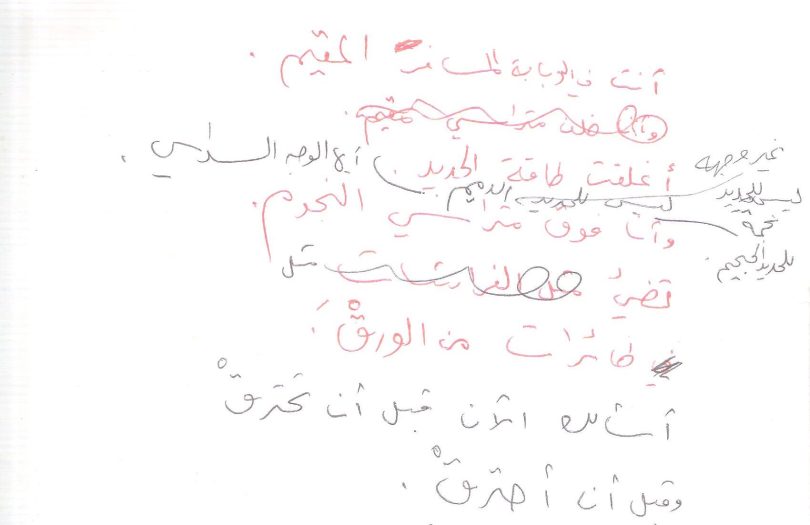
In 1982, Mahmoud Darwish and Muin Bseiso lived through Israel’s two-month siege of Beirut. They wrote this poem together. It was published in Al-Safir on July 24, 1982.
Bseiso and Darwish were close friends till the end. Bseiso died in 1984, two decades before Darwish, but Bseiso seems to have never left his side. Darwish, it is narrated, encountered Bseiso in a dream the night before his last on earth (the late Elias Khoury related this tale, which arrived to him through the Palestinian journalist Akram Hanieh).
In his obituary for Bseiso, Darwish reflected on the political force of Bseiso's poetry, his wielding of poetry as a weapon against emperors and dictators. But Darwish also affirmed Bseiso’s demand for beauty. “Bad poetry, for him,” Darwish wrote of Bseiso, “even if it assumes an advanced role, is a form of counterrevolution, as Palestine cannot forgive the offense inflicted on its beauty and justice by a bad Palestinian poem.”
In 1982, conditions of siege — tight quarters and death’s persistent knock — transformed Darwish and Bseiso’s friendship into a historic collaboration. That summer, when they sat together in a Beirut facing Israeli invasion to write a single poem, their Letter to an Israeli Soldier, they wrote a letter for us all.
“Never in the history of our poetic literature, which is close to 2000 years old, have two poets written one identical poem. So even though I know intimately the method, the style, the imagery of each, the curves of their psychology and imagination, I cannot distinguish a line by Muin from a line by Mahmoud, Muin’s verse from Mahmoud’s verse, Muin’s vision from Mahmoud's vision.” Thus wrote the great Egyptian writer, prince of the short story, the iconoclastic Yusuf Idriss.
It is fitting then that Bseiso and Darwish’s poem is translated by another Egyptian master of the short story, Ahdaf Soueif. Bseiso and Darwish’s missive to the enemy initiates a conversation between writers. First, their own unprecedented collaboration; then, it staged a conversation between Idriss and Soueif. Beirut and Cairo made one. Gaza and the world, entangled anew.
We have the above note from Idriss, for it dwells among those papers and objects in the possession of Muin Bseiso’s family, collected and preserved over a lifetime of expulsion, dislocation, and exile by activist and educator Sahba al-Barabri, Bseiso’s widow. This archive was rescued from genocide by Tawfiq Bseiso, Muin’s son, last October. Tawfiq was able to preserve the archive, carefully pack it, and heroically transport it, while Gaza City, including his own apartment building, was being mercilessly bombed through land, sea, and air by Israel. Bseiso’s archive once again survived a campaign of destruction and death supported by Palestine’s enemies in the United States, Europe, the United Nations, NATO, and the European Commission.
Soueif is an old friend of Palestine. And she was a close friend of another great Arab writer who wrote in English, Edward Said. “In Bethlehem, in Jerusalem and Nablus,” Soueif recounted at a 2003 memorial service for Said in London, “I saw that Edward’s picture had taken its place on the walls of houses, alongside those of other Palestinians, whose lives now are in the hearts and memories of their people.” Soueif first traveled to Palestine in 2000, shortly after the outbreak of the Second Intifada. She returned again in 2003. By then, Soueif could register the continuous deterioration of Palestinian everyday life under Israeli colonial rule. “Three years ago, Birzeit University was a 20-minute drive from Ramallah,” Soueif observed. “Now, on a good day, it takes over an hour to get there.”
In 2012, in the wake of an Egyptian revolution that promised a world released from the grips of Camp David, Soueif finally traveled to that corner of Palestine closest to her Egypt, the Gaza Strip. In a series of dispatches for Al-Shorouk, Soueif reported on the kinship between her people and the denizens of Gaza, reflecting on the irony and pain of their artificial separation. At Al-Quds University, in a hall that has undoubtedly been destroyed by now — if not in the last year, then in previous Israeli wars on Gaza — Soueif was struck by the tenacity of the Palestinian students assembled, who illuminated the speakers with their cell phone flashlights and kept the conversation going for four hours — only four, because the hall was needed for another event. At the Rashad Shawa Cultural Center, the largest of its kind in Gaza — now, too, rubble — the Palestine Festival of Literature, which Soueif co-founded and was the occasion for her visit, organized a concert for some 3000 attendees. Soueif's constant collaborations with Palestinians remind us that even if Bseiso and Darwish’s collaboration was profound and novel, it also testifies to how all great writing is collective, precisely because it reflects a larger formation.
Death, which now surrounds us in unprecedented numbers on a scale intended to destroy, in whole or in part, Palestinian collectivity, was Bseiso’s enemy. In his obituary for his friend in Al-Karmel, Darwish wrote that Bsesio “was haunted by another obsession: to deepen his stamp on time, to put his signature on every place. To plant a tree, to translate Gaza into as many languages as possible. To build a hut from the rain, to mold a figure from the wind. He chased away the idea of death as he would a fly… He hated mourning and despised the daily Palestinian scene on the line of death.” Against death, which has recently encompassed so many of Gaza’s writers and readers, Soueif has translated Gaza — via Beirut, through Palestine’s poets, against the impossible — for the world.
We may imagine, after Joe Hill, that when Darwish saw Bseiso in his dream that night, Bseiso said, “I never died.”

Letter to an Israeli soldier
“Beirut in Beirut
stands,
and a bird on the barricade
stands.
Beirut in Beirut
stands,
and a window on the rubble
stands.
Beirut is a woman,
storms feed at her fingers.”
We write to you
before a shell sets us or you alight;
a letter from the last besieged to the last besieger.
We write from shrapnel you’ve sent to carry you
from the darkness of the ghetto to our bodies.
We write, to ask you:
Till when will the island wage war on the sea?
Till when will you grab apples from our ribs
and jasmine from our eyes?
Till when will you swell the grave
and live in the grave?
We write to you
before a shell sets us or you alight.
We write from Beirut; a poem of a siege,
its opening lines
asking you:
who is besieging whom?
the one who settles in steel,
or the one who lives in the anthem?
We write to you
before a shell sets us or you alight,
you who are robed in drunk on armour,
you who are fortified shielded armoured, you prisoner, jailer:
are you safe?
Now,
in your tank — in your cell
behind a forest of bars,
are you safe?
The poem asks after Esther:
does she still swim
In the sea off Ashkelon?
Does she break the wave as she breaks a pomegranate,
and bear her children in safety?
You’ve ruined what you’ve ruined
and killed whom you’ve killed,
you saw what you saw,
you blew up and were blown up,
you broke and you were broken —
are you safe?
How do you see us now in Lebanon?
A sandbag?
A fistful of smoke?
Oh! You who are lost in the fables of geography and time,
lost in the maps of forgetfulness,
you child of sacrificial offerings, child of the fire and the knife,
what have you learned from remembrance,
from the ashes of your flesh ground in Auschwitz,
you who drag the grindstone behind you?
Have you taken from the fall of Jerusalem,
from your old Captivity
and your Old Testament —
nothing but the pebbles from David’s slingshot
that you mint into weapons and prophets?
You strike flesh on the anvil, beat it into medals,
you, you executioner and sacrifice,
are you safe?
Aysha is ten,
her bed is sandbags.
Sara is ten,
her window is our mother’s mirror.
Our mother’s face looks out,
and you from a tank look out
and see nothing but our blood.
In your hands a menorah,
are you safe?
Our siege is long,
the sea behind us
and you in our blood.
Our siege is long,
our bodies are trenches,
our blood is flames
and from the mouths of the guns
the Creator dismounted
and made his home in Galilee.
Our siege is long,
we will bake stones
and knead the moon
and complete the journey
on our sweet river.
Our siege is long,
the name’s in the ring
and God is in Adam
and the world will be born
from our shining wound.
Our siege is long.
How is the harvest today?
Have you had your fill of the roar of blood?
Have you killed and been satisfied?
Or have you killed and discovered?
You still have enough fuel and bombs
to set fire to the sky or a field of waves and corn
and a bouquet of scented springs.
You, you face which scares
the children’s dolls,
you face with no shadows,
face that’s become the face of a wandering killer.
You murderee in a murderer,
long are the chains
from Babel to Babel.
For how long have the mirrors been smashed
and soldiers and prisoners been carried
from Babel to Babel?
Till when will you fight?
Till when will you blow smoke in the eyes of the world?
Till when will you feel safe?
You, you hexagon face
you voice of brass
you crier on scattered roads
looking for a wilderness for us
and a grave
and a street and a hole in the air
you, you chained and welded to the tank,
have you found the grave?
And might you admit
before it’s too late, admit
that our home is there and our sea is there
and the oranges blossoming in Daleela
are there and the season of childhood
is there?
Our history is rain,
our gestures are stone,
and we’re still there,
there..
there.
Our roots see you.
Beware of teaching the children
to follow in your footsteps!
Beware the infancy of the volcano!
Beware of feeling safe!
You, resident of the tank,
can a person pee, all their lives, in a tank?
Can a person read, can they write in a tank?
Can a person fly pigeons in a tank?
Can they make love in a tank?
Plant trees in a tank?
You who arrive from the womb of a tank
And return to the womb of a tank,
how long will you stay in the claws of the tank?
How long will you be safe?
What did you write today in that new letter
to Esther so far away?
Did you say: I’ll be back soon?
The war will end soon?
There’s just one burning trench left
and a gun, and a street, and a handful of the besieged
on a pile of firewood
and we’ll finish this war that will breed another war.
This is how the wheel turns
and how hands are washed.
But how can hands be washed,
when the soap is a child’s head
and the water is sand?
How will you, after today, walk in safety?
You, you hexagon face
occupying the land,
till when will you war with time?
Till when will my corpse be a warning
that tolls like a clock on a wall?
Till when will you fear each wave that hits the shore?
Till when will you fear each flower that lights the hills?
Till when will you fear the foot of the deer?
Till when will you fear the earthquake’s bud?
Till when will we wait for you
and for the moment of our explosion
in the moment of your explosion?
Till when will this water be death between us
and bread be death between us?
Till when will we die?
Till when will you die
as though we were two faces
of one corpse, and between us the flood?
Till when will you carry the coffin on your shoulders,
You, you keeper of the coffin?
Are you safe?
Are you safe?
تقارير ذات صلة

‘The camp has grown tighter around us’: Palestinian refugees in Lebanon between war and internal restrictions
In the early hours of Thursday, March 5, an Israeli aircraft struck an apartment near the Khalil al-Rahman Mosque in the Beddawi Palestinian refugee camp in northern Lebanon. The attack…

The quiet power of Gaza’s One More Show
An intimate portrait of Gaza's only circus troupe and their resilience amid Israel's genocide
Your support is the only way to ensure independent, progressive journalism survives.
You have a right to access accurate information, be stimulated by innovative and nuanced reporting, and be moved by compelling storytelling. Subscribe now to become part of the growing community of members who help us maintain our editorial independence.
Join us