
The quiet power of Gaza’s One More Show
I anticipated both immediate tears and later disappointment. To my surprise, neither came. I didn’t cry at all during the screening of One More Show, nor did my friends. I noticed a few red, moist eyes upon leaving the theatre, but nothing like one would expect from a story like this.
The 70-minute documentary, directed by Mai Saad and Ahmed Danaf, tells the story of Free Gaza Circus, a troupe in Gaza that was scheduled to perform a series of shows in July 2024, nine months into the relentless war.
The film is one of function; an attempt to document day to day life under genocide through people’s own telling. That is all it seeks to be; it doesn’t pretend otherwise.
I’ve heard whispers of skepticism for this very reason. For some guardians of cinema and art, and I say this in the most sarcastic undertone, a film of function is automatically repulsive. But not for me. A film can be anything as long as it doesn’t pretend something that it’s not.
In her search, Saad was following the news of the circus on social media. She had long been interested in clowning. Her WhatsApp profile photo shows her with the classic red clown nose. She reached out to someone who put her in touch with Danaf. She told him what she had in mind, and he was excited.
Saad, the Cairo-based filmmaker (among other things), had been searching for an “oral history” project to document life in Gaza during genocide, “a clear testament [that] reflects what they lived through day-to-day, not merely airstrikes news [aired on] TV channels,” as she puts it.
Danaf was an ideal match. A filmmaker from Gaza, with experience in both video journalism and documentary filmmaking, having contributed to several outlets covering the war’s many fronts. His film School Day won the Youssef Chahine Award at the Cairo International Film Festival last year. Saad’s pitch to him immediately struck a chord, he says.
Saad’s WhatsApp photo even came in handy because when she reached out to Mohamed Ayman, the executive director of the circus, he replied: “Then you are one of us.”
And, just like that, they hit it off.

The circus goes back to 2018, when two friends, Youssef Khedr and Ahmed Khedr, founded it as a community troupe, later establishing the Free Gaza Circus Center in northern Gaza as a school for young performers and to grow the roots of a circus culture that was “practically non-existent,” according to their website.
The film embarks on a challenge that could have easily pushed it into a lot of traps. We have the children of the war. We have the men who inspire moments of joy, necessary moments amid the unimaginable destruction. Basically, all the ingredients of a nice recipe inhibiting actionable politics through the satiety of emotional intoxication, a classic liberal sinister trap.
This is why I was worried. There is something troubling about this genre of tragedy films. There is an urge to use the aesthetics of disaster to beautify it, because that is often the only way out for us. It is the only readily available way to find some solace in a crazy world. Run of the mill slogans are used; war cannot beat the people’s will to live.
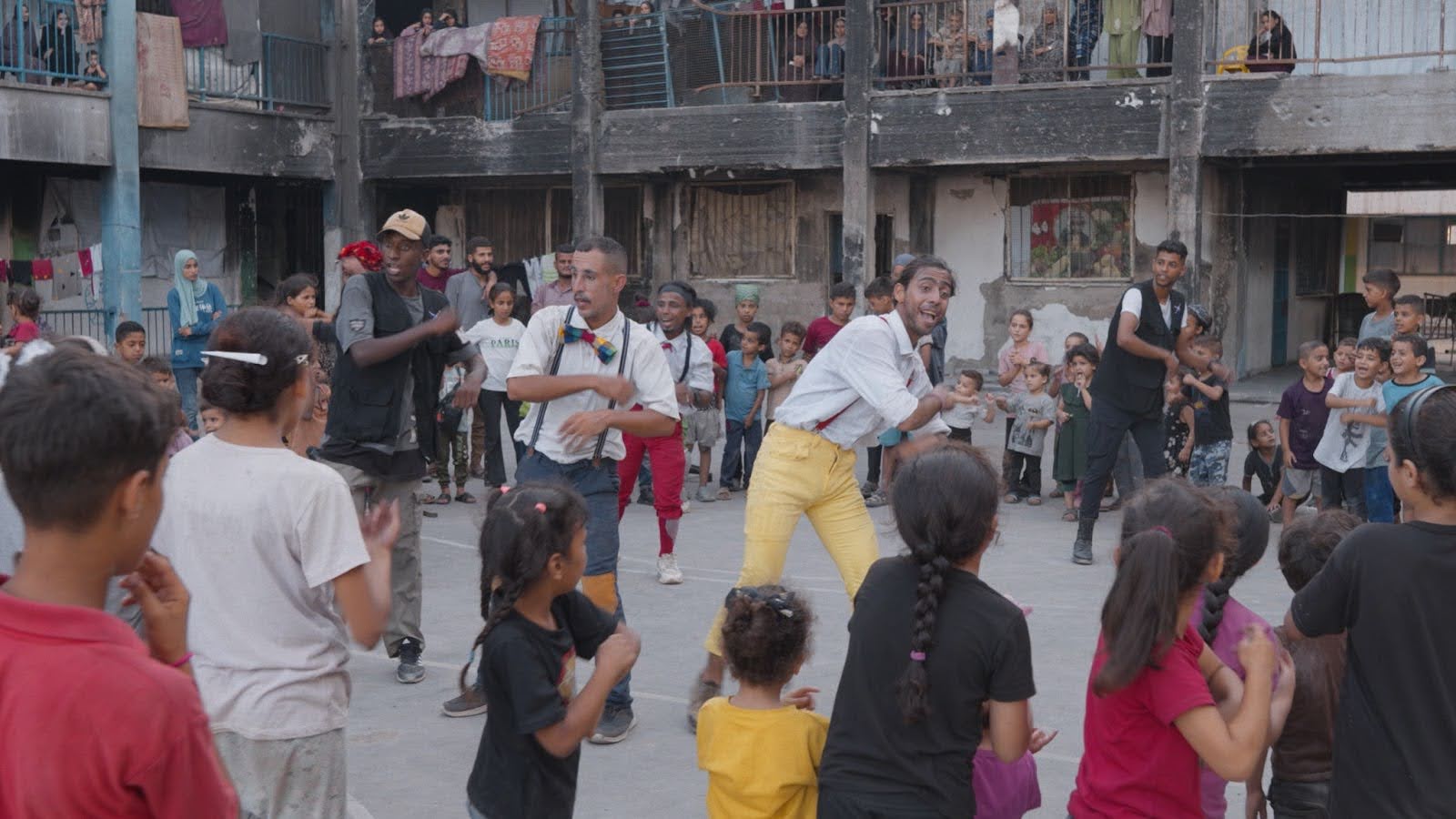
The troupe consists of six performers — Just, Ismail, Batout, Turki, Ashraf and Adam — working under the guidance of their co-founder Youssef and Ayman, the executive director. They travel between locations for small performances, prepare for the next show, practice, and search for means to cook and eat. Despite the fact that the film tells us nothing about the economics of what they do, it’s clear that this is their job. No more, no less.
Youssef managed to get his wife and newborn son out of Gaza. His only remaining connection to them is a video call that pretends to compensate for real connection, a father who tries to wake up his son, only to be interrupted by a bad signal, by life in wartime. Batout had been living in Germany but returned to Gaza only a few weeks before the war to marry his sweetheart. Ismail is preoccupied with his brother, who is trapped in Rafah in Gaza’s south after failing to find an affordable place to relocate.
The easier choice to “humanize” people who have been systematically dehumanized for decades is to let them tell their stories. The headlines can be predictable: “A story about resilience, about the beauty of life,” “superb quality, a technical feat in the midst of war-torn Gaza.”
And indeed, the story is one of incredible resilience, and the film is a technical feat. The cinematography is stunning. The camera's movements are calculated even in the most technically challenging moments. The camera is almost never distracted. Danaf says they opted for a small, fast-moving camera to maintain some flexibility without sacrificing quality. A gimbal allowed shooting inside destroyed buildings and narrow streets. With rubble everywhere, maintaining the equipment was almost impossible. They had to frequently clean the lenses with all the dust from the rubble. They used plastic bags to protect their gear. With electricity mostly cut, they relied on a large external battery and charged equipment whenever possible. Anything that broke was beyond repair.
Despite all this, the film still avoids the easier choice.
In their gatherings, they tell their stories, not directly to the camera but to one another. The conversations feel prompted but not scripted. The camera keeps its distance from individual faces, focusing instead on the troupe. The idea was to observe “how a story lives within a group, not the individual alone: how one is affected by those around them; where they draw strength; how one word from someone could open up an old wound or soothe an escalating fear. This was all part of the experience we wanted to document,” Danaf says.
This communal capturing carried a subtlety that would have been impossible if the protagonists were interviewed or asked to directly speak to the camera. It saves them from an act of pleading and fetishization that neither they nor the film had any interest in. The stories are theirs but also of them as a group, as a people. The personal becomes a gateway to a more generous space of engagement, rather than a mere device of humanization.
Batout’s sweetheart was killed in the war, and he is now left with his melancholy. But his reminiscence of the clean, chilled air of Germany, contrasted with the stench of war, has become a collective exercise rather than an individual one. Their shared yearning for Germany's clean air does not dissipate the war's stench; it reveals how the personal is held and savored within the group. This is how the film steers away from the usual traps.
This dynamic becomes especially important in their performances for children, the universally sanctified category of innocence.
Since World War II, it has been agreed upon that children are the categories of innocence. Even the most ruthless war machines that killed or maimed hundreds of thousands of children always maintained the rhetoric that such losses were “collateral damage.”
But not in this war. This time, the category has been officially renounced. The war machine does not hesitate in admitting that it targets children in this war as fair game. The children of “evil” must also be “evil” by extension.
At first, this was shocking even to some war hardliners. A tough pill to swallow. But swallow it they did. With time, as images of amputated children circulated relentlessly, the category dissolved. Screams of burning children echoed only momentarily. Silence always ensued.

The film refuses to partake in this stream of graphic imagery and our complex complicity in its normalization. There are no amputations, no disfigurements. The performances give a glimpse of a world far beyond us with no way back. But with each show’s end, those moments of escape end. Reality sinks in, the rubble remains. This artistic choice sets the tone for the entire film.
After one performance, an Israeli strike hits a building near where the troupe is staying. Some of them help retrieve remains. That night, sleep evades them. They consider the possibility of being struck in their beds, that these might be their last moments. They put on Quran recitations and try to sleep anyway.
But life goes on. The next day, Youssef tells them he was at a market when a strike hit. Chaos erupted, but only for a few seconds. Everyone is used to it now. Market activity resumed almost instantly. Business as usual.
This is why the film succeeds. Throughout, I kept expecting one of them to die. Isn’t that what we have been conditioned to anticipate for the arc of tragedy to feel complete? But no, none of them died. They are all alive, but everything else is gone. Their center, their homes, all destroyed. I am not exactly sure which is worse. Life is cruel that way.
تقارير ذات صلة

Gaza’s phase two arrives. Kind of …
Consensus over key questions lags behind the United States' announcement of progress.

Gaza’s child amputees

Israel finally approves Egypt’s gas deal after nail-biting battle
In an unexpected move, Israeli Prime Minister Benjamin Netanyahu announced on Wednesday Israel’s final approval of a controversial gas export deal with Egypt, months after Israeli hesitation following the initial…
Your support is the only way to ensure independent, progressive journalism survives.
You have a right to access accurate information, be stimulated by innovative and nuanced reporting, and be moved by compelling storytelling. Subscribe now to become part of the growing community of members who help us maintain our editorial independence.
Join us