
Playground Politics
A birthday is coming up for a student in a pre-kindergarten classroom at one of Cairo’s suburban schools. When asked how old she will be, the girl begins to count up to four on her fingers, looks at her hand in dismay and quickly puts it down.
Only “bad people” make that sign, she proclaims to her teacher, and instead holds up two fingers on each hand to indicate her young age.
The scene has become a familiar one in Egypt’s classrooms, where political debates have gained a new centrality.
The young girl’s gesture was both childlike and unsurprising. The four-finger “Rabea” salute is now associated with the Muslim Brotherhood after the dispersal of a sit-in at Rabea al-Adaweya Mosque last August, in which over 1,000 people were killed.
It is not only those holding up their hands in four-finger salutes at protests who have been arrested. In December, a 15-year-old schoolboy was detained for 30 days because he brought a ruler to school that had a sticker with the Rabea sign on it. His father and two teachers were then arrested for “inciting” the child to possess the ruler.
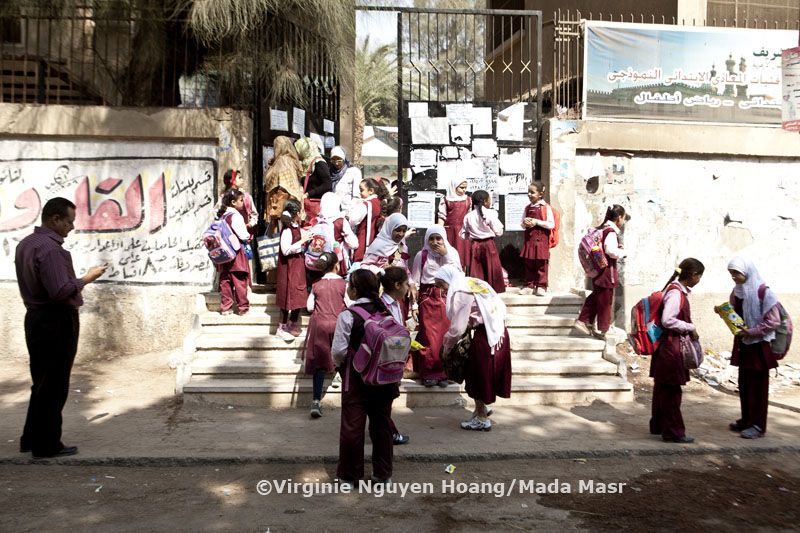
Three years on, arguably one of the most sustained effects of the January 25 uprising is the increased prevalence of discussing politics. It is no wonder that the country’s children are becoming aware of current events. From seeing protests on the streets, to listening to the news at home or experiencing — maybe even participating in — a heated debate at a family event, children are widely exposed to politics.
In a country sharply polarized since the military’s ouster of former President Mohamed Morsi last summer, these divides have made it into classrooms and playgrounds, where bullying and taunting are often colored by political rifts.
A local language school student, Farida Mohamed, 13, recalls things getting heated around the time of the constitutional referendum. She was standing with a group of friends at school when a boy who she identifies as pro-Muslim Brotherhood ridiculed the fact that she and her friends were all voting “yes” on the draft constitution.
“So then I, and a group of others, turned to him and said that they had voted yes for Morsi’s constitution, while another group started telling him that they [the Brotherhood] always think they’re right,” says Farida.
But as minors, none of these young people would actually vote.
“The tone of the argument became more and more aggressive and it started turning into a fight,” Farida remembers.
She reckons that in her class of 28 students, about 20 support former military commander Abdel Fattah al-Sisi and oppose the Muslim Brotherhood, while two support the Brotherhood. The rest don’t really speak up about the issue. The pupil says that most of the time the students get along fine — until the topic of politics comes up.
“We are friends, and they don’t get treated any differently on normal occasions,” says Farida.
A number of schools have enforced a no-politics policy in the classroom, while the Ministry of Education banned questions related to politics in this year’s exams.
The ministry points to cases in which schools are crafting politically biased exam papers. In 2012, a school in Sharqiya asked students to write an essay congratulating the Muslim Brotherhood-affiliated Freedom and Justice Party on their win in the parliamentary elections, and referred to protesters as thugs in an Arabic language exam for primary students.
In another Arabic language exam for a preparatory school in Alexandria, an exam was canceled after one question asked students to describe the National Salvation Front — the main opposition coalition against the Brotherhood — as thieves.
Following a pattern established in the past three years whereby change at the top is reflected in amendments to the school curriculum, after the Brotherhood’s overthrow, the Ministry of Education took measures to reverse any curricular changes introduced by Morsi's short-lived administration.
There have also been attempts to bring schools allegedly affiliated with the Brotherhood under close state supervision.
“We've been given clear instructions to no longer discuss politics at all at school,” says Noreen Ashraf, who teaches grades three and four.
But “the kids are fully aware of everything going on,” she adds.
Ashraf says that there are three students at the school whose parents are pro-Brotherhood, and as a result they are often teased by the other students, who call them, “Morsi’s loves.”
Additionally, because their parents are religious, these students are not allowed to attend certain school functions, such as Halloween or Christmas parties. Since Morsi’s ouster, the other students’ reactions have taken a political hue. They taunt their classmates with jibes like, “Morsi won’t allow them to come,” or, “If Morsi finds out, they’re going to be in trouble.”
Abdullah Ahmed, a nine-year-old who goes to a school where the majority support the Brotherhood, says his classmates tease the minority of Sisi supporters using old-fashioned playground songs and rhymed chants, such as, “Burn it, burn it, we will bring back President Morsi.”
Another popular one is a spin on a classic playground song, “Kilo bamia” (“A kilo of okra”). The new iteration of the song goes, “A kilo of okra, the blind cat stole my shirt and gave it to Sisi.”
“The school keeps saying ‘enough politics,’ but students are always arguing — either 'I'm with Sisi' or 'I’m with Morsi',” says Ahmed. To avoid getting into trouble, Ahmed answers the question of whose side he’s on with a democratic, “I’m not on anyone’s side, to be honest.”
Bullying can have a major impact on a student’s self-esteem, says Rana Heiba, a school counselor.
“It affects who they are and makes them question why they are being hated,” she explains.
Heiba says that the most common forms of bullying include regular teasing and cursing, and can often lead to physical violence.
At schools where the ethos is generally supportive of the events that have occurred since Morsi’s fall from power, students may suffer from what Heiba describes as “systemized emotional strain.”
Schools have not been immune from the general atmosphere of ultra-nationalism that the regime change ushered in, and several schools reportedly play the catchy pro-military song “Tislam al-Ayady” (“God bless the hands”), widely considered the unofficial theme song of the period.
At one school, a teacher relates that when the song would play after the national anthem, some students would burst into tears, remembering family members they had lost during the forced dispersal of the Rabea and Nahda Square sit-ins.
Ashraf says that at her school, where the general sentiment is supportive of the military, most of the students dance and sing along to “Tislam al-Ayady.”
“It’s really intense,” says Ashraf.
Teacher Sarah Akl suggests the no-politics rule is enforced unevenly at her school. She recalls that at the beginning of the year, a pro-Muslim Brotherhood teacher was suspended for discussing politics with his class. One of the students informed his parents of the classroom discussion, and the parent contacted the school, which promptly took action.
“The school held a general meeting afterwards to discuss the case, telling us that this type of behavior is not allowed,” she says.
But the incident was only described and treated as unacceptable behavior because it was supportive of the Brotherhood, Akl claims. In line with the prevailing political climate, the school administration deemed the discussion to be “supporting terrorism.”
“The school also differentiates between students of different political backgrounds,” Akl adds.
But it is not only students who argue — teachers get involved as well.
At her place of employment, Ashraf says that a pro-Brotherhood teacher regularly argues with the students about politics.
“The kids have built a huge wall up between them and her because of that,” she says.
At Farida’s school, a group of students were discussing religion with one of the teachers, who would divert the subject to hint that Sisi is “bad” and that the Muslim Brotherhood is “good,” she recounts. In the middle of the debate, the teacher — who Farida says often makes his political views clear — advised the students not to believe everything they read, nor everything their parents tell them, then ended the discussion before it got too heated.
However, Maha, a teacher at an elementary school, does not find it too difficult to abide by the no-politics rule.
“The students I teach are not old enough to understand what is going on in politics, and they mostly repeat slogans they hear from their parents,” she says.
Whenever the topic of politics is brought up in class, Maha quickly switches to another topic.
But for Akl, a political science teacher for grades 11 and 12, avoiding current politics would be difficult, if not impossible.
“I’m teaching a critical subject, and these kids are old enough to start a debate,” she says.
Even though the school has advised her to stay away from current events, Akl says she discusses everything with her students on a daily basis, and tries to give them an unbiased perspective.
“Students have a lot of questions,” she explains.
For Akl, the experience of an open discussion has been quite positive, and she enjoys seeing the students engage in a healthy, constructive debate.
“They are very mature. I didn’t expect them to be this tolerant,” she adds.
Counselor Heiba says that making politics a taboo issue is not a constructive move.
“I think anything that is a taboo makes the students want to talk about it more,” she says, “and then they would definitely use it in bullying each other.”

تقارير ذات صلة
State regulation drive shutters 300 Sudanese community schools, disrupting learning
Many worry the state’s unclear legalization requirements could lead to indefinite shutdowns.

Shifting from private to public school: From the frying pan into the fire
Those who can afford it get to buy the commodity and learn. Those who can’t, don’t”
A new school meal system: What has really changed?
Components of the new school meal system are supplied by contractors involved in the old program
Your support is the only way to ensure independent, progressive journalism survives.
You have a right to access accurate information, be stimulated by innovative and nuanced reporting, and be moved by compelling storytelling. Subscribe now to become part of the growing community of members who help us maintain our editorial independence.
Join us