
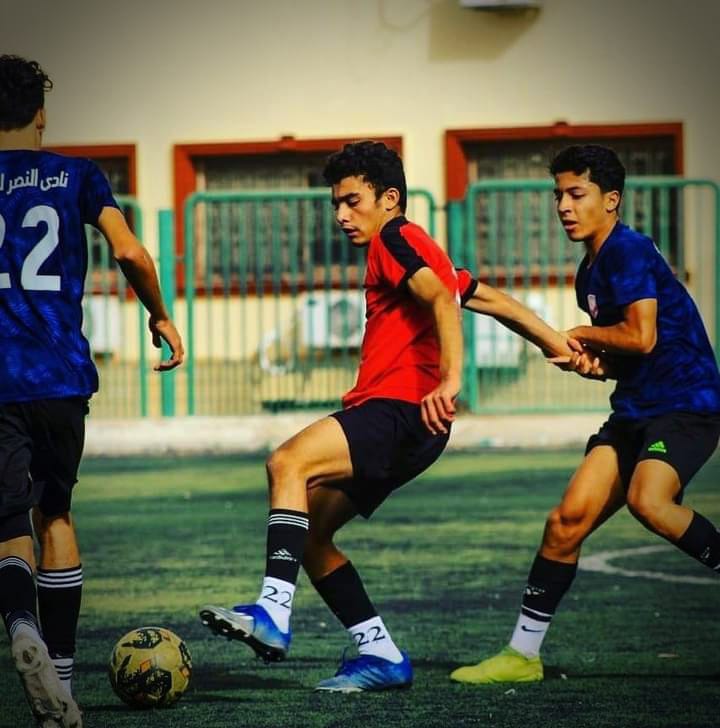
Pay-to-play: How private investment is eroding youth football in Egypt
Outside a one-storey house on a narrow alleyway in Giza’s Shabramant village, 16-year-old Mostafa Abdo — a former member of the Asmant Helwan youth football squad — stands in an Egyptian national team jersey, raving about his favorite players.
Abdo first developed a passion for football as an eight-year-old. Like thousands of Egyptian boys, he first began playing on the streets of his neighborhood, and despite his short stature and slim build, he outplayed every other kid in the village. “Ever since I saw him playing on the street,” says Mohamed Ahmed, a coach for Al-Omraniya SC, “I knew he’d be big. I recommended that he play professionally.”
Abdo took his first step toward a football career in 2017, trying out for the youth football team at Asmant Helwan, a fourth-division club, where he was eventually selected from among hundreds of applicants by the head of the club’s youth division.
Three days a week, he would join a 9 am training session. The commute cost a total of LE25 and involved taking a small van from his house to the Moneeb metro station, where he would hop on a train to the Helwan metro station and finally make his way to the club on a city bus.
Abdo’s primary job was in AC repair, which earned him between LE30 and LE35 per day. He also helped out his father in his barbershop. Money was tight, but Abdo would do his best to make it to training while also trying to keep to a strict diet. “I have to eat two hours before training,” he says. “I need to consume as much protein as possible, things like eggs and milk; and I stay away from street food.”
Abdo’s father, who is a passionate supporter of his son’s dream to become a professional footballer, advised that he opt for an industrial secondary degree as opposed to a standard one. The idea was to free Abdo up to train more while saving on private tutoring costs. “My father would give me time off from work when it clashed with a training session,” he said. “He advised me and showered me with encouragement to pursue a footballing career.”
Abdo plays as a forward or attacking midfielder. He chose that position to follow in the footsteps of former Al-Ahly SC and national team star, Mohamed Aboutrika. “He’s just like me, he came from an economic background exactly like mine, and he, too, is from Giza,” Abdo says. “The only difference is that, back in his day, you didn’t need to pay to be on a team — unlike now.”

A year into his training with Asmant Helwan, the head of the youth division informed Abdo that the team had been bought by an investor and that each player was now required to pay a LE3,000 membership fee if they wanted to play the following season.
“It was shocking having to pay a fee to stay on the team for another season,” Abdo says. “My wages were almost entirely spent on transportation. I could never put together that kind of money.”
With no way to afford the down payment, Abdo was forced to quit the team. Two months later, he tried out for the third-division Goldi SC and was accepted. However, three months in, his new coach informed him that the youth division of the club had also been bought by an investor. The required payment this time was LE5,000. “Some players stayed on the team because they could afford it. A number of new players with no talent also joined,” he says.
Abdo was driven out of a third club for the same reason. The Matrouh-based Al-Qadsia SC had a team for players born in 2004. A year after Abdo joined, it was similarly acquired by an investor who required team members to pay to remain on the squad. “We were the best team in the youth division and won against first-division teams,” Abdo says. Yet most of the players refused to pay the fee, so the entire team was dismissed.
Over the past several years, so-called “investment clubs” have become an increasingly prevalent phenomenon in Egyptian youth football. An investor steps in and acquires the youth division of a particular club, then forces players to pay a membership fee that is renewable every season. The fees provide investors with a quick and easy profit. Yet the effects on Egyptian youth football have been pernicious, cutting out players from poor backgrounds who simply cannot afford to pay to play, and, over the long term, affecting Egyptian football as a whole by missing opportunities to groom budding young talent for the premier league.

Like tennis and squash, football first came to Egypt with the British occupation in the late 19th century. In his memoirs, Khedive Abbas II Hilmi Bey — who governed Egypt from 1892 to 1914 — notes that British commanders and officers had their own communities, clubs and sporting venues, while rank and file soldiers lived in military camps and barracks closer to poor neighborhoods. Egyptians from these neighborhoods often battled it out with British troops in football matches held in the barracks and in Cairo’s streets and public squares. According to Yasser Ayoub’s Masr wa Kurat al-Qadam (Egypt and football), despite football at the time being considered a lowbrow game that was dismissed by elites, it quickly turned into the country’s most popular national sport.
In 1921, the Egyptian Football Association was established, and in 1957, Egypt joined the Confederation of African Football. Egyptian football is managed by different committees within the association that oversee all aspects of the various leagues, including scheduling matches and tournaments, considering grievances and overseeing the enrollment and transfer of players.
The National Youth Football League begins with a group stage organized into several age categories. For example, the 2020–2021 season includes 64 teams divided into four categories by year of birth: 1999, 2001, 2003 and 2006. With each team comprising 20 players, the total number of players in the league comes to 1,280. Through this, the pay to play membership model offers investors an easy source of income. If each player is forced to pay at least LE3,000, the total revenue comes to nearly LE4 million.
“The green light for youth divisions to be sold off to investors came from the Egyptian Football Association,” a Youth and Sports Ministry official tells Mada Masr on condition of anonymity. “The bylaws currently allow for it. Player enrollment and dismissal, as well as the registration of team lineups are all done through the Egyptian Football Association. So the association must introduce language in the bylaws to prohibit youth teams, divisions or players from being sold without its approval. As long as it allows this, it is responsible for wasting football talent.”
Investment clubs often even force players who want to leave a team to pay fees in order to get their necessary paperwork cleared, according to Mahmoud Fathy, an Al-Helal SC youth coach. The football association currently does not legally prohibit such practices or monitor investment clubs’ activities overall in any meaningful way, Fathi says.
In the current environment, many talented players are driven out of their youth clubs while others are rejected during tryouts simply because they cannot afford the fees, according to Tamer Abdel Hamid, a former player for Zamalek SC and the national team. “Only people with money are accepted into teams, regardless of talent,” Abdel Hamid says. “Most club boards are uninterested in youth championships because they’re not profitable,” he says, which leads to youth divisions across the country being reduced to nothing more than sources of quick cash.
Providing the attention, care and support needed for young players to refine their talents, develop their skills and qualify them for primary teams is far from a priority for most club boards. “Most youth teams don’t have pitches for training,” says Essam Safaga, a former youth coach at Al-Ismaili SC’s Cairo branch. “Al-Nasr SC’s team for players born in 2005 used to rent the Hikestep playing field. That’s a great cost to clubs. Some youth teams train on artificial grass, which is inadequate. A number of ENPPI SC youth players, for example, sustained muscle and joint injuries because of artificial grass, as natural grass is expensive and requires daily maintenance.”
Instead, club boards are typically drawn toward generating a quick profit. Selling a club’s youth division to an investor and channeling the funds toward helping its primary team advance in the premier league is an easy fix, says Ilwy Ahmed, a former administrative official at Goldi SC and a head coach at Al-Ismaili SC’s Matrouh branch.
A lack of funding is a problem that smaller clubs particularly struggle with. According to Saleh Reheim, chairman of Zamalek’s Matrouh branch, the football association provides financial support to teams in all divisions except for Division Four clubs, which are excluded because they do not get to vote in the association. The only funding Division Four clubs receive is from the Youth and Sports Ministry, which only comes to LE40,000 in two separate injections during each season. At the same time, hosting just ten matches can cost a club around LE80,000 in player transportation expenses, pitch rentals and salaries for players and staff.
Zamalek’s Matrouh branch, for example, is forced to rely primarily on donations. “The best we can hope for is someone to donate uniforms or even balls for the primary team,” Reheim says. “[We have no sponsorship from] restaurants, shops or wedding halls, and no support from investors, unlike teams affiliated with corporations.”
A lack of funding can affect bigger teams as well. Al-Mokawloon al-Arab SC held youth and children tryouts for all age categories in mid-July. Liverpool superstar Mohamed Salah and Arsenal midfielder Mohamed Elneny came up through this very club, driving thousands of young players to apply. “There were so many of us,” says 18-year-old applicant Khaled Abdel Halim. “We faced off in groups, and a lot of us were excluded in the first round of tryouts. The rest of us were told to come back a week later for the second round.”
Abdel Halim, who was trying out for the club’s 2001 team, made it through five rounds in total. “It took nearly a month of tryouts. Most of us were from different provinces and couldn’t afford to stay in Cairo, so we went back and forth every week,” he says.
Eventually, he was one of five players selected to join the team. On the final day of tryouts, and much to his surprise, he was asked to pay a whopping LE30,000 membership fee. Abdel Halim says he was approached by a man who introduced himself as the presenter of a radio program called “Sawt al-Nashiin” (Voice of the Youth) and reportedly told him: “Al-Mokawloon al-Arab SC has become an investment club. Pay now and you’ll reap millions in the future.”
“It was a shock to all of us,” Abdel Halim says. “It had been a long, grueling tryout process, and only one of us could afford to pay the fee.”
Ahmed — the head coach at Ismaili SC’s Matrouh branch — says Al-Mokawloon al-Arabhas been transformed from a reputable club that once produced a large number of talented young players to a solely profit-driven organization. “Three years ago, an investor bought the club’s team for players born in 2000. The return was massive for the investor, with a LE20,000 fee from each player,” Ahmed says. “He then bought the 2004 and 2006 teams for LE800,000. The club realized that membership fees could provide a big source of cash, so it decided to ask its own incoming players for LE30,000 as well.”

Overall, Egyptian football has seen marked changes over the past couple of decades, with an increasing number of corporate-affiliated teams rising to prominence until they comprised a majority of the premier league. Meanwhile, popular clubs — like Alexandria’s Olympi, Tirsana, Mansoura, Suez, Damietta and Damanhour — have faded into irrelevance after suffering debilitating financial crises, leading to them being dominated on the pitch by well-funded teams from rich clubs who have the means to buy good players. More than 60 percent of all teams competing in the most recent season of the Egyptian Premier League have corporate affiliations. The three new teams that qualified for the league’s next season are all corporate teams: Pharco, CocaCola and Eastern [Tobacco] Company SC.
Critics point out that the football association initially places corporate-affiliated teams in easy Second Division groups that make it more likely for them to advance to the premier league. The Second Division is divided into three groups: Cairo, Lower Egypt and Upper Egypt. Each group includes 12 teams, the top three of which qualify to the Premier League, while the bottom three drop to Division Three.
“[The association] bends the law to pack the Premier League with corporate-affiliated clubs by means of ‘remote participation,’” Ahmed says. “Some Giza and Cairo-based clubs are allowed to compete in the Upper Egypt group,” where competition is less intense. “Whenever the football association wants a corporate-affiliated team to advance, that team gets placed in the Upper Egypt group. The National Bank of Egypt SC team, for example, played in the Upper Egypt group. So did Eastern Company SC.”
Ahmed notes that this undermines equal opportunity in the league, as most teams in Upper Egypt are in dire financial straits, where players are paid meager salaries, forcing them to take second jobs to make ends meet.
Meanwhile, 16-year-old Abdo still dreams of pursuing a career in professional football; he just needs to find a team that will not force him to pay to play.
تقارير ذات صلة

The day we stopped cheering
Video | As stars set and rise
Al-Falaki is the most famed of Alexandria's Ramadan street football tournaments

Daily COVID-19 roundup: June 28
Preparations for the Egyptian Premier League have stumbled due to new infections.
Your support is the only way to ensure independent, progressive journalism survives.
You have a right to access accurate information, be stimulated by innovative and nuanced reporting, and be moved by compelling storytelling. Subscribe now to become part of the growing community of members who help us maintain our editorial independence.
Join us