
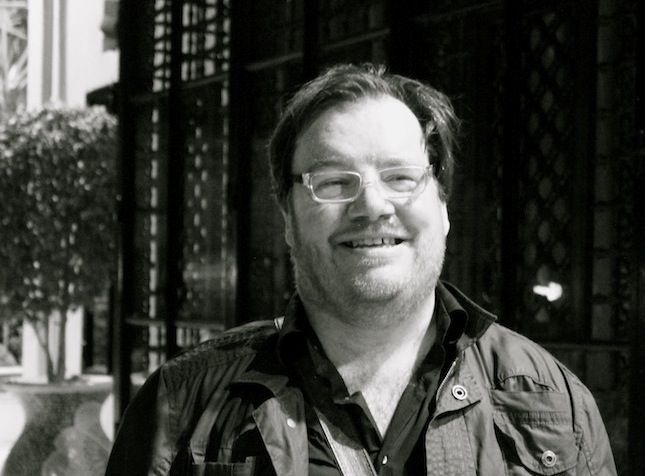
On the lives and afterlives of literary texts
Sinan Antoon thinks of literary texts as wearing black, waiting for a translator to liberate them into the afterlife.
The Iraqi author, translator and filmmaker characterized the translator’s role in this way during a lecture titled “Translation as Mourning” at the American University in Cairo on March 4.
The metaphor is based on a quote by Iraqi scholar Kathim Jihad in a 1989 review: “Every text remains in mourning until it is translated.”
Antoon suggested that authors, translators and readers play the role of hosts or ghosts, receiving or inhabiting a text to give voice to people who have died through a process of discursive mourning.
Antoon is a teacher, an author of novels, poems and literary criticism, as well as a documentary filmmaker. But the AUC talk focused on his translations of works by renowned poets Mahmoud Darwish, Saadi Youssef and Sargon Boulus.
He sees these translations as conscious acts of mourning. In translating their works, he is mourning the deaths of both Boulus, an Iraqi-Assyrian, and Darwish, a Palestinian. But at the same time, he is also mourning the “death of homeland,” of native lands that have changed beyond recognition. Like the poets he translates, Antoon has also known exile, and continues to live outside of Iraq.
Antoon spoke of being “haunted by the nameless dead” as the layers of the past and violence are being erased in different directions. With the dismantling of the Iraqi state in 2003, there is no official collective memory. Referencing Hannah Arendt, he said that in such a context writers have an important role as “guardians of the truth.”
There is a particular passage that he read from at length — both in Arabic and his own English translation. It was Boulus’ “A Portrait of an Iraqi Person at the End of Time” (published in Jadaliyya). The poem roots humanity’s ongoing struggle in “history’s repeated explosions” — with Babylon used to represent an ancient land, perennial toil and collective memory — before finishing on a more hopeful note of triumphant resilience.
Themes of memory and resilience appear in much of both Antoon’s writing and in that of the poets he has translated. But he was careful to point out that he takes pains to avoid a selective framing of violence. “Snares of tradition and nostalgia” can be uncritical and limit creativity, he explained, while on the other hand there has been a cultural interrogation of Arabic literature since 9/11 as being from “guilty cultures that have to exonerate themselves.” To refute this, his work consciously acknowledges more of Iraq’s recent past than the occupation.
While he believes that people will always make reductive assumptions about him, the poets he translates, and the Iraq war, one way of dealing with this is to try to convey emotions and feelings to his readers.
In his own poems, he also seeks to avoid selective framing of violence by trying to rescue the memories of the dead, as what we choose to highlight can end up reinforcing present and future perspectives. He said that writers have a responsibility to play a disruptive role and challenge perceptions in their work.
The dead should therefore be addressed, conversed with in their absence, and not spoken for. Antoon believes poetry enables the deceased to speak to the living and vice versa.
In another of Boulus’ poems, “I Came From There,” a deceased friend’s ghost visits the poet in San Francisco to explain the state of Iraq. It is as though the living are dead and the dead living, Antoon said, offering the idea of mourning without end as the aim of this discursive process. Endless mourning is “to learn to live with the dead and speak to, rather than exorcize them.”
As usual with this series of talks, “In Translation,” led by AUC’s Center for Translation Studies, the event was well attended and an interesting question and answer session took place.
When asked how he distinguishes between his own voice and those of the poets he translates, Antoon replied that he doesn’t want to separate himself from them, but rather internalize their language and imagery, always conscious that we don’t write on a white page (as Darwish said), but are part of a lineage of writers.
I found the lecture fascinating but was left with many questions. If texts have lives and afterlives, when do they die? Momentarily, with the passing of the original author? Does the spectral form of the ghost take on new meaning beyond the national? And what exactly is the role of the translator in this instance?
At the end, chair of the evening and Center for Translation Studies head Samia Mehrez encouraged Antoon to extend his opening metaphor.
“If texts are clad in black, mourning and waiting for resurrection, or a savior, does this mean the role of the translator is god-like?” she asked.
“I’m merely a prophet,” Antoon replied modestly, providing a moment of light relief.

Laura Bird
Laura has been working with Mada Masr since December 2013. She edits the opinion section and occasionally writes. Laura has an MA in Middle East Politics from SOAS, and worked…
تقارير ذات صلة
Ahmed Bassam Zaki’s charges highlight flaws in penal code
Zaki’s sentence may ultimately come down to the judge’s interpretation of the facts of the case.
AUC students merge politics and play in graphic design exhibition
The program has recently been placing increased emphasis on conceptual thinking.
Book review: AUC and its students — irrepressible bubbles and inevitable politicization
Moataz Bellah’s bold introspective narrative tracks the rise and fall of the student movement in AUC
Your support is the only way to ensure independent, progressive journalism survives.
You have a right to access accurate information, be stimulated by innovative and nuanced reporting, and be moved by compelling storytelling. Subscribe now to become part of the growing community of members who help us maintain our editorial independence.
Join us