
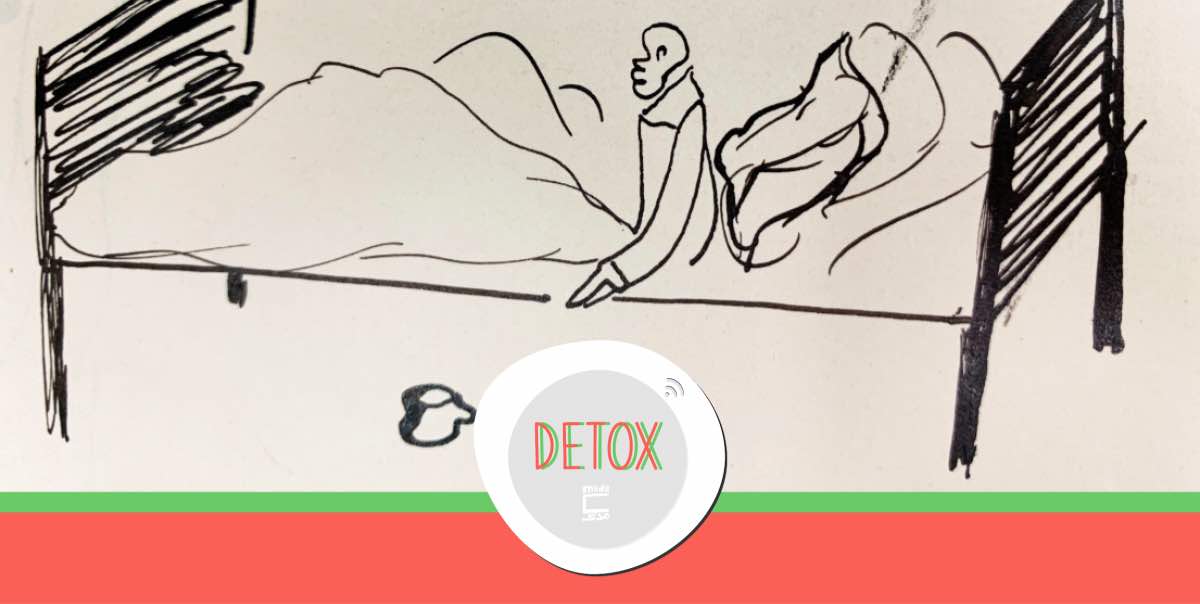
WHAT’S UP?
Well, we all know what’s up, and it’s not pretty. These are dark, anxiety-ridden days, but we choose to keep the faith. We reassure ourselves, dear readers, as we reassure you: everything’s gonna be alright. Soon. Hopefully.
[wonderplugin_video iframe="https://www.youtube.com/embed/STMZsfAhxwc" lightbox=0 lightboxsize=1 lightboxwidth=960 lightboxheight=540 autoopen=0 autoopendelay=0 autoclose=0 lightboxtitle="" lightboxgroup="" lightboxshownavigation=0 showimage="" lightboxoptions="" videowidth=600 videoheight=400 keepaspectratio=1 autoplay=0 loop=0 videocss="position:relative;display:block;background-color:#000;overflow:hidden;max-width:100%;margin:0 auto;" playbutton="https://thefuturebegins.today/wp-content/plugins/wonderplugin-video-embed/engine/playvideo-64-64-0.png"]
READ
Today marks the day iconic Czech author Franz Kafka was born in 1883. What everyone knows about Kafka is that he is the creator of nightmarish worlds where humans turn into cockroaches or are arrested and tried for crimes they do not know — to the extent that we call dark or grim situations we encounter “Kafkaesque.” But instead of delving into a typically predictable narrative about Kafka’s life and why his work was so “bleak,” we thought — in addition to inviting you to revisit his work, of course — we’d reflect instead on his literary will (he died in 1924 at the age of 41).

The story goes that Kafka — who had burned a number of his own manuscripts when he was alive — wanted all his unpublished works of fiction, in addition to personal documents such as letters and diaries, to be burned after his death, and entrusted his friend, the author Max Brod, to carry out his wishes, which Brod ultimately ignored. However, there’s more to this story than the insecurity of an author who deems his work unworthy; Kafka wasn’t really as nihilistic as this narrative depicts him. In fact, he instructed Brod to keep five specific works of his, which shows that he did take pride in some of his endeavors, but perhaps wanted to shape his legacy a certain way. After all, if he had really believed all his work was so insignificant, why didn’t he burn all of it himself while he could?
“Burn it to the last word, unread. I do not forbid you from taking a look, although I would prefer if you don’t. But in all cases no one else can,” one of Kafka’s notes to Brod read. This hesitation casts doubt that Kafka really wanted all his works to be purged. But what’s certain is that Max Brod went against Kafka’s wishes, acting as a guardian of sorts over his legacy.
Brod’s guardianship over Kafka’s work sometimes manifested in the form of considerable intervention, where he would remove certain parts to protect Kafka’s privacy or because he deemed them inappropriate. A new edition of Kafka’s diaries was published earlier this year, including some previously omitted entries.

After Brod’s death, Kafka’s manuscripts were left to Brod’s lover, Esther Hoffe, eventually culminating in an ownership conflict analyzed in-depth by Judith Butler in her famous lecture (Hoffe made more than two million dollars when she sold the manuscript for The Trial in 1988). Later, another form of guardianship was practiced over Kafka, which had nothing to do with his work but with his identity: In 2015, an Israeli court ended the years-long dispute by ruling that Kafka’s works belong to the National Library of Israel — on account of his Jewish identity — rather than to Hoffe’s daughters, who both reside in Tel Aviv.
So much for the man’s wishes to have his works burned — not only have they survived, to be read and pored over by millions, but the legal battle for their ownership made headlines across the globe. That situation was often described as “Kafkaesque,” as is the situation these days, in the midst of a relentless pandemic and life’s other ordinary tragedies. But we shouldn’t taint Kafka’s work with the sad reality in which we’re living now. The man died nearly a hundred years ago, and the truth is he was beautiful. He played no part in the orchestration of our world’s current misery. In fact, according to the book Kafka’s Last Trial by Benjamin Balint, when Kafka’s former lover Milena Jesenská heard about his death, she said that he was “a man who beheld the world with such excessive lucidity that he could no longer bear it.”
WATCH
Ahmed Wael recommends To the Bone:
In light of the impact the past few months of self-isolation have had on our bodies, and given that we live in the neverending nightmare where we are constantly advised to diet and exercise to burn fat, we feel it is an opportune moment to recommend the Netflix film To the Bone, directed by Marti Noxon (creator of acclaimed HBO series Sharp Objects, which you should definitely check out if you haven’t watched it yet).
The film follows Ellen (Lily Collins), an artist in her twenties who posts her work on Tumblr and obsesses over her weight, making sure the thickness of her arms never surpasses the meeting point of her index finger and thumb. She measures the calories in each meal and never eats more than the bare minimum. She does sit-ups and runs to burn calories and once we get to see her body clearly we realize it has no fat at all and is skinny almost to the bone.

From our first encounters with Ellen we feel she’s going through a lot. She’s quit college and taken down her illustrations on Tumblr and with that we realize she’s struggling with two issues simultaneously: The first is the suicide of one of her followers after saying she was inspired by one of her paintings, and the other is the health risk posed by her anorexia.
We take Ellen’s story in doses. Her parents exit from her life while her stepmom and stepsister are the ones who remain close to her and encourage her to join a non-traditional program with a new doctor called Beckham (Keanu Reeves) who adopts an experimental philosophy through which he gives his patients points if they gain weight.
The film brings us into the world of young people who don’t eat, how they get rid of their food and what they end up losing.
The sensitivity of the film lies in never forcing its characters to explain why they refuse to eat. Ellen — who changes her name to Eli in the middle of the story — herself never shares why she doesn’t eat but only that there is a voice inside her that tells her not to eat. Her doctor then tells her to curse and yell at this voice to shut it up.

In one of her therapy sessions, the doctor invites Ellen’s family to join, but her father is notably absent and only the female characters in her family show up: her stepsister, stepmother, her mother and her mother’s girlfriend. Beckham comments that this is the most mothers to ever attend a therapy session for one patient.
The director gradually and cleverly reveals to us Eli’s issues with her mother, whom we realize was not always supportive of her. The two reconcile when her mother takes her on her lap and feeds her milk from a baby bottle, in an attempt to make up for lost time.
— The film was produced by and is available to stream on Netflix.
Listen
This week, as we always do on the first weekend of the month, we bring you Ahmed El Sabbagh’s Tafneeta: a carefully selected collection of recently released tracks from here and there.
On Spotify:
On Youtube:
[wonderplugin_video iframe="https://www.youtube.com/embed/videoseries?list=PL2b4XFUJwARHUp7Iw96hC5Wowrj_g1NlL" lightbox=0 lightboxsize=1 lightboxwidth=960 lightboxheight=540 autoopen=0 autoopendelay=0 autoclose=0 lightboxtitle="" lightboxgroup="" lightboxshownavigation=0 showimage="" lightboxoptions="" videowidth=600 videoheight=400 keepaspectratio=1 autoplay=0 loop=0 videocss="position:relative;display:block;background-color:#000;overflow:hidden;max-width:100%;margin:0 auto;" playbutton="https://thefuturebegins.today/wp-content/plugins/wonderplugin-video-embed/engine/playvideo-64-64-0.png"]

تقارير ذات صلة
Detox | An ode to the delivery worker
On curfew nights, only the roar of delivery motorcycles and the barking of dogs pierced the silence.
Detox | The final puff
I decided to quit, with the hope that I would continue to be kick-ass even without cigarettes.
Detox | A tuk tuk ride through the world of anthropology
We chat with anthropologist Mai Amer, the creator of a new show called Tuk Tuk.
Your support is the only way to ensure independent, progressive journalism survives.
You have a right to access accurate information, be stimulated by innovative and nuanced reporting, and be moved by compelling storytelling. Subscribe now to become part of the growing community of members who help us maintain our editorial independence.
Join us