
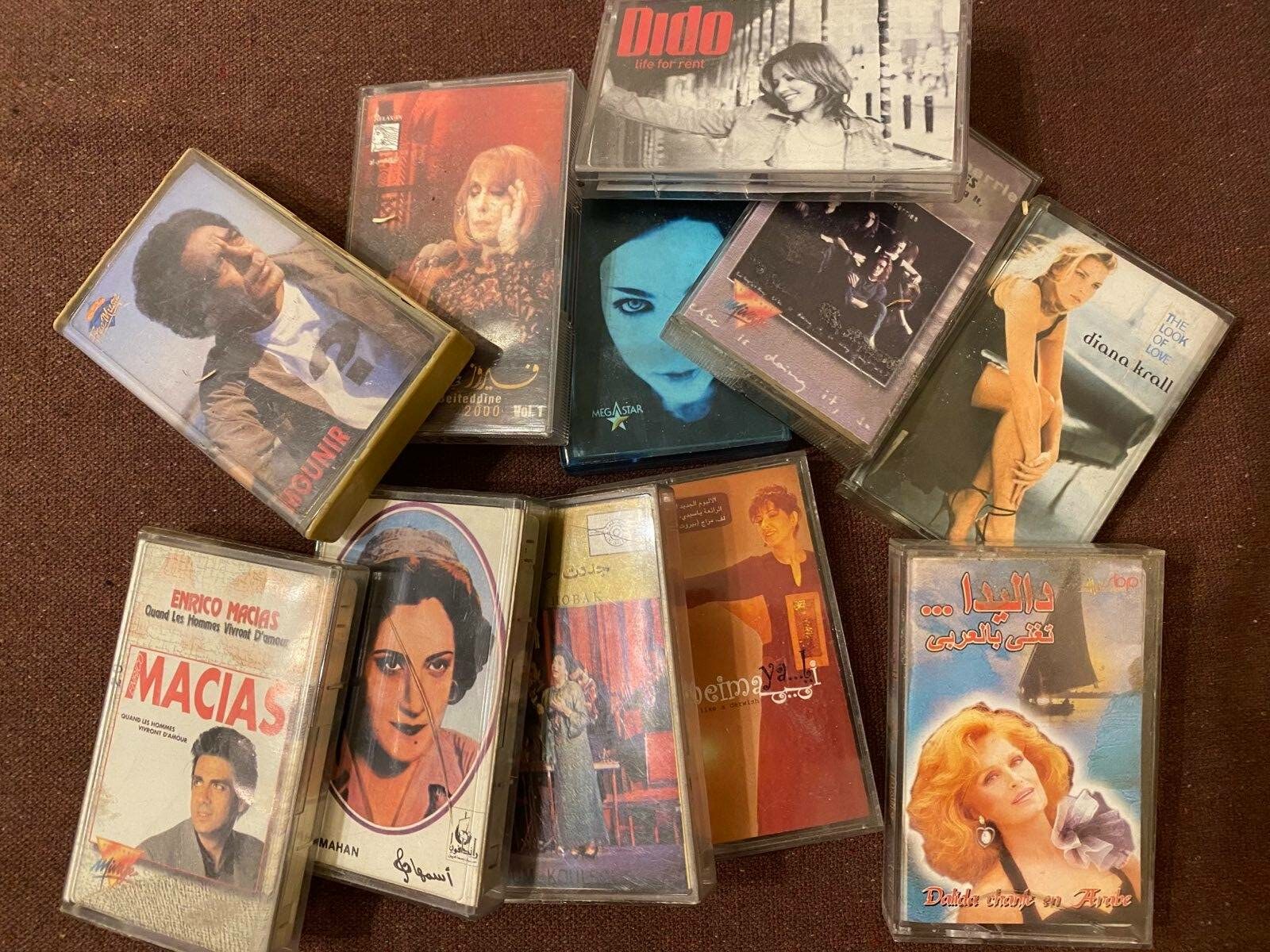
Creating a history mixtape: A conversation with Andrew Simon
As cassettes entered the mainstream, no one anticipated how much of an impact they would have on our daily lives. In the 1970s and 80s, when cassettes became popular, they were an immensely important cultural artifact not only in Egypt but around the world. This technology became so popular because it provided voices that up until then had been silent with a new medium and platform to circulate their work.
Through a history of cassette technology, Media of the Masses: Cassette Culture in Modern Egypt, published by Stanford University Press earlier this year, presents us with a history of Egypt through the analysis of their circulation and consumption.
As the book argues, cassettes decentralized state-controlled Egyptian media long before the invention of the internet by enabling people to participate in the creation of culture and the circulation of content, since they weren’t as rigorously controlled as the radio. Through the use of cassettes and other modern sources, such as popular magazines like Rose al-Youssef the book critically analyzes narratives on Egyptian culture and writes a new history of modern Egypt. Importantly, the book demonstrates that with the help of cassettes, non-conventional and less well-known artists became more popular because they could overcome radio censorship. Cassettes created a new soundscape by allowing many artists, popular and less popular, to freely record their voices and to be heard.
Mada Masr spoke with Andrew Simon, the author of Media of the Masses, a historian of media, popular culture and the modern Middle East, and a senior lecturer at Dartmouth College.

Mada Masr: Why did you choose the medium of cassettes to understand the history of modern Egypt?
Andrew Simon: Media of the Masses was nearly a decade in the making and the book’s origins can be traced back to my time in Egypt. A week after completing my B.A. in Arabic, Middle East and Islamic studies at Duke University, I flew from North Carolina to Cairo for an intensive Arabic fellowship at the Center for Arabic Study Abroad that just so happened to coincide with the 2011 Egyptian revolution. In the days leading up to Mubarak’s fall, I was living in Mounira and would walk down Qasr al-Aini Street to go to class. In Tahrir Square, I witnessed a number of scenes that came to characterize the mass demonstrations in the eyes of many people. I snapped pictures of powerful signs, colorful graffiti, and public performances. All of these sights captured my attention, but something that soon dawned on me was the importance of what I was hearing: demonstrators chanting slogans, new artists, like Ramy Essam, setting those chants to song, and older voices, like Sheikh Imam, surfacing once more. All of these sounds piqued my interest in Egypt’s acoustic culture, and when I returned to the US for graduate school at Cornell University I dove deeper into Egypt’s soundscape. I wrote papers on particular artists, musical genres, and religious currents, and at the center of these diverse endeavors was one common thread: cassette tapes. Following this discovery, I set out to write a history of the cassette in Egypt. I returned to Egypt for fieldwork and started reading popular magazines, like Rose al-Youssef where I saw cassettes surfacing in places I did not expect to find them, from court cases and celebrity news to police reports and advertisements for the “modern home.” It was then I realized that I could write a history of not only cassette technology in Egypt, but a history of Egypt through the window of its cassette culture. Media of the Masses is the outcome of this journey and is a project where I wished to consider how media technologies and the stories told by them can assist us in reimagining the making of modern nations.
I am very fortunate to have an incredible mentor in Ziad Fahmy. Taking a cue from Ziad’s scholarship, I strove to approach popular culture as an avenue of critical inquiry as opposed to something we simply enjoy when we are not conducting research. This perspective, I believe, is all the more necessary since films, songs, and countless other creative productions often shape our understanding of the world around us.

MM: Moving on to your findings, what impact did cassettes have on Egyptian culture and what do everyday technologies teach us about modern Egypt?
AS: Oftentimes, histories of technology privilege inventors. In this book, I set out to explore what happens after everyday objects, like cassettes, come into existence. The introduction of the very first compact cassette by Philips in 1963 is but a bullet point in this broader story of an ordinary technology’s extraordinary impact once it traveled well beyond the walls of its workshop in Europe.
In Egypt, cassette technology empowered an unprecedented number of people to create culture, circulate information, and challenge ruling regimes long before the internet entered our daily lives. As I show in the book, cassettes and cassette players did not simply join other mass mediums like records and radio; they were the media of the masses. At a point in time when local authorities strove to control the shape Egyptian culture assumed, cassettes permitted countless people to become cultural producers as opposed to merely culture consumers. The resulting cassette culture gained ground in Egypt against the backdrop of state-controlled radio, which, through screening committees and selective stations, ensured that only certain voices reached a wider audience. But, with cassettes, anyone, for the first time, could reach a mass audience.
This is not to say, of course, that cultural gatekeepers refrained from trying to control what and who appeared on audiotapes. In the 1970s, there was a censorship office in downtown Cairo for artistic works that was responsible for overseeing that the content on tapes was “tasteful,” aligned with public morals, and adhered to political, social, and religious norms. This office, however, had 15 employees, seven cassette recorders, and was responsible for screening every commercial cassette in Egypt, a task that proved to be completely impossible. Ultimately, cassettes and their users radically expanded the horizons of Egyptian culture.
MM: How did cassettes change Egypt’s soundscape?
AS: One of the new genres that gained ground courtesy of the usability, mobility, and affordability of cassettes was shaabi music, which, in many ways, precedes and parallels mahraganat music today. Shaabi singers performed in colloquial Egyptian Arabic, sang about everyday issues, and ended up at the center of contemporary discussions on the perceived downfall of music, the end of high culture, and the death of public taste in the 1970s and 1980s. Something I came to see in the course of my work was that these discussions were less about the content of songs than those who created them. From the perspective of critics, ordinary people had no business making culture.
One of the artists who take center stage when it comes to Egypt’s cassette culture is Ahmed Adaweya. Adaweya was born in the mid-1940s, relocated to Cairo when he was still quite young, and learned how to perform on Muhammad Ali Street. His first cassette sold over a million copies and that’s not even counting all of the pirated tapes. Adaweya’s songs, significantly, were not broadcast on state-controlled radio. His numbers did not aim to educate or enlighten Egyptians. Instead, Adaweya’s productions reflected people’s lived experiences. Some of Egypt’s top artists criticized Adaweya in one breath and tried to capitalize on his popularity in another. Here, one of my favorite stories involves Abdel Halim Hafez and Mohamed Abdel Wahab, who ran a recording label together called Sawt al-Fann and tried to poach Adaweya from his label. Abdel Halim traveled all the way to London, where Adaweya was performing, joined him on stage, and sang “Al-Sah al-Dah Embu,” Adaweya’s first major hit. After a photo of this performance surfaced, Abdel Halim denied it ever happened. Celebrated by some and condemned by others, shaabi music took off with cassette technology and came to form a key part of Egypt’s broader cassette culture.
The audience for many individuals grew exponentially as a result of cassette technology and its countless users. Someone like Adaweya, who performed for small crowds early on, could all of a sudden circumvent state-controlled radio entirely with tapes, which also collapsed the boundary between the public and private in Egypt due to their mobility.
Some early advertisements for cassettes went so far as to refer to the technology as a “moveable friend,” which you could take with you wherever you went. Cassettes fit into your pocket; you could carry them in your hand; you could bring them on a picnic, to work, or anywhere in between. And, for the first time, people could listen to what they wanted when and where they wished. This development prompted a lot of discussion in the popular Egyptian press around noise pollution, with critics writing off many of the voices on cassettes as “noise,” revealing a wider struggle over what Egyptian culture was and should be.

MM: Who were the most popular artists using this new medium and who listened to it?
AS: Many voices contributed to Egypt’s changing soundscape. We have shaabi singers, like Adaweya and Hassan al-Asmar. We have Western music, from Madonna to the Beatles to Michael Jackson. We have Islamic voices, such as Sheikh Kishk, a popular preacher who was critical of political authorities and circulated widely on cassettes, many of which were amateur recordings produced by prayer-goers who attended his sermons and pirated by others afterward. We also have pop music icons, like Amr Diab, who surfaced on cassettes before gracing the covers of CDs, in addition to everything from short stories and nursery rhymes to popular jokes and personal messages. Cassettes carrying all of this content enjoyed a long life in Egypt and only with the dawn of flash drives in the early 2000s did the technology’s use begin to diminish. As for those who listened to audiotapes, people from all walks of life in all different places enjoyed cassettes.
MM: How did cassettes have an impact on religion?
AS: Cassette technology presented anyone with an opportunity to speak in the name of Islam, an activity that was no longer limited to a small community of religious scholars. Here, one need only consider Sheikh Antar Saeed Mussallam, who was born in a village in the northern governorate of Gharbiya and would go on to become a popular Quran reciter. Sheikh Antar’s innovative recitations circulated widely on cassettes and inspired the ire of Islamic authorities at Al-Azhar, which deemed his recitations heretical and banned him from reciting the Quran. Nevertheless, Sheikh Antar’s voice continued to sound on audiotapes, a number of which have since found their way online.
At the same time, the impact of audiocassettes extends well beyond the realm of religion. Another important voice, for example, is Sheikh Imam, who, following his expulsion from an Islamic institute in Cairo, crossed paths with the poet Ahmed Fouad Negm and went on to set his verses to song. The resulting collaborations challenged the stories told by Egypt’s ruling regimes through non-commercial cassettes, created, copied, and distributed by individuals. Cassettes, then, carried a wide array of religious and non-religious content, from Quranic recitation to counternarratives.

MM: You write that oil and migration became huge factors in spreading the cassette culture. What did this process look like?
AS: Yes, the oil boom played a key part in the construction of Egypt’s cassette culture. Starting in the 1970s, an increasing number of Egyptians ventured abroad in search of higher wages. Taking advantage of notable advancements in the realm of mass transportation, they traveled across the Arab world, earning a living everywhere from Libya and Iraq to the Gulf. At a distance from Egypt, many Egyptian migrants purchased consumer goods, including cassette players, a practice so commonplace that it is a cliche in Egyptian cinema. As late as 1990, there are even photographs of Egyptians fleeing Kuwait following Saddam Hussein’s invasion and returning to Egypt with cassette players in hand. The origins of Egypt’s cassette culture, then, are in part transnational and owe a great debt to the oil boom. At the same time, Egyptians did not always need to travel abroad to procure cassette players. International companies working with locally licensed agents made the technology available in Egypt, where it contributed to a broader consumer culture and the making of the “modern home,” a space whose modernity derived not from its occupants but from the objects owned by them.
MM: In one chapter, you write about black markets and their influence on cassette culture. Can you explain in what way they influenced the circulation of cassette players?
AS: As cassette technology and mass consumer culture gained ground in Egypt, smuggling became a prominent practice, with no shortage of consumer goods passing through places like Port Said’s free zone, Alexandria’s harbor and Cairo’s airport. Among the more common objects people from all walks of life smuggled were cassette players. In Media of the Masses, I explore how crime reports intended to showcase the security sector’s success in cracking down on smuggling and theft in the popular Egyptian press actually reveal a thriving black market for cassette players that proved impossible to police.
As for the circulation of cassettes, it, too, proved difficult to control. With the advent of audiotapes, piracy became a truly popular practice, involving everyone from individual listeners to state employees to international parties. Here, it’s useful to consider a song from one of Egypt’s most iconic artists: Mohamed Abdel Wahhab. Following the release of the song “Min Gheir Leih” Without Asking Why), Abdel Wahhab received a letter from the Tunisian government congratulating him on the track. The congratulatory note, however, was not well received. Much to Abdel Wahhab’s dismay, it confirmed that his tape was available in Tunisia, something he had not authorized. Ultimately, efforts to eliminate cassette piracy, which assumed many different forms, from a cassette police force to messages on cassette sleeves addressing prospective consumers, proved to be in vain, while the smuggling of cassette players contributed to a broader “economy of desire” in Egypt.
MM: What sources did you use and how did you choose them? What difficulties did you have in obtaining them?
AS: I relied upon audio, visual, and textual materials that exist outside of state collections, from films, memoirs, and social media posts to popular periodicals, cassette recordings, and the places that continue to contain them. All of these items converge to constitute Egypt’s “shadow archive,” a constellation of formal and informal sites that exist outside the National Archives of Egypt and provide us with a lively glimpse into Egypt’s recent past, as opposed to what a small number of people found worthy of preservation and continue to police. In the process of navigating Egypt’s shadow archive, I strove to reorient prevailing discussions of restrictive research clearances, inaccessible state holdings, and missing documents in Middle East studies by considering the opportunities inspired by these obstacles. Such an undertaking, I believe, is critical not only when it comes to deepening our understanding of what once was but also countering the attempts of local authorities to monopolize the past in the present. The resulting book traverses a dynamic moment in the making of modern Egypt and redirects our focus from major events to more mundane matters, from the consolidation of power to its contestation, and from religion to the profane. In sharing this story, I invite readers to question how we know what we know about the past and what sorts of stories archives make possible.
MM: You divide your book in two parts, with each part focusing on a different dimension of cassette culture. Why did you choose those titles and how do they reflect your research on cassette culture?
AS: Something I realized quite early on in my research was that I did not wish to tell a chronological story. Media of the Masses, consequently, takes the shape of a mixtape, with each chapter, or track, revolving around a particular theme, from consumption, the law, and taste to circulation, history, and archives. As for the book’s parts, I see them as serving as the two sides of a tape. On side A, we examine the advent of Egypt’s cassette culture, while on side B we explore the impact of cassette technology and its users on the creation of culture, circulation of content, and writing the history.
Simon will be making his private collection of cassettes public in a digital archive later this year and is currently exploring the life and legacy of Sheikh Imam.
تقارير ذات صلة
Folk life, new data, a moment of danger: Stories about art and writing in Egypt in the 1990s
Toward the end of the interview, Samir Gharib says: I applaud you for being enthusiastic about something like this, because, girls, art is a thermometer for progress. That is, the…
On Farouk Wahba’s atelier: Chronicle of a mentor and his students
Alexandrian artist Farouk Wahba created a contemporary art movement which still echoes today
Egypt’s 19th-century brush with fine arts
Thanks to a French sultan, an Albanian soldier and two Egyptian Azharites.
Your support is the only way to ensure independent, progressive journalism survives.
You have a right to access accurate information, be stimulated by innovative and nuanced reporting, and be moved by compelling storytelling. Subscribe now to become part of the growing community of members who help us maintain our editorial independence.
Join us