
Laughter at the time of polarization
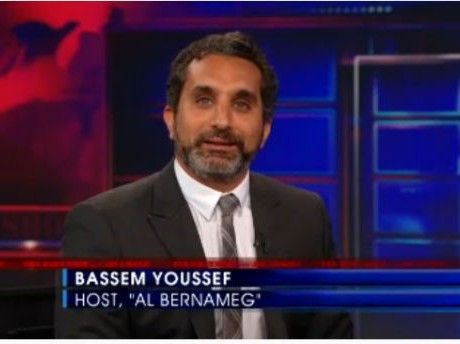
In his come-back episode after a period of self-imposed silence, renowned satirist Bassem Youssef didn’t disappoint. And while it may well have been on account of what he said, the episode’s success is may also be indicative of people’s desire to laugh.
Judging from the noise on social media and the number of curtain raisers published in several outlets, the episode was heavily anticipated. The legacy of Youssef’s satire, which had become an outstanding political weapon during the short-lived rule of former President Mohamed Morsi and the Muslim Brotherhood, was recalled. But also pre-show discussions indicated a curiosity about whether and to what extent Youssef would actually manage to cross the red lines in the current milieu of a pro-military government that has been receiving little to no criticism in mainstream media.
In a poignant tweet, Timothy Kaldas, a photographer and writer, described the anticipation for Youssef’s show as a dire need for a different voice, a different sentiment. “Two and a half years into a revolution, we obediently sit at home Friday night at 7 on army’s orders hoping a comedian will criticize our rulers for us.”
In the show, Youssef did three main things, after candidly and of course, satirically, putting on display the confusion and disorientation that he and his crew had to go through during their temporary silence. He mocked Morsi and those who still speak of his return. He mocked the pro-military government and those who idolize the army. And by mirroring the absurdity of the deep polarization between Morsi and military supporters, he mocked the overall conflict Egyptians have been living the last four months.
The product is a satirical version of the third space that some chose to occupy, that refuses to side with either poles of the conflict. This position is never easy to navigate and has often been bashed by both Brotherhood supporters and army lovers as treason in disguise. Youssef’s promise is that with some laughter, this position can be more easily swallowed.
Taking such a position is not easy at a time when most mainstream media has chosen to form a chorus in support of the military, while other dissident voices have been largely silent. Youssef wants to remain critical. But if he is back to stay, how can he strike a balance?
Some viewers felt that Youssef was treading a fine line. In a post-show reflection, writer Mohamed El Dahshan tweeted, “Bassem is making fun of [Armed Forces Commander in Chief Abdel Fattah] al-Sisi’s fans and not Sisi himself. This is smart. But what is unfortunately true is the show was freer and more audacious at Morsi’s time.”
Sherif Azer, a human rights advocate responded to this with, “I think he mocked Sisi in as much as he is comical compared to Morsi.” In another tweet, he continued, “I see that he said all the fun stuff that can be said about Sisi and if Sisi did other funny things, they will come up in future episodes.”
For Azer and others, Youssef mocked the conditions surrounding Sisi, from his cosmetic appointment of a civilian president whose name is barely remembered, to his public call for a popular mandate to use violence against adversaries. For them, Sisi was not spared, and it should not be expected that he be mocked the same way as Morsi because they are fundamentally different.
Others also felt that while Youssef was being careful, he was also successful. Basma El Husseiny, a cultural figure, wrote two tweets in the span of an hour: “Bassem is walking on a very fine line. Let’s see if he will fall.” This was shortly followed by “Bassem is tamam” (Bassem is good).
The final few minutes of the show perhaps point to the ways in which Youssef will continue to negotiate the red lines that limit today's political discourse. It is only at the end of the hour-long episode that we hear the word “coup,” and it is not uttered by Youssef himself. He along, with a few others, is performing a song, and one of the supporting singers uses the term. The others get worked up, surround him, and Youssef asks him to repeat what he said. When he says the word “coup” again, he is smothered. In a biting parody of the current political climate, Youssef, with a frenzied tone accuses the young man of hating the military and of being a Brotherhood supporter, unfazed by the revelation that the man is Christian.
For many online observers, one measure of success was the amount of negative reactions the episode generated from Sisi’s supporters, much like the wave of attacks to which Youssef was subjected from Morsi’s supporters in the past.
One sample is this: “It looks like the lieutenant is making many people jealous. Here’s to more!” Aya Kamaly, a young tweep wrote.
A more infuriated tweep is actress Ghada Abdel Razik. She was granted a parcel of mockery from Youssef when he showed a short clip of her praising Sisi shortly before making fun of her flamboyant hairdo. A more serious Abdel Razik registered her criticism in patriotic language, leaving all talk about hair aside. “You are all agents of America, Qatar and Israel, and from now on we will not be silent,” she wrote in a tweet. “This is the fifth column that started with ElBaradei and now Bassem Youssef. But this is in your dreams. Egypt is the army and you are all traitors.” Abdel Razik insisted on telling her fans that it’s not about her, that she is not upset that Youssef made fun of her, but it is Sisi who must be defended.
Patriotism aside, Abdel Razik did finally get personal in her criticism of Youssef, even if it was just with one tweet. “He is a failed doctor turned into a TV host and he is taking millions of pounds for it. Ask him how much he is making.”
This backlash against Youssef presents a fresh understanding of the deep polarization amongst Egyptians today. In many ways, Sisi’s supporters mirror Morsi’s in their steadfast positions and in their rejection of any counter thoughts. Amro Ali, a scholar and researcher, wrote, “it seems like the blind-ridden Muslim Brotherhood and Sisi supporters struggle to understand puns, metaphors and subtext.”
With this level of retaliation, which includes cases already filed against Youssef by military supporters who couldn’t go to bed without seeking "justice" against him, it could be said that Youssef did the job, without being literal about it. Journalist Dina Samak put it like this in a tweet, “Bassem Youssef didn’t tell people today the king is naked but asked everyone to look at his clothes.”
In so doing, Youssef showed one more time the potential of humor as an unmatched political weapon but also as a mirror through which we can better see each other; a view that we cannot afford to have while in ongoing conflict mode. He also showed the potential of negotiation with perceived limitations as an alternative to silence.

تقارير ذات صلة
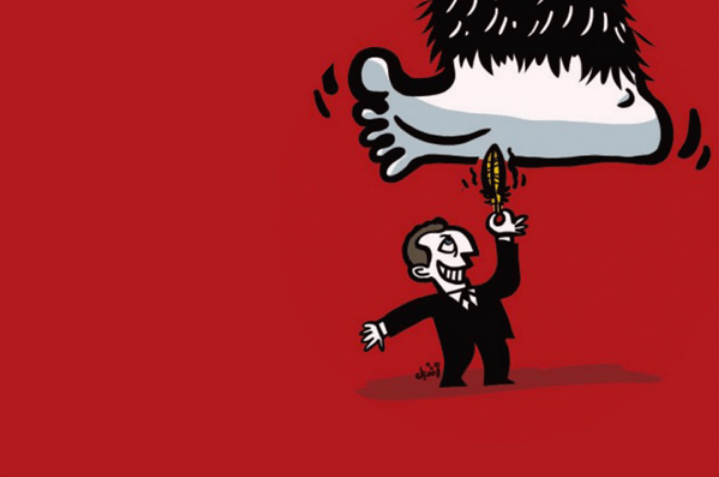
On the giant that Bassem Youssef did not tickle
Our premature revolution was born from a sterile womb, and from that same womb Al-Bernameg was born unripe
Three films, one spectator and a polemic: Arab documentaries and ‘global’ audiences
Sometimes being simplistic, clichéd and politically problematic is exactly what a film needs to succeed.
A year of comebacks and retreat
With the onset of a new regime, a new government, jail sentences and dropped charges, and preparations for a parliamentary elections, the year 2014 has seen old familiar faces making…
Your support is the only way to ensure independent, progressive journalism survives.
You have a right to access accurate information, be stimulated by innovative and nuanced reporting, and be moved by compelling storytelling. Subscribe now to become part of the growing community of members who help us maintain our editorial independence.
Join us