
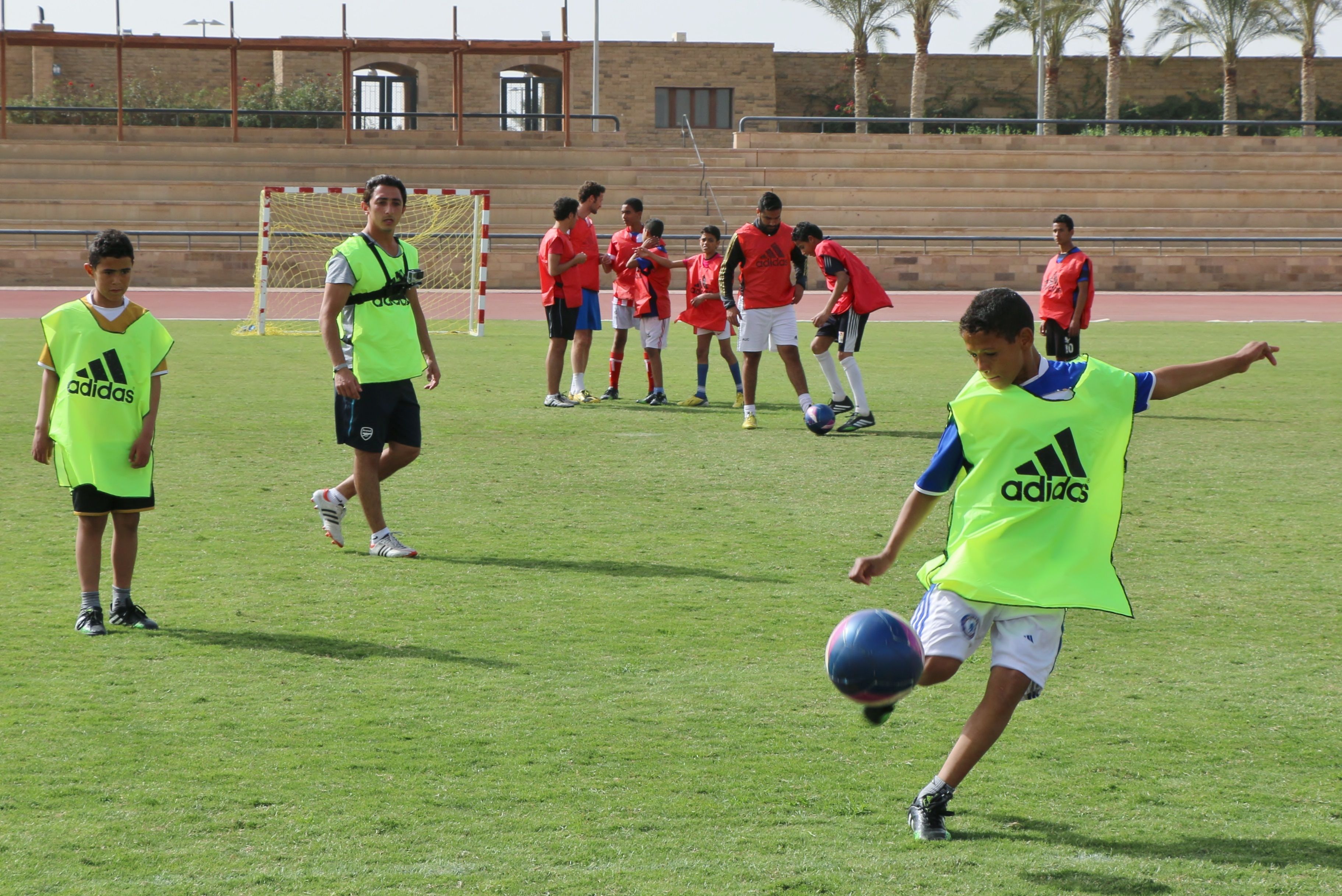
It’s a Saturday afternoon, and there are about 15 boys on the football pitch at the American University in Cairo’s new campus. Half of them are in neon yellow jerseys, while the others are in an equally neon pink. Khaled Mohamed is dribbling the ball up the field backside; he passes it off to the right flank where his teammate is running up the field. Reaching the ball just before it goes out of bounds, the boy nails it across the penalty box — an almost perfect corner kick that lands smack dab in front of the goal. At this point, Khaled has made his way into the offensive mix, collects the ball at his chest and knocks into the goal with one clean swoop.
“Goooooaaaaal” all the boys shout as they huddle around each other, high fiving, dancing, and praising one another with your typical athletic rapport, “You’re the man!” or “You’re a star!”
On the pitch, these boys are just like other budding football players. They are confident, and collectively minded — they make mistakes and get angry with themselves only to redeem themselves during the next play.
But it wasn’t always like this for them. They used to live on a very different playing field and a much harsher pitch: the street. Now, they are hoping to go Rio de Janeiro later this month as part of the Street Child World Cup in Rio.
These boys are no longer street children. All of them have been living at their respective NGOs for at least a year, mostly they are split between those living at Ana El Masry’s (I the Egyptian) facility in 6 October, Hope Village in Maadi, and Face Children’s accommodation. This past week, Save the Children, one of the largest global children’s charities also announced their partnership with the Street Child World Cup.
Initiated by British human rights group the Amos Trust, the inaugural Street Child World Cup took place in Durban, South Africa in March 2010, with eight participating teams of boys and girls from four continents. Through football, art and an international street child conference, the organization aims to challenge the negative perceptions and treatment of street children worldwide and to provide a global platform for street children’s voices.
According to Maha Maamoun, a member of the Popular Campaign for the Protection of Children, the main factors that lead children to the street are poverty, followed by family or domestic violence.
“Once on the street, the children continue to receive day to day abuse by others living on the street,” Maamoun explains. “But, the other major issue is the hundreds of children that are scooped up during protests, jailed, and then further abused in prison. It’s not necessarily by the police or security forces, but mainly by other inmates encouraged by the supervisors.”
Egypt, Maamoun says, has a particular cultural issue in dealing with children in general, and as a society often treats them as adults.
“Street children are often stereotyped as criminals, so we need a huge effort to reform this culture and the aggression towards children — they are on the street to begin with because of inhumane treatment and abuse by society, so all efforts that work to combat this perception and treatment of children are beneficial,” she says.
Egypt’s team, which has now been training twice a week for close to 18 months, was initiated by Karim Hosny and Mohamed Khedr. The coaches say they have always believed in the possibility of utilizing football’s momentum to create something positive for society. After learning about the Street Child World Cup in 2011, they approached the local NGOs now participating in the project.
But, along with the program there are difficult decisions to be made. Only nine players are allowed to travel as part of the Egyptian team to Brazil due to the financial cost and limited accommodation at the Rio de Janeiro camp. Starting with about 20 kids, the team has gone through several rounds of cutting players. Hosny explains that while it is not an easy process, he believes in the life lessons associated with try-outs.
“We tell them about our long-term plans which make them feel less sad, and sometimes we go to visit them in the institutions,” he says. “For sure they feel sad [when cut] but at the end of the day it's a part of the experience.”
Those involved with the local project hope to also add a female team to the World Cup in the coming years.
“I believe that football has the dynamics for everything, such us teamwork, wining and losing and footwork. I think that the dynamics of football include all factors of life,” Hosny says.
The boys speak of the cuts with grace, saying only that they hope to travel to Brazil, and talking about the lessons they’ve learned from the team.
“In the beginning we were not familiar and we did not want to cooperate in the game because we did not trust each other,” says 14-year-old Khaled Mohamed, who spent five years on the streets before coming to Ana El Masry But after a while we got to know each other and we started to cooperate until we reached the level we are at now, which I think is very advanced.”
Problems at home forced Mohamed and his sister into a life on the street before they moved to the NGO facilities two years ago. Mohamed recently refused an offer from PEPSI to join its football team in order to stay with his sister at the NGO.
“I refused because if I left with them, I would not be able to travel with the academy [to Brazil], and I think the academy is better for me because they raised me and provide me with needed support.”
As he comes off the pitch, 13-year-old Abdallah Ezzat, who has been a resident of Ana El Masry since he was nine years old, talks about how he can snatch the ball but is working on his speed.
“This is the first time I’ve played football with grown up people,” he says. “I have learned to cooperate with other players, and I think football is not just a game — it is a way of living.”
“We get excited when we play football. We learn how to cooperate, how to perform as a team, and how to recognize mistakes and correct them,” he continues, “Also, never to undermine one’s teammate, even when they make mistakes, and to always encourage them.”
At the Ana El Masry facility in 6 October, Khaled and Abdullah sit next to each other in Arabic class. The two boys look focused as they read out loud from their textbooks while the teacher moves between the students and the wall, pointing out images of the vocabulary they are learning.
Made up of three adjoining sand-hued buildings in the desert established in 2008, the Ana El Masry facility currently houses 144 children, while also providing the children and their families with what they hope can eventually become a holistic rehabilitation program.
There are no accurate figures for the number of “street children” in Egypt due to the difficulty in defining which children should be included in the survey. Locally focused NGOs including “Plan Egypt, Face Children” estimate numbers are between the tens of thousands to upwards of two million, mostly in Cairo and Alexandria.
“It always starts with children on the street,” the director of Ana El Masry, Soheir Mourad Malek, explains. “This is the outreach program — the aim is to know the children and their environment and to try to convince them to make decisions about their future.”
If the child, sometimes with the involvement of their family, chooses to enter the institution, they are then evaluated by Ana El Masry staff, which includes teachers, psychologists and social workers. They are then placed in a comprehensive program working towards rehabilitation and each child is provided with an educational program, vocational training and healthcare. The NGO also often helps the families move off the streets or find more stable income through micro-finance entrepreneurial projects.
It costs between LE1,500-2,000 per child, each month. Malek explains that 83 percent of the funding comes through the Sawiris Foundation, with occasional injections from the founding members. However the institution continues its struggle to raise the needed 17 percent to remain sustainable.
For Ahdy Ezzat Iskandar, a founding member of the NGO, it is difficult to rationalize the amount of money needed to send the children to Rio. Despite this he has been working with the other NGOs, to help raise money, approaching corporate sponsors and individuals who are excited by the program, although no funds are coming from Ana El Masry directly.
For Adel Gad al-Karem, a manager at Hope Village NGO, the Street Child World Cup program helps by reinforcing the legwork local NGOs have already put in. After launching a sports academy in 2007, the NGO found that sports both attracted children and helped significantly in their rehabilitation process.
“Egyptians are fond of football and all the children know that,” he explains. “The media spotlights the trophies of the national team and Ahly club, and that makes football a source of attraction for these children.”
Last year’s Street Child World Cup proved to be a growing platform for more than just football; the children also took part in what is considered to be the first international street child conference, leading to the Durban Declaration, a collective voice demanding the rights of street children be recognized.
During the conference, the children worked with the Street Child World Cup organizers and Plan International to draft a manifesto around the issues of home and family, protection from violence, and the right to access education and healthcare. The declaration was then presented to the UN Committee on Human Rights, central and regional governments, in addition to various civil society organizations. According to the Street Children World Cup website, the manifesto calls on these organizations to challenge the impunity around the violence faced by street children, lobbies for preventative measures that enable them to stay at home, in addition to suggesting greater investment in services for street children and for their voices to be heard.
In the 2011 tournament, eight teams competed in a seven-a-side football tournament, in which India beat Tanzania 1-0 in the final, receiving high-profile support from football legends like David Beckham and Sir Alex Ferguson.
This year, the Street Child World Cup will be held in Rio de Janeiro before the next World Cup — the tournament will kick off on March 28 and will also feature a girls division. More than 20 countries and 230 boys and girls are expected to participate. Again there will be an arts festival and a global street child conference that will culminate in the Rio Declaration that will include a number of country-specific tasks.
While Ana El Masry’s Iskandar remains supportive of the program, due to its ability to alter global perception that street children are not a time bomb for society, but rather victims that deserve rehabilitation and a fairer playing field, he continues to have reservations.
“I’m really surprised that people want to pay for a ticket for one of these kids to go and spend a week,” he says, “and yet they don’t want to sponsor bringing them up.”

Maha ElNabawi
After graduating from the American University in Washington, DC with a Bachelors degree in Business, Maha began her publishing career in NYC with indie pop culture magazines, the likes of…
تقارير ذات صلة

The day we stopped cheering
Video | As stars set and rise
Al-Falaki is the most famed of Alexandria's Ramadan street football tournaments
Pay-to-play: How private investment is eroding youth football in Egypt
The effects have been pernicious, cutting out players who simply can't afford to pay to play.
Your support is the only way to ensure independent, progressive journalism survives.
You have a right to access accurate information, be stimulated by innovative and nuanced reporting, and be moved by compelling storytelling. Subscribe now to become part of the growing community of members who help us maintain our editorial independence.
Join us