
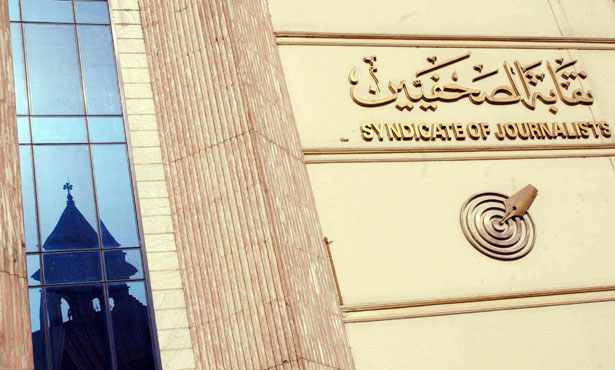
Journalists welcome new syndicate head with high expectations
Newly-elected press syndicate head Yehia Qallash’s win against his predecessor Diaa Rashwan in Friday’s vote has raised the hopes of many journalists across Egypt.
Rashwan, who was elected to the post in 2013, has been the subject of severe criticism in recent months, along with the board of the syndicate, for failing to come to the defense of journalists victimised in their daily practice.
These factors contributed to his loss to Qallash, with a 900-vote difference. Qallash’s win is seen as a victory for those who have fought for the independence of the syndicate against those aligned with the state.
The following is an outline of the most critical issues the new board has inherited.
Protection of journalists
The endangering of journalists following the 2011 revolution, and especially over the last two years, has been one of the most contentious issues in the syndicate and wider media circles. Over 12 journalists have been killed since 2011, including: Ahmed Mahmoud — a journalist for Al-Ahram newspaper killed in January 2011, Hosseiny Abou Deif — a journalist for Al-Fajr newspaper killed in December 2012 and Mayada Ashraf — a journalist for Al-Dostour newspaper killed in March 2014.
As the number of journalists killed while covering events has increased, no one has been convicted for their deaths. Former President Mohamed Morsi and 14 Muslim Brotherhood leaders are currently on trial for Abou Deif’s death as well as protesters killed during the “Ettehadiya presidential palace” events, with a verdict due on April 21.
The front to protect journalists and their freedoms, made up of a number of journalists, has documented the cases of 24 journalists behind bars, some detained pending investigations and others currently undergoing trials.
One of those detained is freelance journalist Mahmoud Abou Zeid, known as “Shawkan,” who was arrested on August 14, 2013, while covering the dispersal of the pro-Morsi Rabea sit-in. He has been imprisoned for more than 500 days on charges of murder, attempted murder, the possession of arms and vandalism.
Most arrested journalists are facing criminal charges unrelated to publishing. Gamal Ziyada, a correspondent with Yaqyn network, has been detained since December 2013, when he covered clashes at Al-Azhar University.
The International Committee to Protect Journalists said in a statement in February that the Egyptian authorities have been using criminal charges to crack down on media and limit the coverage of protests.
Other journalists are still awaiting final decisions in their cases, such as Youssef Shaaban, a journalist for Al-Bedaya website who was sentenced to two years in the “Raml Police Station” case on charges of rioting in Alexandria. Shaaban says he was arrested while covering a sit-in and is appealing his sentence.
Another journalist who has been on a government list of Brotherhood members and associates whose assets are to be frozen is Hisham Fouad, who works for the Nasserist Arab newspaper.
In a report presented by the outgoing board during the general assembly, held on the day of the elections, the board stated that it had provided journalists with protective gear in coordination with the ministers of defense and interior. Journalists have repeatedly deemed such measures as insufficient.
Rashwan repeatedly defended the syndicate, asserting that representatives attended the court sessions of journalists, and that journalists have been requesting more and more in the face of an organized and intentional attack.
Working relationships with media institutions
Over the last year, several newspapers have dismissed large numbers of journalists: Youm7 laid off 130 and Al-Ahram laid off 200.
As syndicate protection is limited to members, most of those who were laid off were not supported.
A condition for syndicate membership is formal employment in a media institution, leaving those working with no contracts unable to gain membership.
In a report on Friday, the syndicate board said that it had intervened in several of these cases, but was restricted by its bylaws. Journalists say such laws discriminate against individuals rather than institutions.
During the meeting of the General Assembly, journalists recommended that the syndicate put pressure on newspapers to issue periodic reports, including the numbers of interns working for them. They also demanded that the syndicate extend its protection to include non-members and encourages institutions to improve conditions for all journalists, including the establishing of a minimum wage.
Legislation concerning journalists
Legislation governing media and journalism present a challenge for the new syndicate head. The 2014 Constitution contains several articles protecting the freedom of the press, including Article 71, which prohibits media censorship. However, there are several laws in the penal code that oppose this.
A national committee was formed late last year to amend media-related legislation, including 24 syndicate members, and the Supreme Press Council.
This committee has completed a draft resolution to amend or annul over 40 articles in the penal code that allow for the imprisonment of journalists, according to a report it released, as well as recommendations for the drafting of laws that complement those in the constitution guaranteeing freedom of the media, including a law supporting freedom of information.
Syndicate laws and admission rules
Since its issue in 1979, the Journalists Syndicate Law has not been amended to match developments in the profession. A majority of journalists deem admission regulations problematic and call for amendments to include those in the profession who are not tied to an institution.
Lack of syndicate recognition for organizations with online content only and no print edition is a contentious issue, leaving many journalists with no access to membership.
The committee working on media-related legislation is also reportedly developing a requirement for compensation in the case of arbitrary layoffs of two to four months, as court cases related to dismissal have reached 250 in recent years.

تقارير ذات صلة
What happened in the first coordinating session of the National Dialogue?
Sessions in the National Dialogue proper are set to begin after Eid al-Adha
Security interventions place 3 pro-govt figures on Egypt’s Journalists Syndicate council
The security apparatuses sent a list of six nominees by WhatsApp to newsrooms
Permits, penalties and paranoia
Foreign media under Rashwan's State Information Service
Your support is the only way to ensure independent, progressive journalism survives.
You have a right to access accurate information, be stimulated by innovative and nuanced reporting, and be moved by compelling storytelling. Subscribe now to become part of the growing community of members who help us maintain our editorial independence.
Join us