
In the Spider’s Room: Because one hand met another 15 years ago
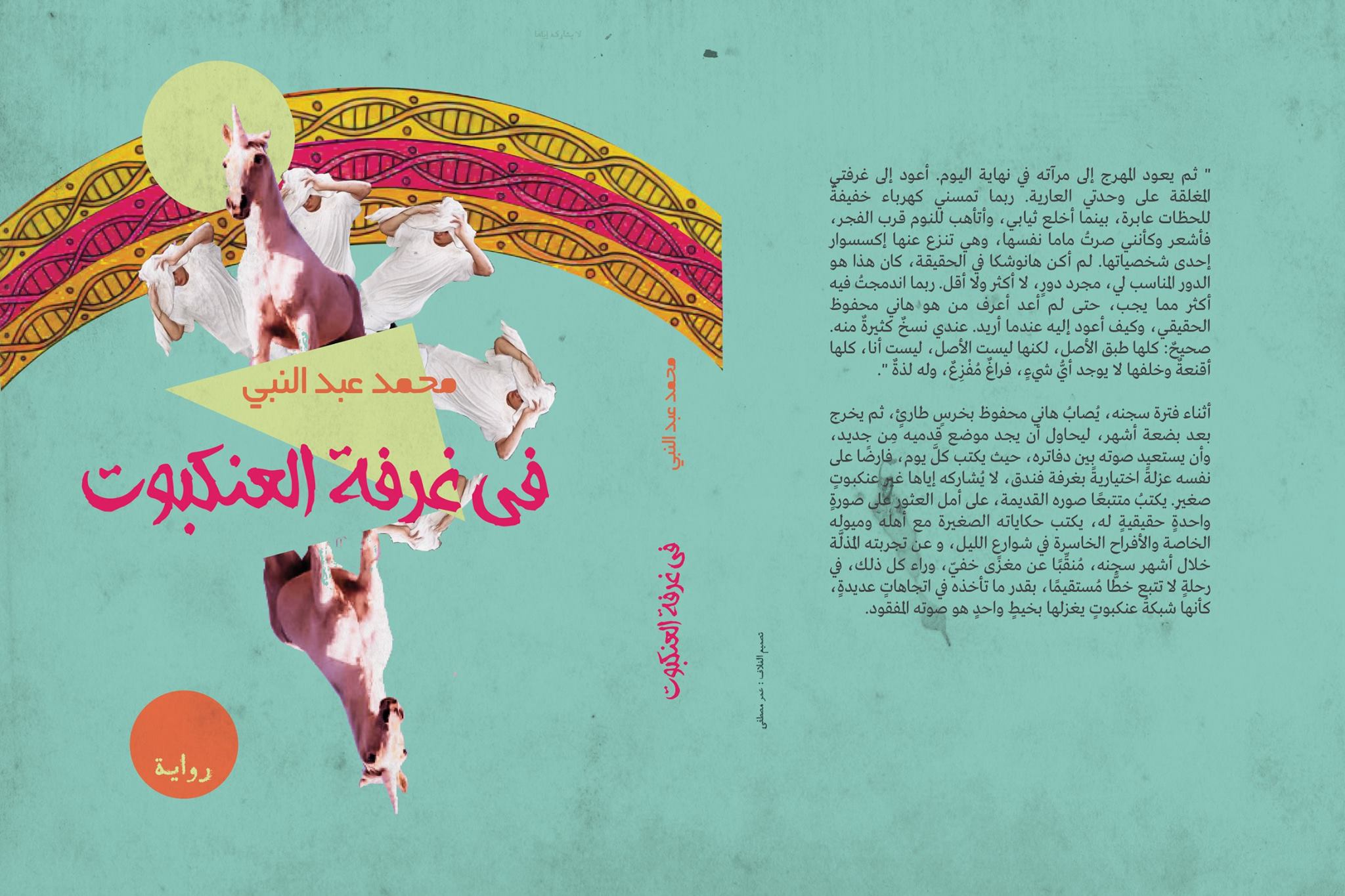
Author and translator Mohammed Abdelnaby places many obstacles in the path of his protagonist in Fi Ghurfat al-Aankabut (In the Spider’s Room, Dar al-Ain, 2016).
Hani Mahfouz is lonely and reticent, but if it were not for these difficulties perhaps we would not have known that much about Mahfouz’s life. This is not a confessional novel, though it may seem like one.
The author does not provide an initial explanation for his protagonist’s immediate candidness, and readers of In the Spider’s Room proceed to get entirely entangled in a spider’s web.
Abdelnaby’s focus is a 15-year-old incident, when guests of the Queen Nariman boat on the Nile were arrested, known in the media during the ensuing commotion as “the Queen Boat case.”
The spider’s first thread is spun when someone is arrested in the street for holding his partner’s hand. It was just a hand meeting another in the public sphere.
Despite the scene’s symbolism, it expresses the cruelty, agony and ferocity of reality. Outside this novel, we have seen how the life of a male who expresses his feelings for another in Egypt can be violated by the judiciary; its constant condemnation and ensuing social stigmas are usually underpinned by the moral guardianship of the press and viscious attacks on people's characters. Luckily, there aren't many who have paid attention yet to female gay relationships.
Mahfouz gradually reveals himself over the course of the novel, but the author does not easily give away the reason for this.
Mahfouz expresses passionate feelings, despite being largely reticent about the details of his life. He reveals very little about it, and shares very little with people around him. He only expresses his feelings, particularly his sexuality, after going through a harsh experience. Under the shock of prison, he loses his voice during trial. He becomes temporarily mute and turns to writing.
As we get to know his story through his continual writing, it eventually becomes clear that a psychiatrist’s advice is key, and that what we’re reading is actually motivated and driven by this unknown figure. Readers might find this discovery disappointing. I can recall my lack of enthusiasm while reading Franz Kafka’s Amerika and hearing that the text was written during therapy.
Behind Mahfouz’s biographic log, the author plays aesthetic roles; one can sense his subtle mark on the text as if he were not author but invisible editor. The documentary feel might lead the reader to falsely assume that Abdelnaby edited Mahfouz’s journal.
The protagonist was not a guest on the infamous boat. He has no involvement with Samir Barakat, the main suspect in the case, but is arrested on the street after a police informant snitches on him. The protagonist is a passerby, jailed for months before being acquitted in the first hearing. It’s an interesting angle for the author to explore the novel’s major theme.
Deliberately and repeatedly, the protagonist shocks us with his reactions. The reader may think he is an egoist who only thinks about himself, yet he is afraid to disappoint his mother, a famous actress, if she ever finds out. He openly tells us his hidden history, revealing his secrets to us rather than those around him.
Reading becomes an evolving relationship, a joy born of a friendship with this spiders web that Mahfouz unravels for us, despite the fact that he is good at hiding and enjoying as many pleasures as possible.
Like many gay men in Egypt, he has lived over 40 years disguised by various masks. He has been a husband and a father of a little girl, he hasn’t cared much for the political situation in the country, and he’s never had a hobby — except for creating masks, like when he keeps meeting a woman for sexual practice before marriage.
With Abdelnaby’s subtle style, this biography transforms into a beautiful and immensely enjoyable text, despite its relative lengthiness.
He presents a view that sides with Mahfouz’s voice — a voice that has been lost, as mentioned — making this novel his own lost voice. This intersects with another reference: the defendants in the “Queen Boat” case hid their faces with plastic bags or napkins. Although their full names were published, they still wanted to hide from society in that vulnerable moment.
Beyond condemning their feelings, the accusations levelled at them included forming a religious cult calling for the vindication of “Lot’s people,” and blasphemy. They only managed to hide their faces, but Abdelnaby gives one of them the chance to speak out.
While the author sets his character in this case and tells the story through him, he does this within the literary frame of a story that takes the form of a confession.
Behind this artistic mask — story masked as confession — the reader will find an investigative spirit in the spider’s room, where descriptions and words seem extremely sensitive. They express the author’s view of and affinity with Mahfouz’s voice, more than expressing his community.
Abdelnaby’s text is delicately packaged, but the aesthetics of his writing don’t compromise precision. The author thinks carefully before deciding on one word over another. He describes a meeting between Mahfouz and a friend, which shakes the stable ground of his life and marriage, using a simple expression: “My friend entered me.” He doesn’t choose an aggressive or erotic expression, as if he takes the side of Mahfouz’s precise feelings, and continues to express them without reservation.
Just as Abdel-Aziz is Mahfouz’s mature choice, Abdelnaby’s subtle style reveals his own sense of maturity and his awareness of the power of words. When he uses an expression that condemns same sex relationships, he places it between quotation marks, knowing the kind of impact it will have. And thus the novel is accomplished without omitting society’s constant condemnation of gay “lovers,” as described by the author.
To read In the Spider’s Room is to enter a powerful story. It seems like the author wanted to rehumanize each person affected by the flames of that old incident after they were dehumanized by condemning looks. Abdelnaby’s writing averts an existing evil, and leaves Mahfouz still looking for a way to survive in his society in the face of any future incidents.
Read Ahmed Shafei's take on the novel here.

Ahmed Wael
Egyptian journalist and writer. Generally interested in cultural affairs in Egypt. He's currently interested in stories and the nature of life in the city.
تقارير ذات صلة
Noor Naga, metafiction and the limits of self-knowledge
Sometimes a story needs three acts

‘Nothing moved but the mirage’: Movement and its absence in Adania Shibli’s Minor Detail
The novel is a contender for the 2020 National Book Awards
What I didn’t tell the officer: a review of Randa Shaath’s The Sand Mountain
"The Sand Mountain? Hmmm … Is this a political novel, Mr. Shady?”
Your support is the only way to ensure independent, progressive journalism survives.
You have a right to access accurate information, be stimulated by innovative and nuanced reporting, and be moved by compelling storytelling. Subscribe now to become part of the growing community of members who help us maintain our editorial independence.
Join us