
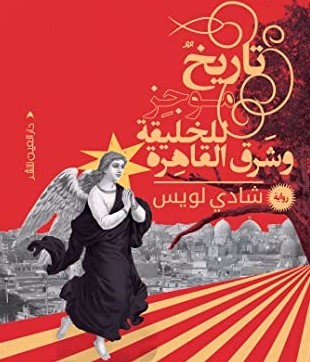
In Other Words | A brief history of genesis and East Cairo by Shady Lewis
Editor’s note:
Published by Dar al-Ein earlier this year, 2021, A brief history of creation and East Cairo is Shady Lewis’ third novel, and perhaps a continuation of the journey of his main character in both his first novels. It’s also a continuation of ongoing reflections on fragility, and specifically on being a Coptic Christian in Egypt.
When I was a child, our street didn’t have a name, but a number. They say numbers don’t usually have a meaning, and if they do, they are abstractions pointing to a larger meaning. But it would be a mistake to assume that the number 30 is a reflection of anything other than itself. And yet, because it was the number of the street we lived on, it became an abstraction of endless memories. Naturally, memories have no significance until they are narrated, and there would be no point in narrating them if there was nobody to listen. And there is no meaning to listening unless the narrator and the listener share a common language. This was Adam’s conundrum at the beginning of all things. Who was there to listen to his story? When God created for him all manner of creatures: And Adam gave names to all cattle, and to the fowl of the air, and to every beast of the field. This was quite a feat and would have taken some time. After all, there was nobody to help Adam out. Once this was done, God took one of his ribs, and closed up the flesh instead thereof; And the rib, which the Lord God had taken from man, he made a woman, and brought her unto the man. Adam also gave her a name. Eve, or Hawa, because she was the mother of all living beings. He who names something becomes its master and God had allowed Adam to name all created beings for that very purpose.
Numbers were all that remained to Eve, and perhaps this was to her good fortune, for she kept this monumental secret to herself, pondering it in her heart. Modesty is the best cover for the oppressed. A word that remains unuttered holds within itself an entire universe. And so, when God expelled Adam and Eve from heaven, names lost their absolute honesty. Words no longer meant what they used to. They became pictures, mere shadows of their former selves, symbols that we agreed on just enough for us to understand one another, and barely at that, because it still entailed a fair amount of guessing. Because the innocence of paradise was forever lost, interpretation became a necessity. But it was only ever approximate and always the object of suspicion, demanding dictionaries, teachers, poets and clergymen. This is how twin siblings, rhetoric and deceit, were born. It is also how Adam lost his mastery over the creatures of the earth and came to fear monsters. They too came to fear him and an eternal rift was born.
As for Eve, driven by the fear of the disgraced, she kept her secret to herself, even after the fall from Paradise. Perhaps she also acted out of hope for the uncertain salvation of her children. Thanks to her, numbers held on to their original innocence, remaining objective, at least in appearance. They did not invite interpretation and analysis, except as a simple and direct mathematical concept, promising a return to the lost paradise of a long-awaited world.
For a child my age, my father was Adam, my mother was Eve and Street No. 30 was my paradise, or as I would discover later, the winding road connecting paradise and purgatory. The street stood at the crossing of two worlds. Said to have been built by a Swiss company and gifted to Nasser at the end of the fifties, our neighborhood was the driving force behind the urbanization of Ain Shams, which served as a natural barrier separating Masr al-Gedida, New Cairo, with its villas and palaces, from the rural Matareya. Meanwhile, the Hilmeya Estates were a mix of the two, or rather a buffer zone between them. At worst, this made them a doorstep from one world to another entirely different one.
Our small neighborhood was made up of a network of streets lined with upright trees of uniform height, with small squares drawn at each intersection and little gardens at the center of each set of four squares. This validated my father’s claim to distant relatives that the two-story house of carrier walls that we lived in, with its back yard and cement balcony, was in fact a villa. Hearing this, my mother would turn her face away, biting her lip and muttering: "And now public houses have become villas".
My father’s claims did not stop there. He would often repeat to us and to others - and even to himself - that we basically lived in Masr al-Gedida, or Heliopolis. “It’s only ten minutes to Heliopolis, and Heliopolis is in Masr al-Gedida, right?" And if no one responded, he would reply himself, saying: “Of course, Heliopolis is the fanciest area in Masr al-Gedida".
On occasion, he would draw his final card, one he saved only for his most stubborn audiences. These would be desperate cases, when even he would begin doubting himself. "Heliopolis is Ain Shams and Ain Shams is Heliopolis". He would proceed to share a thorough analysis of the etymology of the word. With great poise, granted by the certainty of his knowledge, he would explain that helio meant sun in Greek, and polis meant city. Most people, therefore, believe it to mean the city of the sun. However, they are surely at fault. Polis can also mean police or government: the eye guarding the body, alert in protecting it. And so, in conclusion, Heliopolis means Ain Shams, the eye of the sun. Granted this was a slight deviation from the truth, it remained a perfectly acceptable interpretation, even after the passing of thousands of years.
Here the discussion would usually end. The audience was not necessarily convinced by the argument, but they admired the effort exerted, the sophistication of the argument, and appreciated that they had witnessed a game well played, albeit by an opponent. That being said, none of the listeners could claim any knowledge of Greek or of etymology.
My mother would retort sharply and logically from the kitchen: "Ten minutes from Heliopolis?... Imbaba is ten minutes from Zamalek, does that make Imbaba in Zamalek?" She said this not to provoke conflict, but rather to entertain the guests with a show of marital bickering. These performances, though mundane and fabricated, were popular in family gatherings and television dramas alike.
I have long been impressed by my father’s knack for playing with language, excavating the etymology of words, transforming them, flinging them from one language to the next and leaping between eras with the purpose of pushing the meaning of each word just enough to redefine it. Although this talent dazzled me, it also left me in a perpetual state of suspicion. I couldn’t trust names and I was relieved that our street, No. 30, could not become the victim of my father’s exhausting — and humiliating — maneuvers.
The guests arrived unannounced; my mother was obliged to whip up a quick meal. But first, she changed out of her oil-stained house dress into something appropriate and clean, and quickly fixed her hair into a bun with a few bobby pins. A bun, after all, was the safest and easiest fix — and the most elegant. That was how visitors had showed up in the past: a light knock on the door and at the entrance, the earth would split before them. Sudden arrivals always triggered a state of anxiety. I would hear commotion in the kitchen, pots banging louder than firecrackers on a public holiday. This was an essential part of the joy of hosting, a catalyst for the hope that hit us like a light fever, particularly on slow days, as we waited for the anticipated guests with a mixture of relief and apprehension.
“The bald girl brags about her niece's hair, Om Sherif.” The guest's comment was followed by a brief, half-forced chuckle from Mother, expressing her gratitude for his participation in the game. Closer to a friend than a relative, Raga’i, my father's cousin, was the closest relative to him in his age range. Perhaps that is why mother found no shame in this little joke she performed for him and for his wife, who always seemed fresh and carefree.
Uncle Raga’i's visits, which only took place two or three times a year, were a source of great joy. Among all our relatives, only he was wealthy enough to shove five pounds into my little palm upon his arrival — and back then this was a considerable sum.
Despite the smell of the cigarettes which he chain-smoked, he carried with him a strong, refreshing smell, which hit you like a slap on the face. It became a part of his physical presence and lingered about the house for a day or two after his visit, like a memory that fades into sadness and regret. I could never decide whether I loved him because of the cigarette scent or loved the scent of cigarettes because of him. None of our other acquaintances had such an overwhelming scent and charisma. Another reason we loved him was his soft and kind accent, native to Luxor. When he spoke, his qafs became Cairene jeems, and he dragged his vowels. All this gave him a halo of mysteriousness and an air of affectionate virility.
I followed his hands as he put his cigarette aside, resting it on the copper plate in front of him. I guessed, from his light taps on his thigh, that he was about to say something important. He only ever surrendered his cigarette for an urgent matter, or for one of his long chuckles that made his giant body tremble, as if to shake out some invisible dust left behind by his uninterrupted smoking.
Uncle Raga’i leaned towards his wife, as if to speak to her, or to say something only to please her. Aunt Hilana didn't reveal any special expression of gratitude, maintaining a silence that was more drowsy than graceful.
"Something stranger than fiction once happened to me in Imbaba."
My mother sprinted from the kitchen to the living room, in a series of childish hops that seemed uncoordinated given the square-shaped, curvy terrain of her figure. Her entrance was sudden and surprising. She came to a halt in the middle of the room, then began taking hesitant steps backwards. She dragged her feet on the tiles, as if erasing a mistake she’d made by joining us. She returned to the hallway and leaned with her left shoulder on the wall, awaiting the guest's wondrous story. She was close enough to be part of the group, but far enough to remain an outsider to it. This was one of the many maneuvers, small in detail and little in consequence, that mothers must seriously contemplate and consider. She was in limbo between the kitchen and the living room, always in two places at once. This all seemed appropriate and intuitive, for she still had the knife in her right hand, now resting on her waist, and the half-shredded onion in the other hand. Her forehead was dripping with sweat, a testament to the August heat and fire under her many pots and pans.
"Let me help, Om Sherif, it's so rude of us to make you work so hard."
Aunt Hilana jerked out of her seat, standing with both hands outstretched in the direction of my mother. In her voice was a ring of admonition. But a light gesture from Mother's hand was enough to convince the guest to sit back down. Hilena lost the expression of exaggerated pity on her face and replaced it with one of resignation, which also quickly evaporated.
"Your presence is a pleasure to us. We don't see you every day."
My mother would always follow this habitual statement to all our guests with a gesture that angered my father and embarrassed me. She would hold the long sleeve of her blouse and pass it over her eyes and cheeks, wiping away a mixture of sweat and tears shed over the betrayed onion, closing the scene with a long and loud sniff.
I had heard Uncle Raga’i's story about Imbaba at least twice in his previous visits. I had also heard it more than once from my father. His little anecdote was not the only repetitive thing about family gatherings. In a time when very little happened, and when we desired very little to happen, there were merely a handful of subjects for conversation with guests. After the customary complaints about the hardships of life that worsened by the day, peppered with memories of better days that wouldn’t ever return and followed swiftly by the renewed mourning of a relative swallowed by bedsores in the insurance hospital, it became necessary to repeat jokes and anecdotes. These were always greeted with the same awe as the very first time and with immense relief at their seasonal return.
"Hold on, Raga’i. I'll get the cassette recorder."
Father jumped from his chair, gleefully skipping up the stairs to his room on the second floor. As expected, my mother and Aunt Hilana exchanged a look of mild belittlement. The Toshiba recorder was Father's newest toy, the greatest luxury a thriftless government clerk could enjoy. Other homes had replaced their black and white televisions with bigger colour ones. Some had even acquired a VCR. We would often receive invitations from acquaintances to spend evenings gathered around it. We watched films, often ones we had already seen on the television a few days earlier. Still, my father was most motivated to buy a cassette recorder. He purchased it from an installment store using six IOUs, each amounting to half his monthly salary. He was fascinated by home recording and the power it gave him to control time. He moved it back and forth, replayed it over and over, stopping it if he so desired. In defiance of the laws of nature, he slowed time down, admiring it sometimes and speeding up what did not concern us.
"What are you recording, man?"
Uncle Raga’i laughed and waved his hand dismissively. He refused to play the game.
"We only see you every now and again. We can listen to it when we miss you."
Aunt Hilana's expression suddenly changed. Upon hearing Father's sentence, a wave of sadness fell over her. My mother glanced at her sympathetically, as though she knew the secret behind her sudden mood shift.
"Record it, Raga’i. For me"
Aunt Hilana's insistence made her husband put his cigarette aside and lean back, announcing to everyone his readiness to sacrifice his story as a tribute to Memory. He fixed himself in his seat and cleared his throat. Father loaded the tape in the cassette player and pressed with his two fingers, one on the play button and the other on the red button beside it. The blood-colored button gave a warning impression. After all, cassettes are not danger-proof. The press of a button can erase just as it can record. Oftentimes, erasing means irreversible loss; remembering, after all, requires us to forget other things.
To avoid such catastrophic accidents, the device was designed in such a way that it demanded persistent and simultaneous clicks on both buttons. These precautions were characteristic of responsible technology, which took the liberty to infringe on the deepest parts of the human soul, protecting it from itself and from mankind’s long history of trial and error. Thousands of deadly clicks fired with more than one weapon — casualties that could easily have been avoided.
Warda's voice exploded from the speakers, at the highest volume — I lie to you! Father was startled. I lie to you! A smug chuckle escaped me before I could suppress it. The click was unsuccessful, only the play key had dropped, the other remained stuck halfway. Father’s head leaned in towards the cassette player for a moment; he reassessed its contents, bidding farewell to the main body of the song he had recorded from the television a few days earlier. He tried once again, pressing aggressively. He pulled the trigger, and both buttons dropped together. We heard a strong click, followed by the gentle whirring of the tape and swishing of the gears meticulously grinding the song. The small recording bulb lit up. Warda was his favorite singer, but there was no room for regret.
A moment of anticipation followed. Everyone leaned in towards the cassette player. The quiet rolling of the tape had a similar effect to the slow routine of those days. Uncle Raga’i prepared himself to leave a dent in the world’s memory, albeit a minor one known only to five people. But even that was not to be taken lightly. It was worth pausing to reflect on — but the philosophical reflection was interrupted by Father's stern wave, nudging Raga’i to begin.

Shady Lewis
Shady Lewis is a psychological specialist and journalist based in London.
تقارير ذات صلة
In Other Words | The Musk of the Hill by Sahar El Mougy
I took a breath, and a second, and a third, as if I were shoving away the heaviness on my heart

In Other Words | A Very Social Distance by Amr Ezzat
“What brought you here, you bastard? Are they arresting people who write down their dreams now, too?
In Other Words | Sorrow in My Heart by Hilal Chouman
“There is no pleasure for me without sorrow,” I once told Adrian, my psychotherapist.
Your support is the only way to ensure independent, progressive journalism survives.
You have a right to access accurate information, be stimulated by innovative and nuanced reporting, and be moved by compelling storytelling. Subscribe now to become part of the growing community of members who help us maintain our editorial independence.
Join us