
I like collecting ugly things: On Amgad Naguib’s Townhouse show
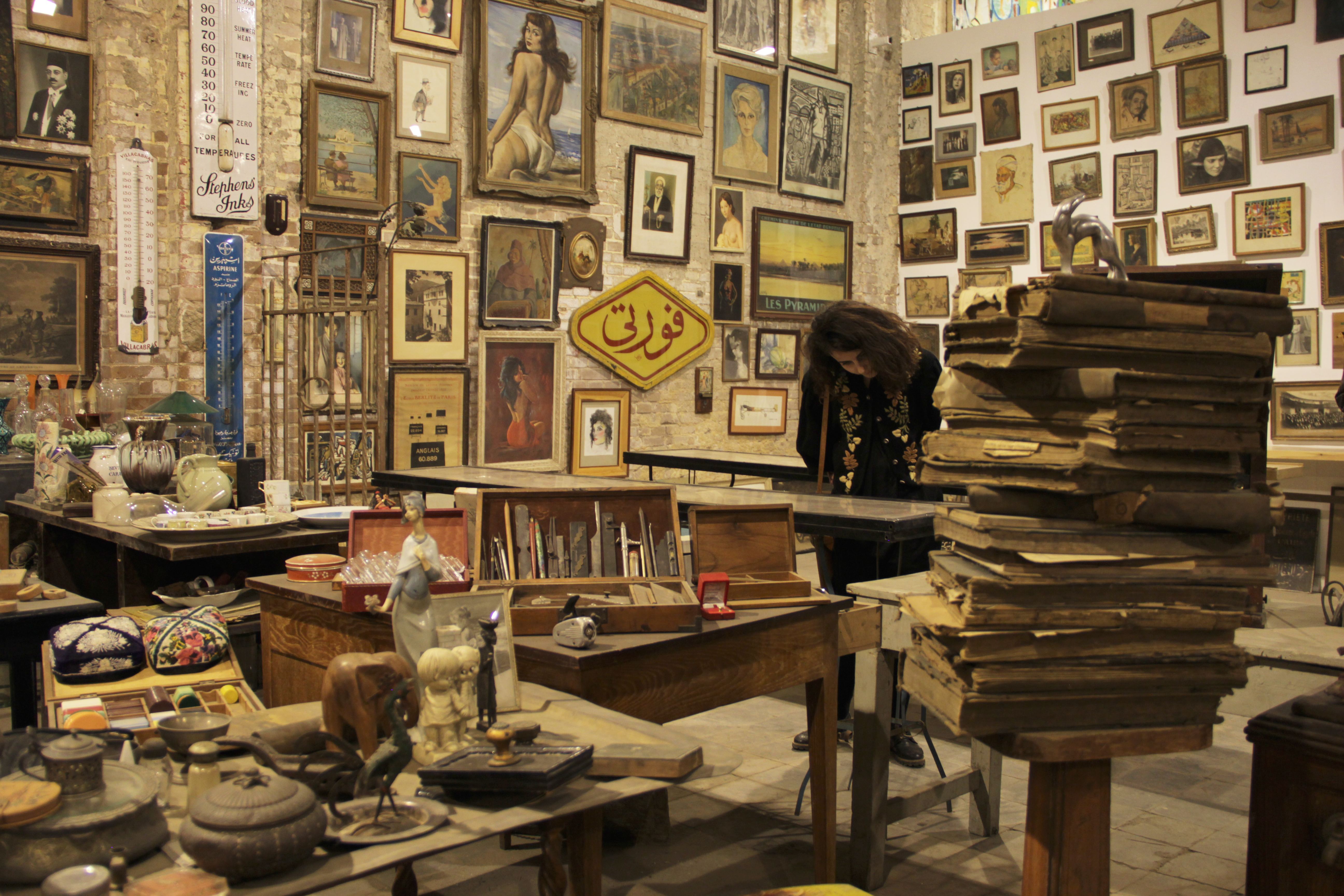
Amgad Naguib, Cairo’s famous object collector and dealer, mesmerized his audience last week at Townhouse as he recounted a lifetime of adventures collecting weird and wonderful things, many of which are on display at the downtown gallery’s The Past is Always an Invented Land exhibition. Crowded with everyday gadgets, trinkets and ornaments from different eras, the display feeds into wider questions with which historians often try to grapple: What to do with the leftovers of historical inquiry, the excess material that cannot be accounted for — the things that just don’t fit?

Uncurated and undated, Naguib’s display is described as an “emphatically disorganized anti-exhibition,” as it refuses the tenants of classification and arrangement. Ransacked from the homes of wealthy dead people, rescued from derelict downtown apartments vacated when the rich fled to gated satellite cities or collected from markets around the country, the cluttered items compete for attention in large glass cases and on tables strewn across half of Townhouse’s Factory Space. Too rickety to look like an antique shop and too chaotic to resemble a museum, the display brings to mind the smells and sights of a junk shop, those now endangered spaces of which author Luc Sante recently crafted a panegyric in the Paris Review: The items in a junk shop are “heaped together like survivors on a raft,” he writes. They “account for the strays, the odd volumes, the loose parts, the damaged examples, the gizmos of uncertain use, the artifacts of uncertain age, the treasures of uncertain value. If antique shops preserve and sell the winners of past cultural struggles, junk shops harbor the losers.”

Naguib’s omnium gatherum is indeed a trove of losers. The items are the rejects of taste, necessity and history: a useless shower head with a crevice for a flame that must have once seemed like an ingenious way of warming water, framed portraits of former President Gamal Abdel Nasser erstwhile hung in a diplomat’s home that now provokes chuckles from gallery visitors, disposable quotidian paraphernalia that previously governed movement, leisure, meal times, memory and style: tram tickets, radios fallen into disuse, expired drivers licenses, photographs, buttons, sandwich presses, tins, decorative statuettes — and a hymn to the desperate, perhaps timeless, pursuit of rest: a small, pretty bottle labeled simply “sleeping pills.”

“I like collecting ugly things,” Naguib confessed, “because they are so rare.” Putting aside the instability of that label (because who defines ugliness?), that revelation is telling. Where narratives privilege triumph and success, Naguib’s display is a breath of fresh air because it is partly an encomium to tastelessness, rejection and the unglamorous. It tells a story of failure wounding the aspirations of success. This is what makes the display so appealing — it presents us with the history of possibilities where now there is hind-sighted snickering at their impossibilities.

To gather his things, Naguib tends to arrive at the homes of the deceased long after antique collectors have plundered the chandeliers, the grandiose furniture and the expensive artworks. The leftovers, often hidden in drawers, kitchens and bathrooms, are for Naguib's taking — letters, photographs, clothes, pills. A collection of 1960s matchboxes found tucked in the drawer of a Nasserist diplomat, upon which is scribbled dates and people’s names, says Naguib with a smile, are far more valuable than her bronze chandeliers. In one way, the display is a story of death, of the things we leave behind.

The burden and anguish of representing the past hangs heavily in the gallery, but ideas of what historians might do with these gizmos animates the imagination. What space is there for an undated tin, an archaic hearing aid, or a beautifully crafted whisky bottle rescued from the dump of a dead aristocrat in revealing the secrets of the past? The display gives us a glimpse into the material culture of various eras, yet their forms and manner of display, blurring time and space – dateless, nameless, unidentified – disrupts the processes of disciplining knowledge at the heart of historical inquiry. In the display, as in junk shops, conventional forms of “history” are effectively collapsed.


While old books and periodicals garner much interest, what research institute, university or historian would invest in non-paper junk — toy cars, decorative vases, hundreds of buttons — and transform them into “historical artifacts?" It would be a labor-intensive exercise to decode the meanings inscribed into each item, to trace their social life and determine what they might tell us about politics and economy, but also about power and privilege, love and heartbreak, and their relationship to capital. Each thing stores purchasing power as well as memories, thrusting open a history of commodities, economics and their relationship with emotion. The exhibition engenders questions about consumerism, mass production and social mobility. The history of things is a history of capital, embedded within the politics of labor, industry and global commercial networks of trade — of Egypt as a colonial market for goods and commodities shipped in from abroad, and the history of politics and leisure inscribed in their uses and forms.


To transform junk-shop items into historical artifacts, however, requires the type of classification that the exhibition rejects. Choosing to focus on one item, to pluck it out of a heap of knick-knacks and proclaim it representative of an era, is a politicized and exclusionary act. Other things would be left behind, sad, despised and rejected. In a sense then, the display is a humbling experience because it fractures any pretense of being able to ever fully capture the intricacies of the past. It renders historical objects and sources as the suspicious selections of an archivist or curator. When we write and read histories, we are merely scratching the surface. This is an exhibition, therefore, about the magnitude of what gets left out, and about the futility of capturing the messiness of the past in all its clutter, banality and, at times, ugliness.
--
All photos and captions by Rowan El Shimi

Ifdal Elsaket
Ifdal Elsaket is assistant director and program coordinator of Arabic Studies and Islam at the Netherlands-Flemish Institute in Cairo. She has a PhD in history from the University of Sydney…
تقارير ذات صلة
Reading turath in Ahmed Sadiq Saad’s texts
Tanmiya and turath: a dehistoricized tradition is the effect and pivot of a dehistoricized present
Q & A with Elise Burton: On genetics and nationalist projects
Genetic data collected from individuals only becomes meaningful in relation to the data of others.
Shafiqa al-Qibtiyya: The Blueprint for Egyptian Celebrity
The 1920s in Cairo was the age of the female celebrity
Your support is the only way to ensure independent, progressive journalism survives.
You have a right to access accurate information, be stimulated by innovative and nuanced reporting, and be moved by compelling storytelling. Subscribe now to become part of the growing community of members who help us maintain our editorial independence.
Join us