
How a young doctor assigned himself work at the beach
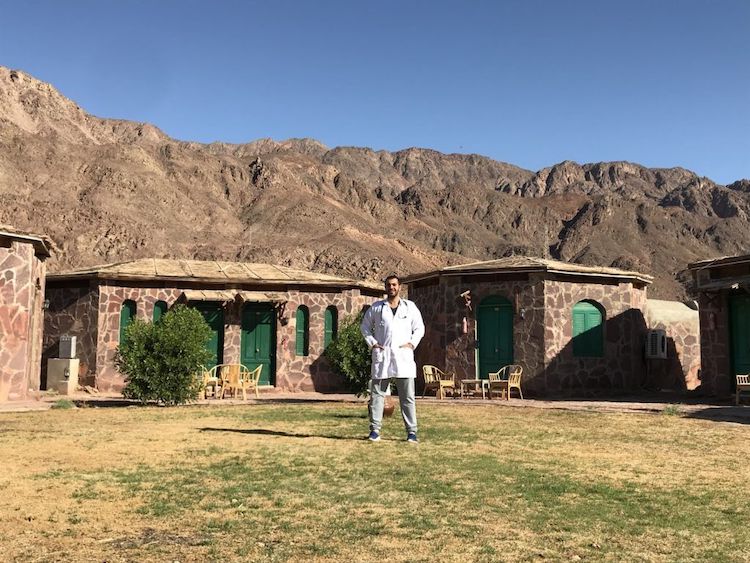
The Wadi al-Malha camp sits off the Nuweiba-Taba road in southeastern Sinai that connects the Gulf of Aqaba to the Colored Canyon. A waiter in the camp’s simple restaurant shack pours tea into paper cups and hands one to a young man sitting on the edge of the bar. “Here you go, Dr. Khaled,” he says. A young woman in a swimsuit seated nearby turns to him and asks, “What kind of doctor are you?” The man smiles as he stirs his tea. “I graduated in March 2020 but until the old assignment system is restored, I’m working in a private capacity here at the camp.”
His answer caught everyone’s attention. The coronavirus pandemic had forced the country to go on a partial lockdown for months and anything to do with health care had become a hot topic.
Meanwhile, the government’s new system regarding medical school graduates had faced a boycott by graduates.
For decades, the Health Ministry has assigned thousands of medical school graduates to two years of mandatory service at a primary health care facility, a policy known as takleef that is similar in some ways to military conscription. The assignments are the first step doctors take in their careers at the Health Ministry and are the main supplier of physicians to primary care units in underserved rural areas.
As he worked through his final year at Tanta University’s medicine faculty, Abdel Aziz thought his immediate future was all planned out. After graduating in March and earning a license to practice medicine, he would embark on his two-year mandatory assignment and choose between two options for the first phase: either a full year at a primary health unit in a rural area and go on to be a general practitioner or a shorter six-month stint in a remote part of the country during which he would receive a higher wage and go on to choose a field to specialize in.
But five months before his graduation date, the system was changed.
In October 2019, the Health Ministry announced in a surprise move that it was abolishing the takleef system for the Egyptian Fellowship Program, a professional training program coordinated by the ministry.
Under the new system, doctors join the fellowship program after graduation for a period of three years instead of two and specialize in a particular field. However, the fields of specialization are assigned by the ministry, not chosen by doctors themselves. The graduates spend nine months each year in a hospital, where they receive training, and the remaining three months serving in a primary health care unit where they rotate with other doctors. The country’s 5,300 primary health care units are scattered across the country and include health bureaus, family health units and larger family health centers. Those who specialized in a less common field — such as anesthesia, emergency or intensive care — are excluded from serving in a primary care unit and instead spend the entire length of their training period in the hospital.
According to Health Minister Hala Zayed, the new fellowship program is intended to overcome a severe shortage of doctors in Egypt in the 691 public hospitals across the country. The public health care sector became unappealing for doctors under the old assignment system, which is riddled with problems, including meager pay, poor facilities and training and low retention rates.
Doctors had expressed opposition to the new assignments system introduced in 2019 since it required doctors to carry out long stints in isolated rural hospitals for wages as low as LE2,000 a month, as part of the comprehensive health insurance plan.
Yet the Doctors Syndicate has cast doubt over whether the fellowship program will have the capacity to handle an annual surge of thousands of newly graduated doctors. The Health Ministry has only accredited 302 hospitals to be part of the new fellowship program, according to the health minister’s remarks to Parliament in November.
The fellowship program (which doctors used to join at the end of their two-year assignment) previously accepted just 2,000 doctors and now will have to take in approximately 8,000 doctors. This puts a strain on the program, which hands out the country’s most prestigious medical accreditation. Another concern raised by the syndicate is how the new program will cover all 5,300 primary care units if doctors are registered to work at public hospitals right at the beginning of their fellowships.
The head of the Doctors Syndicate also said that the health minister neglected to consult with the syndicate while the new fellowship program was being devised. When asked about it, the minister appeared to confirm this point, saying that she called the head of the syndicate the day before the announcement of the new program.
As of July, the majority of March 2020’s class of 7,000 public university graduates — the first since the new system was put in place — have refused to register for the new fellowship program, despite a law passed to force the new doctors to enroll, and have demanded that the ministry abolish it and return to the old assignment system.
Abdel Aziz says the new fellowship program is “designed to bridge the shortage, but it’s not fair to the doctors.”
“Under the old system, you could explore the reality of medical practice for the first six months through interactions with people at health care units, and land on the specialty closest to your heart,” he says. “The new system, on the other hand, forces you to specialize at a time when you have yet to make up your mind. This is one of its downsides, given that a specialty stays with you for life,” he adds. “Two things that a doctor gets stuck with for life are his specialization and marriage. Even marriage can simply end in divorce if both spouses are in agreement, but you can’t change your specialization. One has to have a chance to become familiar with the different fields.”
Abdel Aziz joined the opposition to the new system that was organized through his class’s Facebook group. Upon obtaining his license from the Doctors’ Syndicate in early March, he refused to register with the Egyptian fellowship program and started thinking about alternative paths.
Only a few days later, the coronavirus outbreak hit Egypt. For three months following graduation, he reflected on his decision to take up his classmates’ demands and boycott the new system. “The desperate state of the health care system and doctors’ conditions within it” left the graduates with no choice but to demand a better system, Abdel Aziz says. “You start with great ambition but then you face the reality of the healthcare system.”
Yet Abdel Aziz was haunted by moral concerns about pulling out of the system at a time when the pandemic was spreading with no clear end in sight. “Can I be held legally liable for evading assignment? Am I shirking my duty? Where’s my conscience?” he asked himself. But he quickly allayed his concerns. “I’m not shirking my duty. I have yet to become part of the ministry’s workforce, and I never got a paycheck from the government.”
He first encountered problems with the health care system during his final year at university, when, like all medical students, he was required to complete an internship, typically at a university hospital, training under faculty members from various departments. During the first three months of his internship at Tanta University Hospital, Abdel Azizi was stationed in the emergency room. He eventually submitted a request to be transferred to a public hospital in Gharbiya. The university hospital was far from where he lived and he also wanted a chance to experience working at a public sector hospital, as opposed to the university hospital internship where trainees only observe department heads instead of actually practicing medicine.
He requested the university administration reassign him to Zefta General Hospital. Tanta University approved his request, on the condition that he waive his monthly training stipend, which he used to get as compensation for working at the university hospital. “The training bonus was LE400 per month. I gave it up even though I would [still] be a part of the university’s workforce while posted to Zefta General Hospital serving out my internship,” he says.
In April, the bonus for student doctors working at university hospitals affiliated with the Higher Education Ministry and Azhar University hospitals was raised from LE400 to LE2,200 per month. According to a statement put out by Finance Minister Mohamed Maiet, the raise — which came as part of a package — was put in place by a presidential decree, and would cost the government LE320 million annually.
After three months at the Zefta hospital, Abdel Aziz was plunged into a bout of depression. He began to wonder whether he could practice medicine at all. “I don’t know if I loved medicine anymore as a profession or if I just didn’t want to practice within this health care system.”
Abdel Aziz worked 12-hour shifts in the emergency room. Horror stories he had previously heard from older doctors became his daily reality. Patients would barge in with an aggressive attitude and sometimes try to assault him, prompting hospital security to intervene. While the hospital was clean and fairly well-equipped, it could not deal with the high patient load. There are only a few hospitals in the governorate and a small cadre of doctors who are forced to work in very difficult conditions, he said.
He pushed through and eventually got the hang of the job. “Whenever someone came in sick and I was able to relieve their suffering, I felt content and satisfied. Those were times when the stress would be lifted.”
He had a particularly rewarding experience last winter. Abdel Aziz was on the night shift in the Zefta General Hospital emergency room. An old man came in with urinary retention, his bladder enlarged and about to burst. “This is a kind of pain that is beyond your worst nightmare,” Abdel Aziz says. The surgeon was not available but as it so happened, a doctor had taught Abdel Aziz how to catheterize just a few weeks earlier though he had never performed a catheterization himself. He plucked up the courage, took the old man into a procedure room and successfully fitted him with a catheter. The man let out a sigh of relief as the backed-up fluid left his body. He kept piling prayers and praise on Abdel Aziz until he left the building. The young doctor was filled with pride.
By the end of his internship year, he had served two-month stints at every department in the hospital. He also received some training in administrative skills. In his last few days he was the acting supervisor on the emergency room shift.
Yet after graduation, he found himself without a clear path ahead as he joined in classmates in boycotting the new fellowship program.
For the first time, Abdel Aziz says he came to understand that having too many options to choose from can be daunting, especially when deciding on issues that would have a deep impact on his future. He was overwhelmed with questions. “What should I specialize in? Should I stay here or migrate abroad? If I emigrate, where should I go? If I stay, should I opt for a lucrative career or endure hardship for the sake of learning?”
In mid-May, the Tourism Ministry permitted some hotels to reopen at 25 percent capacity after hotels and beach camps had shut down as part of the government’s coronavirus prevention measures and the tourism industry had ground to a halt. The move to partially reopen hotels was aimed at reviving domestic tourism. For facilities to reopen, they were required to obtain a health safety license, which included hiring a resident doctor to observe guests. In the entire Nuweiba area, only five beach camps managed to fulfill all the requirements and reopen. Abdel Aziz’s friend told him about a number of camps in Nuweiba that were looking for a doctor.
Abdel Aziz arrived the day before Eid al-Fitr and started working with the owners of the camps to lay out a detailed action plan before a committee from the Tourism Ministry and the Health Ministry came to oversee the new measures. He also coordinated with the Nuweiba Health Directorate to facilitate testing and diagnostic imaging in the event of any suspected cases arising.
It took him a week to settle in, but he eventually found the situation ideal. He spends his days reading, relaxing and doing a bit of studying. He examines employees at the camps and treats guests for minor injuries and gets a fair wage for his work.
Abdel Azizi grew to love Nuweiba and promised himself to get assigned there if the old system was restored or the new one reformed. Lacking adequate child health care in the Nuweiba valleys, Bedouins in the area have suggested that Abdel Aziz take up pediatrics and start a life there. He finds the prospect tempting
تقارير ذات صلة

Piled-up debts, missing medicines: Sisi cuts back powers of Unified Procurement Authority
UPA’s debt crisis has led to severe drug shortages and higher out-of-pocket costs for patients
No prescriptions, no appointments: Cancer patients at Hermel Hospital hit by treatment crisis after private sector take over
The waiting area of Dar al-Salam Hermel Cancer Hospital was crowded earlier this month with patients and their families who had come for the treatment they are accustomed to receiving…

New legislation paves route for private sector to take over public hospitals
The House of Representatives passed government-proposed legislation on Monday to allow the private sector to establish and manage public healthcare facilities. This legislation reflects a vision President Abdel Fattah al-Sisi…
Your support is the only way to ensure independent, progressive journalism survives.
You have a right to access accurate information, be stimulated by innovative and nuanced reporting, and be moved by compelling storytelling. Subscribe now to become part of the growing community of members who help us maintain our editorial independence.
Join us