
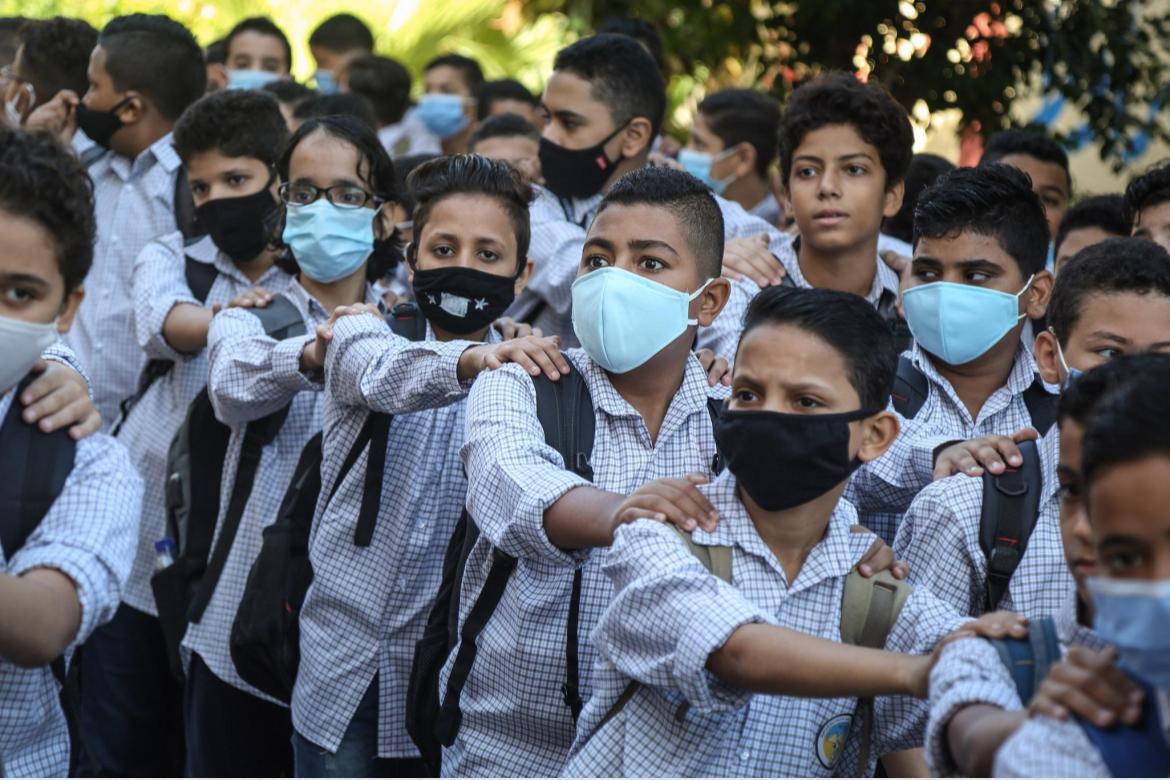
Going it alone: Schools, teachers, families struggle with second COVID-19 wave
One week after schools started in October, Nour*, who is a teacher at a public secondary school in Cairo, felt severe COVID-19 symptoms. She did the necessary tests, and the doctor informed her that there was a high chance she had contracted the coronavirus. Nour informed her school administration, which in turn told Nour to take some time off at her own expense, without offering to administer a PCR test for her to confirm the suspected diagnosis. Nour stayed at home for two weeks until she got better, then she resumed her work.
In the final week of November, Abeer*, a counselor in a public school, read a statement that was hung up inside a complex of schools in Qalyubiya announcing the death of a teacher working in one of the schools inside the complex. The statement did not specify the cause of death, but the deceased teacher’s friends told Abeer that he had died of COVID-19. In the same week, one of Abeer’s colleagues at school asked for time off after developing severe COVID-19 symptoms. In both of these cases, the schools and classes that were frequented by the teachers were not sterilized, and none of the people who were in contact with them was tested.
Since schools started, responsibility for the oversight and implementation of COVID-19 precautions has been scattered between the Education Ministry, school administrations, teachers, students and the students’ families. According to some families, teachers, education experts and officials who spoke to Mada Masr, there is no transparency regarding the number of COVID-19 cases in schools. Moreover, the decision to implement precautionary measures is in the hands of school administrators, who all have different resources and levels of commitment to enforcement. Meanwhile, parents are increasingly scared of sending their children to school, especially as case numbers are on the rise across the country. Nonetheless, remote learning has proved to be difficult.
Tracking cases
On November 15, a little less than a month after schools started, Education Minister Tarek Shawky announced that there were between 200 and 300 COVID-19 cases in schools. Meanwhile, eight teachers and school administrators had died from the coronavirus by that time. But Shawky was insisting that the school year would proceed, and that the COVID-19 strategy for schools was successful.
Education Ministry Spokesperson Mahmoud Hassouna told Mada Masr that the numbers published in newspapers are not accurate, even though those were numbers announced by the minister himself. Hassouna also said that the Education Ministry does not follow a specific protocol to track cases at schools, but rather relies on the data published by the Health Ministry. A former official at the Health Ministry’s preventative medicine department has told Mada Masr that officially recorded cases are at best a fifth of the actual number of people who have contracted COVID-19 in the country.
Left to their own devices, schools have largely kept quiet about the extent to which cases have spread and failed to take the appropriate measures to confront suspected COVID-19 cases, according to Abdel Hafiz Tayel, the head of the Egyptian Center for the Right to Education.
Tayel says that tracking cases would require PCR tests to be administered to those suspected of having COVID-19, but that this does not happen. “If someone develops a fever at school, they should either be isolated immediately or taken home. But not all schools even have thermometers,” he says.
For Tayel, the Education Ministry should step in to manage the situation, and should form a committee to track the number of cases in schools.
Beyond the lackluster response from school administrators, a more robust public health response in schools would also come up against some families who do not report that their children have contracted COVID-19 due to the social stigma attached with the disease, according to Ayman al-Beely, the spokesman for the Independent Teachers Syndicate.
Closing schools
In early October, the Education Ministry announced the conditions for closing schools if students contract COVID-19. According to the conditions, a classroom should be closed for 28 days if more than one case is reported within the span of two weeks. The entire school should be closed for the same period if multiple cases are reported in different classrooms within two weeks, while a complex of schools should be closed if cases are reported in one of the schools after another one in the same complex has been shut down. If a town or city is placed in quarantine, all the schools within it should be closed. None of these conditions, however, provide prescriptions for the eventuality that teachers, school administrators, and other school workers contract COVID-19.
Laila* has a son enrolled in a private school in Qalyubiya and a daughter enrolled in a private school in Cairo. The school immediately next to her son’s school decided to close completely for 28 days after 15 students contracted COVID-19. The school day starts and finishes at the same time at both schools, which made Laila worry about her son. “By the time they had discovered the 15 cases, the virus could have been transmitted,” she says.
As for her daughter’s school, three cases were indeed confirmed — three brothers in three different grades — who had not entered the school grounds but had come in contact with students and teachers that move among the general staff and studentry during private lessons. The school administration asked those who had come in contact with the three boys to refrain from entering school grounds until they had taken a PCR test. But the parents, including Laila, were never informed of the test results. Last week, Laila heard that four teachers in her daughter’s school had come down with COVID-19, each one of whom teaches in at least six classrooms, in addition to the private lessons and educational centers they frequent.
With the rise in cases among teachers, the school administration told angry and concerned parents that the Education Ministry put in place closure conditions that pertain to a rise of cases among students, not teachers, and that the decision to close is left to the discretion of the ministry.
Since schools started in mid-October, Laila has made sure that her children wear masks. “I wear a mask and make sure my children wear masks. But the kids take it off at school. The cleaning ladies and the security guards don’t wear masks either. There is only one employee who checks students’ temperatures in the morning, and it becomes overcrowded. Sterilization also happens once every Thursday. Meanwhile, each classroom has 30 students,” she says. “I won’t send my kids to school, even if they’re offered a bachelor’s degree. I am not ready to lose one of them.”
Beely and Tayel do not object to the ministry’s conditions for school closures that are in place. However, they believe that precautionary measures are not enough. To them, schools are a very dangerous place due to the number of students and the large possibility of transmission between students and their families. They also believe that community transfer in schools can drive up the number of cases in Egypt at large further if the situation gets out of control. They both see that suspending schools in this context is advisable.
Prevention
At the close of October, Minister of Education Tarek Shawky stated that the ministry had devised a plan for in-person education to continue despite the COVID-19 pandemic. The plan included a reduction in classroom density by reorganizing classes and school days as well as morning and evening school periods. Thermometers and disinfectants would be distributed to all schools, and each school would designate an isolation room in the event that a student developed symptoms, so that they could be taken there until their parents arrive to pick them up. The minister also gave school administrators the freedom to write their own schedules, while emphasizing his intention to finance schools that need support.
At the same time, the Education Ministry announced that it would coordinate with the Health Ministry to form a ministerial committee to follow up with the implementation of precautionary measures, to ensure a doctor is present in every school, and to distribute COVID-19 manuals to students and teachers. In addition to this, the committee would make sure that the Health Ministry responds to cases early on.
The Education Ministry’s spokesperson said that the conditions apply to all schools in Egypt, and that the ministry is following up with schools to ensure adherence to the rules through joint committees created by the educational and health administrations in each governorate. “We distributed disinfectants and sterilization tools to all the schools in the country,” he says, explaining that the ministry was responsible for providing detergents and alcohol, whereas parents are left responsible to buy masks and personal alcohol for the students.
Abeer’s school, as well as all the schools in the same complex in Qalyubiya, are not adhering to COVID-19 regulations. “We only have detergents and chloride for the bathrooms. If I want the teachers’ room to be cleaned, I have to ask the cleaning ladies specifically. We are the ones who bring masks and alcohol from our homes. And no one adheres to the regulations. The administration did not lay out any system to follow. But when we had a visit from the educational authority, all the teachers pulled out their masks during the morning line. We also don’t have anyone taking temperatures,” she tells Mada Masr.
As for Nour’s school, the administration provided some disinfectants to clean the classrooms and staircases. It also sold subsidized masks in the school canteen. It did not, however, provide the thermometers due to their high cost. “There is social distancing, but no one wears masks. If someone is feverish, they stay in the isolation room or go home immediately. But no one obliges the teachers to wear masks, and the ministry is not following up with the implementation of precautionary measures, nor is it providing any training for the teachers and administrators,” she says.
If teachers or workers get sick, the school administrations do not give them sick leave. “I have to go to the health insurance office, live through hell, and come in contact with other sick people in order to be able to take time off. Otherwise, it gets deducted from my bonuses and eventually my salary. We are being sacrificed, and if we talk, we get crushed. Schools must be suspended,” says Abeer.
Some schools confirmed that they received follow-up visits, while others stated that they only had one visit.
“Kids do not abide by social distancing rules and they don’t wear masks. The school administrators also don’t try to separate them or force them to wear masks. As soon as a supervisor leaves, the kids take off their masks,” says a director in an educational administration in Daqahlia who spoke to Mada Masr on condition of anonymity about her monitoring tour across different schools over the past month. The director observed that no sterilization was being done, even in the isolation room. School administrators justified this by pointing out that they do not have enough workers to clean. “The employees end up disinfecting the place themselves,” she says.
Schools have relied on individual efforts and donations from parents and teachers to provide disinfectants and sterilization equipment, Beely says. In some schools, the administrators, along with students and teachers, would disinfect the campus themselves. Meanwhile, efforts to raise awareness about the virus have been nearly nonexistent, which prompted the Independent Teachers Syndicate to solicit the help of doctors to educate teachers about COVID-19. It did this in coordination with the syndicate’s 16 branches across the country.
Adel Bekheit, the deputy of a public school in Qanater, agrees with Beely’s assessment, explaining that his school did not receive any disinfectants or thermometers, which the minister had previously stated would be distributed to all schools. As a result, Momen School, where Bekheit works, relied on collective participation to secure these tools. According to Bekheit, some parents who work as pharmacists donated two thermometers, priced at around LE4,000, in addition to face masks for students who could not afford them. As for the isolation room, the school’s board of trustees coordinated with a few businessmen to equip a room in the school with a bed, sheets and sterilizing equipment.
Fears and alternatives
At the start of the academic year, Dina* decided not to send her daughters to their private school for two weeks. “I made the kids stay at home because I was terrified. My mother is 70 years old and lives with us. Later, I discovered that I am the only one who didn’t send their kids to school, so I had to send them. Of course, I won’t make them drop out. But why don’t they let them stay at home this year? What will happen to our planet if they do?” she says.
Dina explains that her daughter’s school tightened precautionary measures when a COVID-19 case was recorded in one of the classrooms in 12th grade, but the school was quite lax early on. Dina believes that it is impossible to control the situation due to the sheer number of students in each school, however.
“The state shouldn’t leave the educational institutions to decide for themselves. There has to be more stringent control,” she says. “I am very worried, but there is nothing I can do about it except make my daughters wear face masks, give them alcohol, and keep telling them not to do this, not to kiss anyone, not to hug anyone.”
Mai* is a mother to two students who go to an international school in Giza. The academic year for her two kids started in mid-September with daily attendance. Mai is extremely worried about the coronavirus situation, but she has no other options, as she says remote learning was not effective last year.
Both Beely and Tayel tell Mada Masr that the ministry is considering continuing to implement remote or blended learning, even after the pandemic is over, under the banner of “developing education.”
Beely says that the primary aim of the ministry’s electronic learning project is to cut spending on education because it will save millions of pounds that go into printing books and exams. However, this lessens the quality of education, especially as teachers turn into supervisors who are meant to follow up with what students learn online. Tayel echoes Beely’s opinion, adding that Egypt’s infrastructure will not help. “There are areas in Egypt that have no access to the internet, and, in general, the internet in Egypt is very slow. This will only cause more children to drop out of school. We will only see students getting exploited,” he says.
According to the Communication Ministry’s estimates in 2019, 52 percent of the population does not have access to the internet.
For Nour, the pedagogical guidelines that have come down to her Cairo secondary school have been clear: she has not been instructed to explain anything to students. Rather, her task is only to revise what they learned on educational platforms. “We are now only teachers in name, and the kids don’t learn anything from these platforms because they are not technologically literate and neither are the teachers,” she says.
Apart from the fears of remote learning, there is also the suspicion that postponing school closures is linked to the financial standing of private schools who are afraid of losing tuition money. For Mai, the school is collecting fees quickly because it is scared of closing. “They raised the fees and the bus fees, and they’re running after us trying to collect the money so that when the ministry announces the closure, they would have all the money. They’re asking for the fees of all terms. It is so depressing. We’re all sitting at home because of COVID-19. Where will we get this money from?” she says.
As for Laila, she paid double the school fees for her children this year. She said that the two schools asked her to pay the fees for last spring’s term, which students attended online, along with the November installment. But ultimately, she decided not to send her kids to school until the pandemic is over.
Tayel tells Mada Masr that private and international schools raised their school fees this year, and some schools asked parents to pay fees for the entire year upfront in November. “The ministry probably wants to allow private schools to collect the full tuition and then issue the closure decision with the second wave,” he says, explaining that the owners of private and international schools constitute a very strong lobby.
According to CAPMAS data in 2019, there were some 19 million students in Egypt’s public education system across 46,000 schools, and nearly two million private school students in more than 7,500 schools. According to figures released by the Education Ministry in February, there are 1.187 million teachers working in schools across the country.
*Pseudonyms

تقارير ذات صلة
Devaluation drama and hot money’s return: What happened with the pound’s historic plummet?
'As long as there is more demand than supply, the price of the pound will continue to decrease.'
Q&A: Egypt’s emissions, the environment, and the relationship between air pollution and COVID-19
The loudest voices in this area are not those of environmental scientists, but of investors
Q&A with anthropology professor Hania Sholkamy | On the need to rethink social spending as crisis response after COVID-19
The pandemic exposed flaws in the way social protection is thought about in Egypt
Your support is the only way to ensure independent, progressive journalism survives.
You have a right to access accurate information, be stimulated by innovative and nuanced reporting, and be moved by compelling storytelling. Subscribe now to become part of the growing community of members who help us maintain our editorial independence.
Join us