
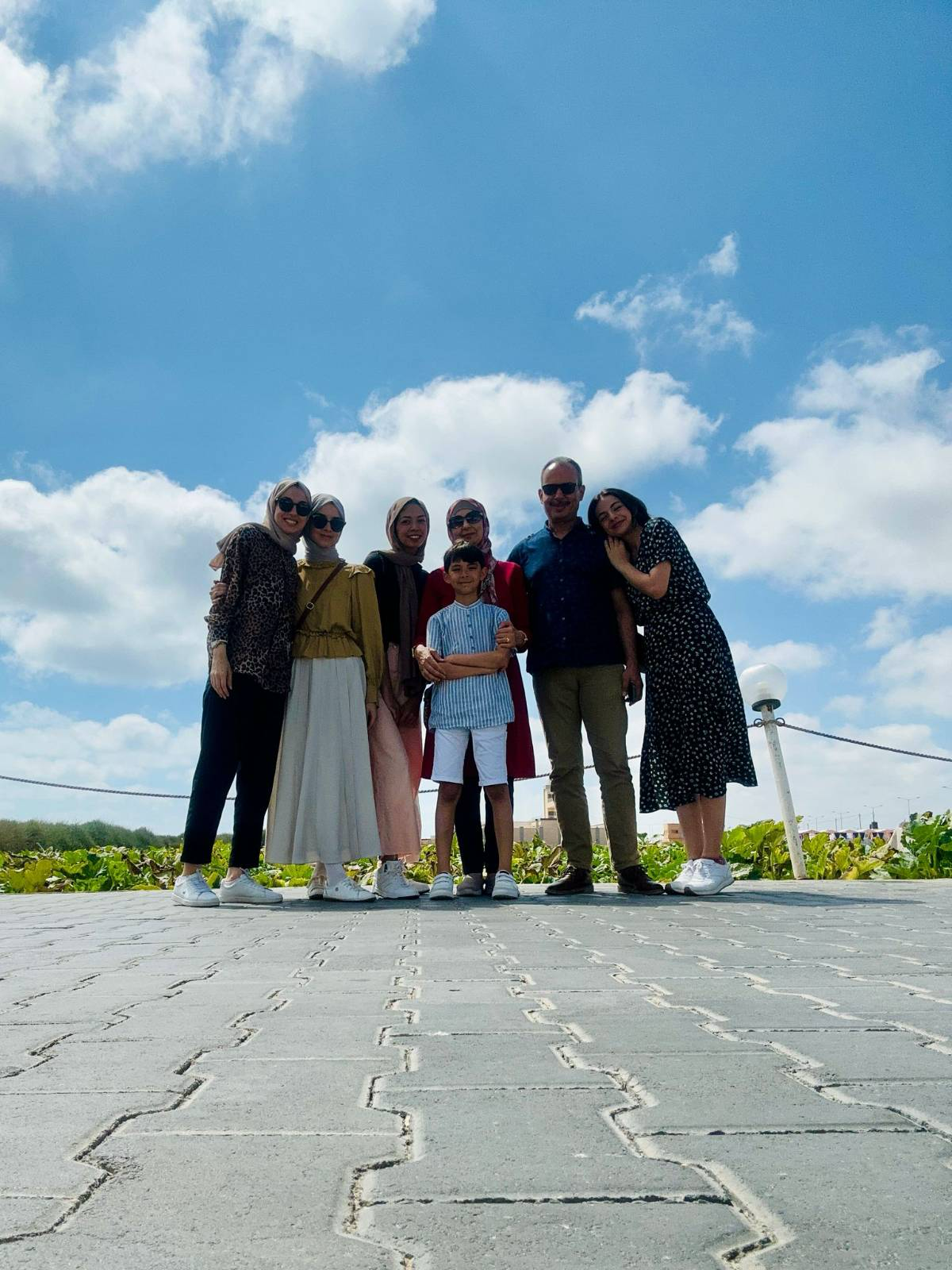
Gaza’s tragedy from afar: A daughter in Beirut follows her family’s journey to the south
“My family is facing death while I’m far away from them,” Lina tells Mada Masr from Beirut, where she has been living since September pursuing a master’s degree in political science. Before leaving for the Lebanese capital, she had lived with her family in the upscale coastal neighborhood of Rimal in western Gaza.
That family house is now rubble, and Lina can only rely on text messages or a short call to know her family is still alive and that it is not yet their turn. “I start my day by checking the names of families who were martyred,” she says.
Lina spoke with Mada Masr to recount her family’s ordeal since October 7, when Israel responded to a Hamas operation into Israeli territory by launching a relentless bombing campaign on the strip, cutting off all vital supplies, including water, fuel and food, invading Gaza with ground troops, and forcibly displacing hundreds of thousands of people from the north of Gaza to the south.
On October 7, Lina’s mother informed her that her grandmother was ill and had been admitted to the Aqsa Martyrs Hospital for urgent intestinal surgery.
The next morning, the hospital informed Lina’s uncle that they had to evacuate all the patients to accommodate the dead and wounded from the Israeli aggression on the Gaza Strip. They transferred her grandmother to the family home for further treatment. Lina’s mother and uncle helped move her grandmother to her mother’s family place in Deir al-Balah Camp, in the center of the strip.
At 2:30 am on October 8, Lina's home, where she had lived for all 24 years of her life, collapsed on her father, mother, two sisters and younger brother. The Occupation military targeted the house of a prominent leader in Hamas, which was separated from their seven-story building only by an empty lot, and was next to the UNRWA-run Maamouniya school.
Due to the force of the strike, a large part of their building collapsed. Lina’s family managed to escape from the rubble and took cover in their car. Her father could barely start the car in the darkness and smoke from the shelling. The car’s windows shattered on the family members, and the father completely lost his sense of direction in the streets he knew by heart. But amid the screams, tears and fear, Lina’s sisters were able to describe the way to their father until they reached their grandfather’s place, which was only one street away from their own.
They sought shelter inside, along with the rest of the family members who were present in the neighborhood. In only a few hours, the family started hearing bursts of gunfire and RPGs.
A short while later, the family was devastated to receive the news that her grandmother had died in Deir al-Balah Camp. Family members there had requested an ambulance, but the hospitals informed them that there were no available vehicles and that the surrounding hospitals were all full. As the bombing and shelling continued over their heads, her grandmother’s body remained in the house until Lina’s uncle and a few other family members were able to carry her out for burial.
“My mother and aunts couldn’t say goodbye to their mother,” Lina says.
Two days passed, and the family, consisting of more than 30 people staying at the family apartment of Lina’s father in the Rimal, continued to endure the bombardment and shelling.
On October 13, Occupation aircraft dropped leaflets on the neighborhood, demanding that residents evacuate and go to the south of Gaza. If they did not leave, the leaflets warned, they would be considered Hamas collaborators.
Lina’s neighbors and the majority of the residents of the Rimal neighborhood went to Shifa Hospital to take refuge in front of its gates and inside the medical complex’s corridors. They considered it a safe area during times of war, according to international humanitarian law. However, Lina’s family decided to move to Deir al-Balah, the smallest refugee camp in Gaza, which is located in the center of the strip.
The displaced family members settled in an apartment owned by the family of Lina’s mother that consisted of one bedroom and a living room with a tin roof and stone walls. More than 30 people came together in the flat, thinking it would be safer than a hospital, school, or refugee center, because the Occupation does not take humanitarian considerations into account and targets the most vulnerable.
Communication has diminished between Lina and her family since they arrived in Deir al-Balah. Where they had previously spoken three times a day, now it is normally once daily: a short text to say “We are fine” or a quick call.
“It’s very dangerous to talk on the phone. They cannot mention anything about the war, Hamas, or Palestine. Everything is monitored and heard,” says Lina. She explains that her family is cut off from news about the rest of Gaza: “They don't know anything except what they can hear of the shelling blasts. They feel it is a massacre and are waiting for their turn.”
Lina’s mother told her about their ordeal in obtaining bread and water after most of the bakeries around them were bombed. A member of her family stands in lines for six or seven hours daily to get a bottle of unclean water, their only option for something to drink.
On the morning of October 26, Lina received a very short phone call from her parents. The next day, Lina received a brief text message from a relative informing her that the camp had been targeted, damaging all the buildings surrounding her family’s place. The relative told her that her parents and siblings were safe, without mentioning her uncles, aunts, and their families, and that they were on their way to Khan Younis neighborhood in southern Gaza.
Lina’s thoughts are consumed by a wish for a ceasefire in any shape or form. “Why is it only our houses that are destroyed? Why is it only our children who are martyred? If people want to liberate Palestine, is it only the people of Gaza who will pay the price for its liberation? Is it only the blood of the people of Gaza that will be shed? Isn’t this the issue of all Arabs?”
Telecom networks in Gaza were cut on October 26, leaving Lina without any means to hear what was happening for two days, until they were restored at dawn on October 28.
As of the time of writing, November 11, the family is living in a small apartment with a relative of the father in Khan Younis after thousands of Palestinians from all northern areas of Gaza joined them in the south.
The United Nations estimates the number of displaced people from northern Gaza to its center and south, yielding to the Israeli military’s warnings to evacuate, at around 600,000 Palestinians. Most of them live in the homes of relatives and friends or in UNRWA shelters and schools, which are not qualified to accommodate these numbers and respond to their basic needs.
But, as grave as they are, overcrowding and lack of basic needs might not be the worst of the issues facing the south.
On Thursday, the Israeli Occupation dropped leaflets on the southern Gaza Strip, warning of its intention to expand the scope of its war against Hamas to include the south, which it previously said would be a safe place for the displaced even as it continued to bomb it. On Saturday, sources told Mada Masr that the southern Gaza Strip witnessed a limited incursion by Israeli military vehicles with cover from air and artillery bombardment. The raids targeted homes in Khan Yunis in the south, killing 15 and wounding dozens of others.

تقارير ذات صلة

Gaza’s phase two arrives. Kind of …
Consensus over key questions lags behind the United States' announcement of progress.

Gaza’s child amputees

Israel finally approves Egypt’s gas deal after nail-biting battle
In an unexpected move, Israeli Prime Minister Benjamin Netanyahu announced on Wednesday Israel’s final approval of a controversial gas export deal with Egypt, months after Israeli hesitation following the initial…
Your support is the only way to ensure independent, progressive journalism survives.
You have a right to access accurate information, be stimulated by innovative and nuanced reporting, and be moved by compelling storytelling. Subscribe now to become part of the growing community of members who help us maintain our editorial independence.
Join us