
Gaza’s social collapse: Popular committees step up
At the end of December, Jamal stood in a long queue outside one of the flour distribution outlets affiliated with the United Nations Relief and Works Agency for Palestine Refugees (UNRWA) in the Tal al-Sultan neighborhood of western Rafah. Suddenly, he heard screams from the front of the line, where dozens of people were crowded. Masked individuals armed with sticks and knives were attempting to steal flour sacks. Police arrived and opened fire, killing one of the attackers.
In response, the family of the deceased blocked several streets in Rafah, set car tires on fire, and then attacked both the distribution center and the Rafah police station.
The incident was terrifying, Jamal tells Mada Masr, especially after the person was killed. However, this was not an isolated event.
In mid-February, a Bedouin boy in Rafah was killed by one of the elements affiliated with the Hamas-run police.
The police-affiliated individual was in the process of securing a humanitarian aid truck arriving to the Gaza Strip through the Rafah crossing. Citizens attacked the truck to seize its contents, and the boy was shot in the clash, a journalist from Rafah tells Mada Masr on condition of anonymity.
The boy’s family "took revenge," the journalist says. Dozens of his family members attacked the Rafah crossing, set fire to car tires at the gate and stormed the crossing courtyard in protest of the murder of their son.
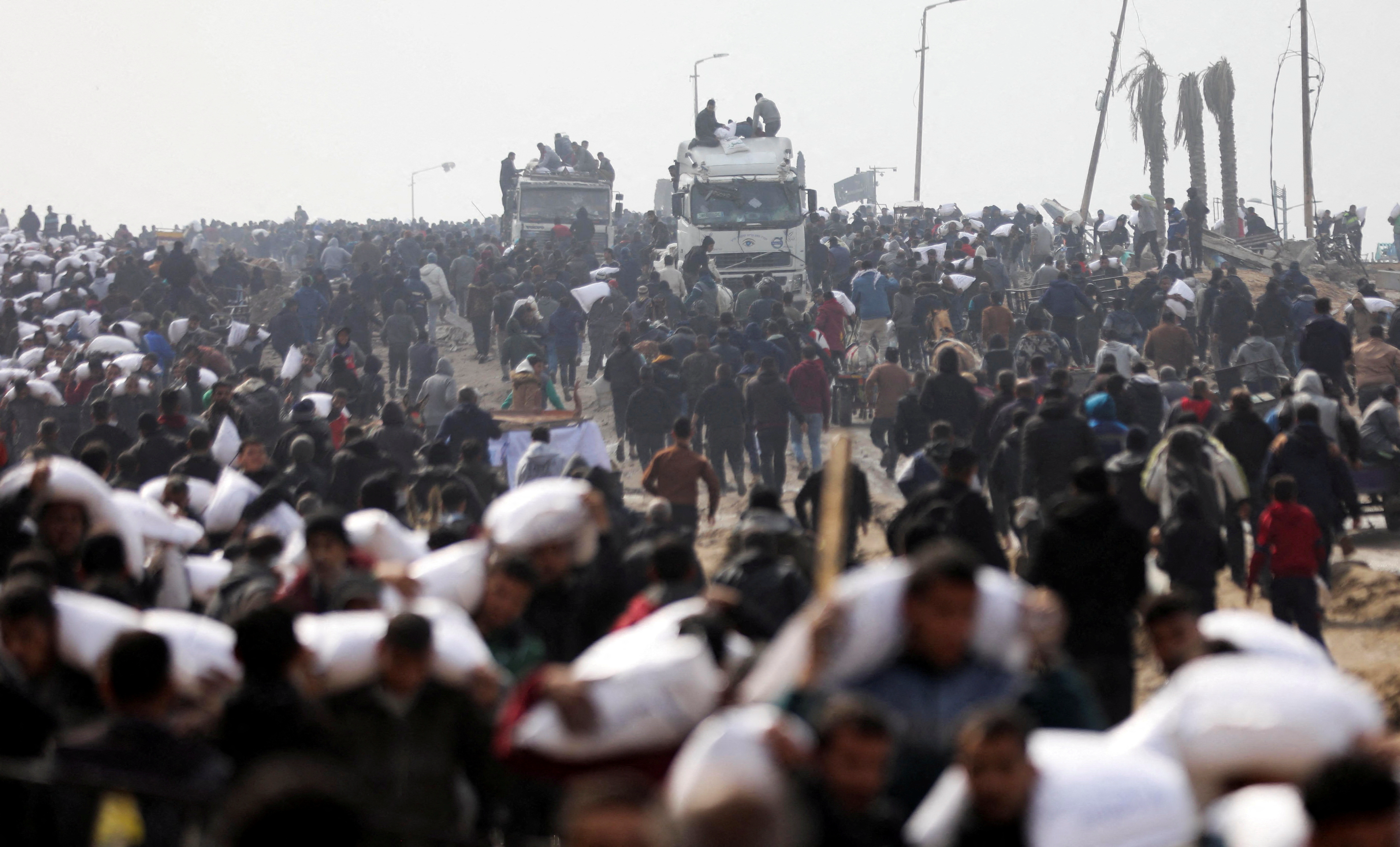
These incidents are part of a broader breakdown in social order, more than eight months into the ongoing Israeli aggression on the Gaza Strip. The scarcity of basic necessities due to the Occupation’s blockade has led to increased looting of trucks carrying aid and goods. Researchers tell Mada Masr that this collapse of social order is a consequence of the war, a deliberate goal of the Occupation to make life unbearable for Palestinians. Amid the deterioration, various popular initiatives have emerged to maintain a measure of order following the withdrawal of the bulk of Hamas security forces due to their targeting by the Israeli military. Some of these initiatives have been cooperating with the Occupation, which in turn seeks to extend control in the strip in hopes of maintaining it after the war.
In January, Nizar, who had been displaced from northern Gaza to a house near Salah Eddin road in southern Rafah, heard gunfire nearby. When he went outside to see what was happening, he saw gunmen stopping an aid truck and stealing its entire contents. No police forces were in sight, Nizar tells Mada Masr, although the looting took a long time.
In the first weeks after the Rafah crossing opened amid the Israeli aggression, the number of trucks entering the strip was limited to 50 trucks per day, according to the Institute for Palestine Studies. This number increased to between 100 and 150 trucks per day after the Karam Abu Salem crossing on the southern border with Israel reopened in December.
As indirect negotiations between Hamas and Israel, mediated by Egypt, the United States and Qatar, continued over the following months of the ongoing war, the Egyptian State Information Service announced in early April that the number of aid trucks to Gaza would double to 300 trucks per day. However, this was suspended when the Israeli military took control of the Palestinian side of the Rafah crossing on May 7, which led to the closure of the Rafah and Karam Abu Salem crossings. According to UNRWA, only 69 aid trucks entered the strip in the two weeks following the start of the Rafah invasion.
UNRWA expressed concerns about the collapse of the humanitarian system in Gaza, as the Occupation obstructed the entry of aid, allowing only a few dozen trucks in, while the strip used to receive around 500 trucks per day before the onset of the Israeli aggression on October 7.
Before the closure of the Rafah crossing, some countries conducted airdrops of food aid. Despite the urgent need to alleviate famine, Gaza’s media office head, Salama Marouf, described these airdrops as "humiliating and demeaning.” Citizens told Mada Masr that the airdrops led to conflicts among civilians over food parcels, with aid boxes often falling in locations that had become known for Gazans, leading to some fatal injuries as they fell on those waiting below.
The World Food Program had repeatedly stated that "famine is imminent” in Gaza due to the lack of access to aid.
And as much the Occupation would weaponize starvation, it also began to target police stations in Gaza during the first days of the aggression, mirroring their tactics in previous wars on the strip.
After the repeated targeting of police officers, the majority of policemen no longer wear uniforms, which made it seem like they were absent, according to a journalist in Rafah, speaking to Mada Masr on condition of anonymity.
Gaza’s Interior Ministry, including the police, comprises around 20,000 personnel.
Israel's targeting of the authorities responsible for public order in Gaza is not new. In the 2008 aggression, Israel launched around 100 simultaneous raids on Gaza’s police stations and Interior Ministry offices, killing on the first day of the aggression around 280 people, the majority of whom were policemen, according to the United Nations Office for the Coordination of Humanitarian Affairs (UNOCHA).
The Gaza government has had a lot of experience in handling emergencies during wartime after enduring four previous wars waged by Israel, a source close to Hamas tells Mada Masr on condition of anonymity. Government offices and police stations are evacuated to minimize losses from Israeli targeting. Police work becomes more improvisational, limited to field work, such as traffic regulation, maintaining public order in markets, and resolving people’s issues, given the closure of prisons and detention centers.
According to the source, the most pressing issue at the moment is managing civil matters in the face of the current humanitarian disaster. This involves ensuring the progress of relief work, such as distributing food aid to the population and protecting it from attacks by locals and thieves, as well as controlling the rapidly rising prices of goods in markets.
The source close to Hamas says that the resistance attempted to restore order across the strip in the weeks following the end of the seven-day humanitarian truce in November, after the shock of the first round of shelling. However, these efforts faced strong resistance from Israel, which intensified airstrikes against the police after the truce. Occupation forces also re-advanced in areas from which they had previously withdrawn, as evidenced by the raid on the Shifa Hospital, which lasted for two weeks in March. The same hospital was raided months before in November. In May, Israeli forces also raided the Jabalia camp and other northern areas for the second time since the ground incursion in late October.
In a rare criticism of the Israeli attacks, US Special Envoy for Middle East Humanitarian Issues David Satterfield stated that the targeted killings of Gaza police personnel working to secure aid convoys had made it virtually impossible to distribute aid safely.
In response, Israel condemned the US warning, asserting that it would continue targeting the police, because one of its goals in the war is to ensure that Hamas no longer runs Gaza, two Israeli officials told Axios.
It is not only a presence on the ground that Hamas police have lost, but also their prestige among families. Another journalist and resident of Rafah, speaking to Mada Masr on condition of anonymity, says that Hamas police frequently clashed with displaced families in shelter centers while attempting to intervene to break up fights or control riots. In a recent incident at a shelter in Rafah, a police officer was killed during a clash with a displaced family from Beit Hanoun in the north.
Following the large waves of displacement over the course of the war, Palestinians have turned to other social relations to secure resources and protection. As a matter of "taking rights by force,” families with many members sought to secure shares of food and relief materials from humanitarian aid convoys. Amid the overwhelming food and security crisis and the absence of law enforcement, family members, often armed with light weapons, have come together to carry out looting and protect those conducting the thefts.
With the absence of official forms of police work and the need to protect their trucks, cargo truck owners have resorted to dealing informally with armed individuals who have connections to Gaza’s security apparatus. However, humanitarian aid trucks still receive less protection, according to the two journalists in Rafah and a source in Gaza’s Palestinian factions’ coordination committee who spoke to Mada Masr on condition of anonymity.
In an attempt to prevent social collapse in Gaza, Palestinian factions, headed by Hamas, Palestinian Islamic Jihad and the Popular Front for the Liberation of Palestine (PFLP), have coordinated with the clans and families in the enclave to form popular committees. These committees are tasked with maintaining security and regulating the markets, according to the source in the factions’ coordination committee.
These committees have appeared on the streets of Rafah as masked men, some armed with automatic firearms, others with heavy sticks, and even children were observed among them. Some members’ physical appearance indicated their military unfitness.
Reuters cited one unnamed committee member who said that their presence was necessary to enforce law and order after police patrols disappeared from the streets due to the Occupation’s targeting. Their mission, the source added, is "to punish those who exploit the needs of people."
On December 22, the PFLP issued a statement announcing that it would "continue its efforts to form popular committees to protect the internal front in the Gaza Strip, strengthen citizen resilience and monitor cases of overpricing and monopoly." The PFLP also stated that these efforts are concentrated "in the areas of Rafah, Khan Younis and central Gaza, [which are] crowded with displaced people, in order to ensure aid reaches all our people, in addition to forming consumer protection committees."
In northern Gaza, factions replicated the protection committee model established in the south but combined their elements and coordinated with the official security apparatus, which has become noticeably less visible in the north, in agreement with clans, according to the factions’ coordination committee source. The arrangements came after a meeting between clan delegations in northern Gaza, UNRWA coordinators and representatives of Gaza’s security forces.
The popular model contributed to solving the dilemma of securing the entry of aid trucks, resolving overcrowding at aid distribution points and ensuring the safe arrival and storage of aid in UNRWA warehouses in Gaza City and northern Gaza governorates without any significant incidents, Gaza’s Civil Defense spokesperson Mahmoud Basal told Al-Jazeera.
Although the popular protection committees’ model is still limited, especially regarding market control, Ahmed Tanani, director of the Gaza-based Orouba Center for Research and Strategic Thinking, believes that the model’s continuity and support could expand its influence. Speaking to Mada Masr, Tanani rules out the Occupation’s ability to overcome the deep-rooted presence of Palestinian factions in Gaza, even within clans and major families.
According to Tanani, the Occupation is forcefully pushing toward chaos to achieve two main goals: dismantling Hamas’ capabilities and encouraging forced migration by making life in the strip unbearable.
"There are several levels of impact from the deployment of the popular protection committees on the ground in the southern Gaza Strip," Tanani says.
The first of these is related to enhancing the sense of personal security for citizens and displaced people in Rafah. These committees have reduced the need for citizens to seek personal protection tools or for clans to arm themselves in preparation for chaos.
The second level, according to Tanani, involves the committees’ role in essential tasks, such as protecting markets and public facilities from looting or theft, as well as securing aid trucks. This has prevented some institutions from using armed groups that offer protection in exchange for payment. Such groups could have evolved into armed entities without a principled or national reference, performing protection duties for material gains, which may turn into formations employed for other agendas in the future.
On a third level, Tanani says that the existence of protection committees, their large numbers, popular involvement and the anonymity of their elements make it difficult for the Occupation to undermine all forms of security and order efforts, complicating endeavors to flood the strip with chaos.
However, the Occupation launched a large-scale attack in northern Gaza in February, targeting the popular committees’ coordinators and members, and assassinated the director of police operations in the Gaza Strip, Fayeq al-Mabhouh, who was tasked with coordinating the entry of humanitarian aid into northern Gaza. Subsequently, police officers were assassinated not only in the north, but also in the south, according to the Palestinian Information Center.
Simultaneously, other parties have taken on some security tasks independently of the factions. According to the New York Times, the Occupation military coordinated in early March with Palestinian businessmen from Gaza to manage the delivery of aid to the north. One such businessman, Ezzat Aql, told the newspaper that he coordinated the entry of 30 trucks to the north.
Speaking to Mada Masr on condition of anonymity, a journalist in Deir al-Balah says that Aql is a well-known cigarette and shisha tobacco merchant in Gaza. Aql has been working to transport aid to the north using his own trucks, the journalist says, in agreement with the Israeli military and in cooperation with relief organizations and Palestinian merchants working in the supply of goods to the strip. These operations rely on armed families to secure trucks, which are guarded from the moment they enter the strip, whether from the Rafah or Karam Abu Salem crossing.
Another source close to Hamas told Mada Masr on condition of anonymity that Israel is trying to consolidate the idea of Hamas’ demise among people by setting the stage for a temporary alternative comprising well-known families who have a degree of power in Gaza to impose their control over some areas.
US media also circulated news about Israel bringing in foreign security companies to the strip, a plan whose full dimensions are still unclear. However, before the end of his government's term, former Palestinian Prime Minister Mohamed Shtayyeh warned in March that "some want to manage Gaza, and there are those who bring in private companies to manage it. We warn against this because it is an aggression against the will of our people."
The escalation of the Occupation’s attacks on security elements, including the targeting of the popular committees in northern Gaza, came in response to the success of the popular model in securing aid, according to Tanani. He explains that this escalation followed the failure of attempts to find local agents that could carry out the task, be they private companies, clans, or even specific political parties presenting themselves as alternatives working on the ground independently of the existing governmental or factional systems in the strip, in collaboration with the Occupation or humanitarian institutions.
تقارير ذات صلة

Gaza’s phase two arrives. Kind of …
Consensus over key questions lags behind the United States' announcement of progress.

Gaza’s child amputees

Israel finally approves Egypt’s gas deal after nail-biting battle
In an unexpected move, Israeli Prime Minister Benjamin Netanyahu announced on Wednesday Israel’s final approval of a controversial gas export deal with Egypt, months after Israeli hesitation following the initial…
Your support is the only way to ensure independent, progressive journalism survives.
You have a right to access accurate information, be stimulated by innovative and nuanced reporting, and be moved by compelling storytelling. Subscribe now to become part of the growing community of members who help us maintain our editorial independence.
Join us