
From dislocation to return: A Tal al-Aqarib story
One family's four-year ordeal to find a home
In 2015, government authorities abruptly relocated the residents of Tal al-Aqarib, an informal neighborhood in southern Cairo, to temporary housing some 50 kilometers away from central Cairo. Over 3,200 families were moved, their homes razed to the ground and a government housing project erected in its place. Four years later, they returned, marking the first time that residents of an informal settlement came back to their neighborhood after its redevelopment as part of a broader government plan to “eliminate” informal areas.
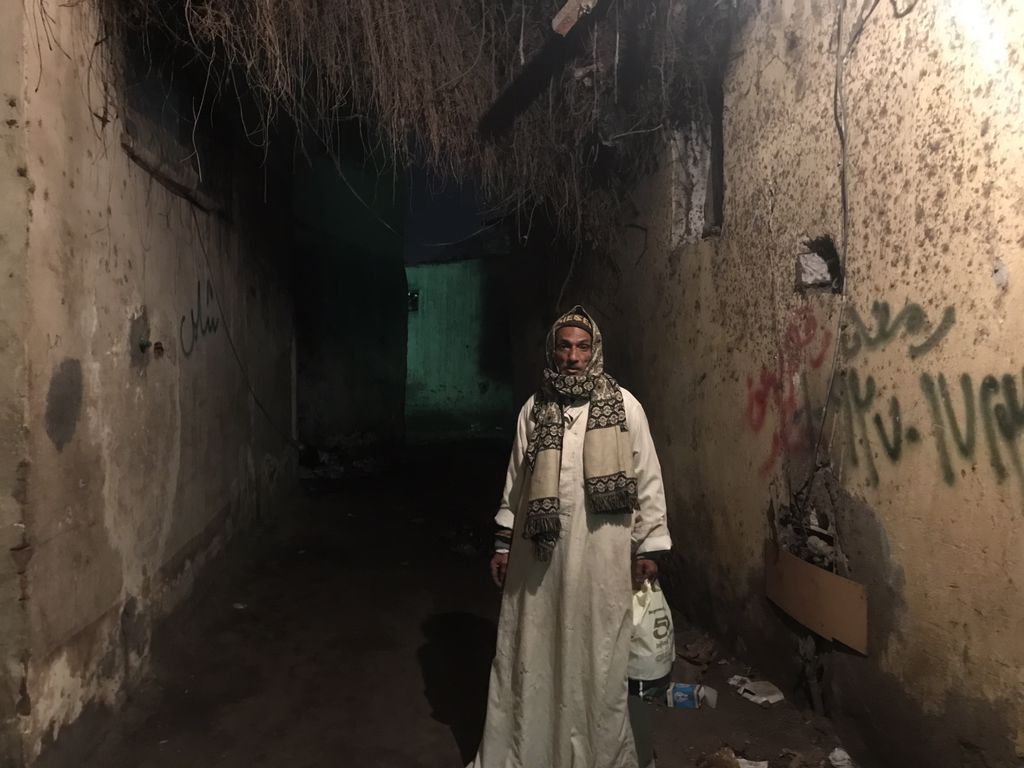
I first met Fares Gomaa in Tal al-Aqarib in 2015, on the day the government demolished his home and moved him and his family to another part of the capital. I stayed in touch with him over the years and visited him often during his time away from Tal al-Aqarib. When, in 2019, he was finally able to return to his old neighborhood to receive his new home, he called to invite me over for a visit
Fares works primarily as a butcher at one of six main slaughterhouses that serve Cairo. He lives with his wife and three youngest children. His eldest son and daughter are married and have moved out. From daybreak until noon, Fares handles the slaughter and skinning of cattle for a local meatpacker, earning a daily wage without guaranteed working hours or pay. In the evening, he mans a small cart where he sells tea and coffee to workers in the neighborhood.
Built in the 1920s, Tal al-Aqarib was originally a cluster of small houses atop a hill overlooking the Nile. The neighborhood’s alleyways are so narrow that cars cannot pass through. In the official administrative division of the city, Tal al-Aqarib is a shiyakha — or sub-district — that falls under the district of Sayeda Zeinab. The shiyakhas in the area are some of the first neighborhoods between the eastern Cairo suburbs of Moqattam and the Nile established by migrants who moved to Cairo in the 19th century.
Over the past 100 years, Tal al-Aqarib’s view and access to the Nile has been increasingly cut off, first by the Cairo-Helwan Agricultural Road and later by another parallel highway known as the Corniche. In the 1980s, following the construction of the first line of the Cairo Metro, a wall was built that completely obstructed passage to the river.
The General Organization for Physical Planning, the state agency responsible for drawing up public policy for urban development, released a study in 2016 titled “Urban Structuring of the Greater Cairo Region'' that found most Cairo development studies followed methodologies for urban spaces that were not suited to planning a major metropolitan area the size of Greater Cairo. These methodologies aimed to respond to problems of transportation and absorbing population growth, rather than build an integrated and comprehensive vision of the capital. A case in point is the development plans to bring basic utilities to Tal al-Aqarib and other old shiyakhas, which fell by the wayside even while major roadways were being built around it. Residents would be forced to walk long distances from their homes several times a day — sometimes, in unsafe conditions — to obtain water from a public source, according to a 2014 report by the National Center for Social and Criminological Research. And since their residential status was technically illegal, residents were restricted in their ability to petition authorities for basic utilities.

Fares’s father migrated from Beni Suef to Cairo and settled in Tal al-Aqarib when it was still a relatively barren hill. He chose the area so that he could be close to the slaughterhouse, and he built a one-story home on an empty plot of land. After he died, Fares inherited the house and built an additional level. He rented the ground floor rooms to migrants from rural governorates who came to the city for work, while a toy seller rented a room on the roof. Then the government came to demolish it.

Eviction from Tal al-Aqarib
I first met Fares in the afternoon of December 9, 2015. He had returned from his job at the Basatin slaughterhouse to find Tal al-Aqarib surrounded by Central Security Forces. The police prevented cars from coming through and security forces lined up along the road facing the neighborhood. Fares suddenly found out that his home was among the first in Tal al-Aqarib to be issued eviction orders.
“District officials never informed me of an eviction date,” Fares told me. When he saw his neighbors hastily emptying their homes of furniture, he realized there was no point in trying to resist what was happening. He went into his house, disassembled the furniture and, with the help of his neighbors, carried it downstairs to the street where his wife guarded it.
The governorate sent four makeshift garbage collection trucks used by the General Authority for Cleanliness and Beautification to transport the furniture. A municipal worker told residents to load their furniture onto the trucks and to wait for a Cairo Transportation Authority bus to take them to their new residences in 6th of October City. But residents refused to let their only belongings out of their sight, and instead climbed onto the trucks and sat on top of their furniture. Fares, his wife and three daughters did the same, along with two neighboring families, and he invited me to ride with them.

The winter humidity helped to lessen the stench of garbage as the truck as we climbed on. We slowly pulled away as two bulldozers moved in to demolish Fares’s house. A cloud of white dust wafted over the entire street, blocking our vision of Tal al-Aqarib as we left it. When I asked Fares where exactly his family was being relocated in 6th of October City, he said he didn’t know.
According to the Urban Structuring of the Greater Cairo Region report, “the expansion of wealthy communities outside of the central urban cluster corresponded to the spread of informal neighborhoods in Greater Cairo.” With limited financial resources, rural migrants from villages in the Delta and Upper Egypt flowed into these cheaper informal neighborhoods in the capital. The lack of municipal services did not deter people from settling down in these areas, as many of them came from villages that had also lacked basic utilities themselves.
In 2007, 6.1 million people lived in 137 informal areas in Greater Cairo, half of whom lived in Cairo, while the other half found space in Giza and Qalyubiya.
The government moved to reduce population density in Greater Cairo’s older districts with a plan launched in 2000 it called the “elimination of informal settlements.” It divided these neighborhoods into those that were “unplanned” — where residential buildings were in good condition but had yet to officially receive utilities — and those that were “unsafe for residents.”
After a devastating rock slide in 2008 demolished homes in the informal housing area of Dweiqa in Moqattam killing more than 100 residents, the government set up a fund under the jurisdiction of the Cabinet to “develop informal settlements.” The fund was responsible for redeveloping unsafe neighborhoods and providing shelter to residents until they were able to either return or receive compensation.
The Informal Settlements Development Fund claims that it has waged a “vicious war” since 2012 against the areas deemed unsafe across Egypt’s governorates, principally in Cairo. The fund counted 404 unplanned areas in Egypt’s governorates and divided them into three categories. The first and second categories included “unplanned residential areas built on lands belonging to the state,” where residents faced a choice between having their homes demolished and rebuilt or financial compensation and relocation if rebuilding in the area was not deemed possible. The third category was defined as “unsafe residential areas that threaten the lives of residents” where homes would be demolished and rebuilt in the same location. The fund would provide temporary alternative housing for displaced residents in state housing projects or by subsidizing them with rental allowances until they were able to return.
Priority Needs
The trucks finally turned off the Wahat Road at a sign that read, Priority Needs Housing Project, leading to an unpaved, sandy plot of land bordered by a cluster of residential apartment blocks. We passed between identical six-story buildings facing each other that stretched into the distance. The streets were empty and the area deserted, a stark contrast to the noisy bustle of the neighborhood from which Fares and his family had been uprooted.
When the trucks stopped in front of one of the dreary apartment blocks, one of the municipal workers responsible for handing over the apartments unlocked the door of the building and switched on the lights to reveal a thick layer of dust covering the entrance and stairs. They began assigning apartments to the waiting families.
Fares received a tiny apartment on the first floor. At just 34 square meters, the unit was far too small for his family of five to live in comfortably. It featured a living room smaller than the bed of a pickup truck, two bedrooms that were even smaller, plus a bathroom.
With fewer units available than the number of relocated families, relatives were forced to share apartments. There was little point in trying to argue with the official in charge. He politely told them he was only following orders and was not responsible for the census district officials had conducted years ago.
Fares signed a “hosting contract,” agreeing to pay LE200 in monthly rent for seven years — the period set by the government to complete the redevelopment of Tal al-Aqarib. He spent the first night cleaning the apartment and trying to arrange his furniture. The floors were covered in brownish dirt and the water that came out of the taps was yellow. The apartment turned out to be too small to accommodate all the furniture, so Fares kept what he could and left the rest on the street.

The following morning, Fares took a walk to familiarize himself with his new neighborhood. Women sat on sidewalks watching children scamper around and take advantage of the wide, empty streets free of cars or pedestrians
The housing project Fares and his family found themselves in is called Masaken Othman. Located at the end of the Wahat Road with cemetery plots extending into the desert beyond it, the location is isolated and far from the more inhabited areas of 6th of October that are surrounded by malls and service outlets.
The government built Masaken Othman in 2005 as part of the National Housing Project, a program launched by former President Hosni Mubarak during the only multi-candidate presidential election of his 30 years in power. The project aimed to provide housing to low-income families. Masaken Othman was named after Othman Ahmed Othman, founder of the Arab Contractors company, which led construction on the project.
Since 2010, the informal settlement fund has relocated most shiyakha residents facing eviction orders to Masaken Othman. Residents from Manshiyet Nasser, Dweiqa and Ezbet Khairallah, were all moved there, in addition to a number of people without homes. The area also began to attract people who could not afford higher rents in other neighborhoods of Greater Cairo, including refugees from sub-Saharan Africa, Syria and Yemen, who wanted to be relatively close to the headquarters of the UN refugee agency located in 6th of October.
Fares found that some residents in Masaken Othman had converted the balconies of their ground floor apartments into makeshift kiosks and shops to sell food. It seemed like a good idea for Fares to bring his food cart. He could go to the slaughterhouse every day, buy kofta, liver and sausage and bring them here to sell sandwiches.
The difficulties began the very next day when he left to head to the slaughterhouse. Fares was frustrated to learn that he would have to take a bus to Giza Square followed by two microbuses to get there and would be spending LE20 on transportation every day. Nevertheless, when he finished work he headed to Tal al-Aqarib where he loaded his cart onto a pickup truck to bring it to Masaken Othman.
Within a few days, he came to realize that the residents of Masaken Othman lived on fuul and taamiya, not meat. “No one had the money for a loaf of bread, the area was practically empty,” he said. After a while, he realized that he could not afford to live in Masaken Othman. He told his wife that he would go to Sayeda Zeinab and look for an apartment or a room to rent.
He returned to Tal al-Aqarib to find that the government had demolished the house and razed it to the ground. Meanwhile, the rents of the apartments nearby had surged after many other families also returned from Masaken Othman in order to live near their work. Fares found a room in the cemeteries behind the Ali Zein al-Abdeen Mosque, in Sayeda Zeinab and brought his family to live with him. They lived there for a while before they eventually rented a small one-bedroom apartment overlooking the mosque itself. The apartment in Masaken Othman remained empty though Fares would check in on it once in a while.

Over four years, Fares observed the rebuilding of Tal al-Aqarib. He would go to his job at the Basateen slaughterhouse in the morning and return in the evening to sell food from his cart which he had brought back to Tal al-Aqarib on one of his visits to Masaken Othman.
He invited me several times to sit with him at his cart. Around us were several butcher shops and knife sharpening stalls. In the narrow alleyways nearby, traders from Upper Egypt and the Delta would leave their cattle in pens overnight. Come morning, they would sell them to meatpackers for slaughter. Most workers in the neighborhood stayed after the old slaughterhouse was moved in 2003 by the Cairo governor to another neighborhood seven kilometers away. Ownership of the land was transferred to the Friends of the National Cancer Institute to build the Children’s Cancer Hospital Egypt. The pens and meat workers on Salakhana Street were one of the last relics of the old slaughterhouse that remained after it was moved.
The return
When Fares returned to Tal al-Aqarib in 2019, he found that its name had been changed to Rawdet al-Sayeda. He complained that he now must pay LE360 in monthly rent after having owned a home in the same location. The 60 square meter apartment was furnished with a sofa and small table in the living room and a TV hanging on the wall. A small corridor leads to the kitchen, bathroom and two bedrooms barely large enough for a bed and wardrobe. A small 2.5 square meter balcony overlooks the street.
The neighborhood itself was transformed. The unpaved alleyways had been turned into wide asphalt roads lined by identical five-story buildings. Police patrols, which never used to come through the area before with its narrow alleyways, now roamed through the streets at dawn.
A month after their return, Fares’s son, Ahmed, was standing in the street with friends when a passing police car stopped to check their IDs. “Ahmed spoke with them in an inappropriate manner,” Fares said. “A policeman extended his arm and held Ahmed at the chest, ripping off a necklace he was wearing around his neck. Ahmed got angry and pushed his hand away. So they took him in the car to the police station.”
After checking his record, it turned out Ahmed had an outstanding conviction for an altercation and had to pay a LE10,000 fine or serve three months in jail. Fares sold a fridge he owned for LE2,500 to pay as a first installment of the fine so that his son would not go to jail. Yet the police conditioned Ahmed’s release on the payment of the full LE5,000, which Fares did not have. Ahmed agreed with his father to spend the three months in jail in hopes that Fares would somehow be compensated for the LE2,500.
Meanwhile, Fares’s eldest son, Gomaa, has been in pre-trial detention for two years on drugs and weapons possession charges. In 2017, on the eve of Eid al-Adha, Gomaa was working with his father on Salakhana Street where he collected the spare meat parts dumped in front of the slaughterhouses and skinned them. He made LE800 for a few hours of work. He went home to shower and change and told his father that he was going out to meet a friend at a bar downtown to celebrate. At the end of the night, Fares received a phone call from his son from the Qasr al-Nil police station where he was charged with possession of a knife and drugs. Over two years, Gomaa has been taken from the prison to the courthouse where his remand detention is renewed for 45 days. Fares’s last visit to Gomaa in prison cost him LE1,000 after he bought him some fruits and three cartons of cigarettes and deposited LE200 for him in the prison canteen.
One evening, as I sat with Fares at his cart, it began to rain. It was 9 pm and no one had passed by and ordered anything from him for over an hour. Fares wavered between packing up and going home or waiting it out. He took out the money he had collected over the day from his pocket and carefully arranged the notes, one atop the other. It came to just LE11. He put the money back in his pocket, turned up the flame connected to a gas cylinder next to the cart and went back to washing teacups.

Finally, the rain stopped and his wife appeared at the end of the alley making her way towards us. He offered her a cup of fenugreek tea. She sat on an overturned bucket, lit a cigarette and asked him in a calm voice: “What are we going to do about the electricity that’s been out all day?”
He went to the grocery store next door and brought back a yellow bag. He gave it to his wife and asked her to put it in the fridge. “A special order of beef knuckles that I kept at the fridge at Samia the grocer,” he told her. “What about the power?” she asked. “God is kind. Let’s see how it goes,” he replied.
Since his return to Tal al-Aqarib, Fares has been trying to adjust to the new system of prepaid electricity service. The power can suddenly go out without warning and he has to recharge the card to restore it. In addition to the LE360 he pays in rent every month, he also has to cover the prepaid electricity service. Before Tal al-Aqarib was redeveloped, he used to receive a monthly electricity bill. When he couldn’t afford to pay or was delayed in his payments, the power would not be cut off. After the redevelopment of the area, the billing policy changed to a prepaid system.
Between 2012 and 2015, Egypt witnessed frequent power outages. The government built new power stations and multiplied its production capacity, eventually ending up with a surplus for export. At the same time, electricity subsidies were gradually reduced over a five-year period. Poor and middle-income families, who consumed the least amount of power, bore the brunt of the subsidy cuts.
One morning, the power went out after his daughter went off to school. Fares and his wife realized that the prepaid card had run out of credit. The couple sat together drinking tea on the balcony before his wife left for work and they started thinking about how they were going to pay to recharge the electricity card. It was a Tuesday, an official day off at the slaughterhouse. Meanwhile, Fares’ wife had two apartments to clean in the nearby neighborhood of New Helmeya.
“I told her that I had LE9 on me and no cigarettes. She took them from me and left. She returned with nine Cleopatra cigarettes. She gave me five and took four for herself. She left and I got up to make a cup of coffee,” Fares said.
Fares took comfort in the fact that the fridge was stocked with food: chicken wings, pasta, rice, oil and sugar. This meant they would not need to buy any more food for almost a week. And if either of the two girls needed anything, their mother would provide. Maybe she would earn enough in the next two days to restore the electricity, he thought.
He had married her for love. She used to work with him at the old slaughterhouse. He had flirted with her for three months and she would respond with a barrage of insults. They eventually got together.
He smoked three cigarettes then went out on the balcony to watch passersby on the street, though he didn’t see any familiar faces. On normal days, a friend might walk by and Fares would invite them in for a cup of coffee. Sometimes, the meeting would end with Fares securing an odd job for the day. The previous week, a friend of his who works as a builder came by and told him he wanted to build a small cement cattle trough in one of the animal pens. When Fares heard he needed someone to assist with the job, he offered to help. His friend was skeptical at first; he knew Fares as a butcher, not a builder, but Fares convinced him he could do the work for a day’s pay. He helped mix the cement with sand on the ground and built the trough, earning LE120.
Fares paid no attention to the other butchers who criticized him for working outside of his trade and he ignored those who scorned him for not keeping a stable career. He actually felt proud that he would never refuse any job that came his way.
He left the two remaining cigarettes on the table and decided that he wouldn’t go downstairs to open up the cart. With the slaughterhouse closed on Tuesday, foot traffic in Tal al-Aqarib would be light. So he went to bed instead and only woke when his two daughters returned from school. He went to the kitchen, made a cup of tea, and smoked his last two cigarettes. After a while, he felt the urge to smoke so he resorted to smoking shisha. As evening fell, he decided to go downstairs anyway to set up the cart just to kill time.
Fares’s household family income places them among the poorest in Egypt, according to the income brackets set by the Central Agency for Public Mobilization and Statistics. Over the past four years, the number of Egyptians living in poverty has increased to 33 million, about a third of the population, the highest percentage in Egypt’s history.
تقارير ذات صلة
Video | No means to make amends
Mada Masr spoke to residents attempting to navigate the costly reconciliation process.
Egypt’s battle over buildings: The government takes on informal housing
In May, Sisi spoke in no uncertain terms and called for informal buildings to be razed to the ground
Floods hit Zarayeb garbage collectors the hardest
"It’s difficult to calculate the number of families ... we receive survivors every 5 minutes."
Your support is the only way to ensure independent, progressive journalism survives.
You have a right to access accurate information, be stimulated by innovative and nuanced reporting, and be moved by compelling storytelling. Subscribe now to become part of the growing community of members who help us maintain our editorial independence.
Join us