
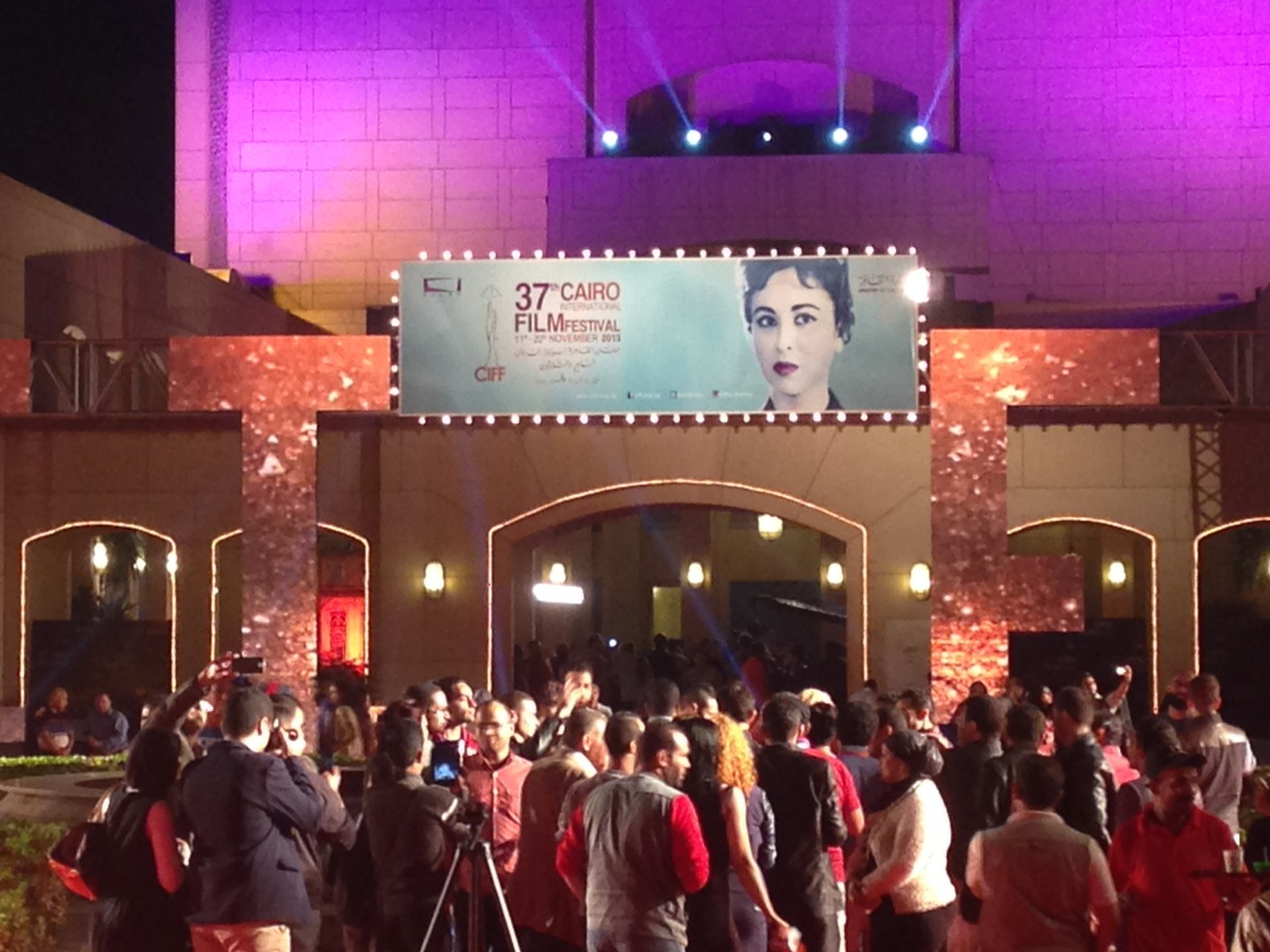
FestBeat: Good films on day one of the 37th CIFF
Each day, FestBeat is going to bring to you the latest buzz from the ground of the 37th Cairo International Film Festival. All the juicy stuff: films not to miss, what people are saying when they chat in between screenings in halls and on social media, celebrity sightings and more. There sure are some amazing films to watch this year, so join me as I explore.
First day, exciting no doubt! Sleep-deprived film nuts are about to roam the halls of Cairo’s Opera House, which CIFF has once again transformed into a glowing mecca for film enthusiasts. Instagram has been flooded with photos of the red carpet using #ciff37. Twitter and Facebook are suspiciously quiet, but I am hoping that this is the quiet before the storm.
I woke bright and early to make the 10 am screening of Wim Wenders’ Everything Will Be Fine (2015). Wenders' first feature film in seven years, it premiered in this year's Berlinale to mixed reviews. It's a melancholic tale about detachment and absorption. The main character Thomas (James Franco) is a writer who is either so absorbed by and open to the world that he becomes acutely in tune to the sounds and movements of his surroundings, or so detached and closed to the world that he becomes deaf to his surroundings and other human beings around him. All the characters struggle to express the world with its many connections and unfathomable events, especially Thomas, whose job is to put into words what in many cases cannot be.
For me, what sticks out about this film is its sound design. Foley work – or postproduction sound work – is often overlooked, but here it made the film’s soundscape impressively intricate. It accentuates the movements between the protagonist's two states, states that are fundamental features of melancholia.
There is no doubt that the film has shortcomings, especially with regards to the acting, but the sound design and the mise-en-scene allow for an affectively impactful meditation on a mood that many regard as the defining mood of today. Melancholia is only possible because human beings are open, vulnerable to the world around them with all its tenderness and harshness. I think this is a mood that is at the heart of creativity. If only for the sound design and the foley work, I would recommend watching this film. It plays again on Monday, November 16.
After Wenders’ very somber film, I queued for the next one. At 3 pm the first light rays hit the screen and 14+ by Andrey Zaytsev rolled. As a director, Zaytsev is decorated by some of Russia’s highest film accolades, but 14+, which received very positive reviews at the Berlinale, is really his first introduction to an international audience and certainly to an Egyptian one. It is a highly relatable story about young love that starts when Alex sees fellow high-school student Vika while strolling through the city streets one day and is instantly love-bitten.
The opening scene introduces the type of images Zaytsev prefers in this film. The façade of a Soviet-era building with its geometric grid of alternating blue and white fills the whole screen. Throughout, Zaytsev’s frames are highly controlled, obviously staged at times, with clear geometrical design. Framing the tender love between Alex and Vika is an oppressive culture of machismo passed down from the Soviet era, which comes across in these acute angles and tight compositions.

Sitting at the dinner table, Alex’s mother and aunt joke that all men are the same and that Alex, now entering adulthood, is doomed to become another "typical Russian man" who drinks too much and sleeps around. The awkward, dorky but charming Gleb Kalyuzhny, who plays Alex, truly delivers on his tough role. He masterfully captures the ambiguity of the transition to adulthood and the unique struggles it involves. Although in some ways it a Romeo and Juliette story, 14+ has a dark undertone like many coming-of-age films. It screens again on Thursday, November 19, and I would highly recommend you watch it.
After 14+, I watched In Your Arms (Samanou Sahlstrom, 2015), a Danish film that is in the official competition, having already bagged the top prize at the Göthenburg Film Festival, Scandinavia’s biggest film festival.
Sahlstrom is said to be a former assistant to Lars von Trier, the director of what I think is the perfect tearjerker movie: Dancer in the Dark (2000). Fittingly, Sahlstrom turns out to be a masterful storyteller who has crafted a tearjerker that lyrically explores the difficult topic of euthanasia. The camera poetically glides through the beautiful landscapes of Switzerland where Niels (Peter Plaugborg) essentially goes to die. His nurse, Maria (Lisa Carlehed), becomes his companion on a rollercoaster journey in which the image of a decaying body becomes a source of real horror.
Once again, the sound design is breathtaking. Just like Wenders, Sahlstrom uses music and the soundscape – in addition, of course, to color – to create the emotional tone of the film. The images are often monotone. White dominates the outdoor scenes, and the indoor scenes tend to alternate between white and a golden brown hue. There is an interesting use of natural light throughout, and the handheld camera moves, dances and glides just like an additional character. A handheld camera is often powerful in poetic films like this one, and here it is combined with jump cuts that give the film a memorable aesthetic.

I would like to think about this film as a road movie, but one that contributes to the genre by introducing the theme of euthanasia. In my opinion, In Your Arms is a strong contender for the International Best Film Prize.
One thing I would add, however, is my disappointment with the subtitles. The Arabic subtitles were obviously added for the occasion of the festival. Whoever did them, though, altered the aspect ratio of the image and actually cut off the bottom part of the picture to add the subtitling. The fact that we are not seeing the frames or compositions the way the director intended is problematic. Can we judge a film if we are not seeing it the way the director intended it to be seen?
Another thing. The screening was the busiest compared to the others, by a large margin. This was to be expected. What was not expected was a sudden stop during projection. Five minutes or so into the film, the projection stopped because the jury arrived late and had to enter. The film started again after they were seated. It was jarring. I hope this does not happen again. You heard it here first!
I did not see a lot of celebrities today. I did see Dalia al-Bahery in the bathroom and Marwan Hamed in the entrance to the main hall because they were among the jury for In My Arms. I didn't approach them to talk, but maybe I will in the future unless they shoo me away. I'll be on the lookout. In the coming days, I will be attending some of the Restored Classics screenings and some the Arab Horizons screening, so a lots is coming up. Till tomorrow, bye!
تقارير ذات صلة
Whose narrative are we writing?
Tamer El Said on censorship, the Cairo International Film Festival and his film’s leak
Is it really possible to avoid politics in a place like Egypt? A conversation with Mohamed Hefzy
Can writer and producer Mohamed Hefzy evade political confrontations and compromises?
Poison into medicine: On watching Poisonous Roses
Ismail Fayed reviews Ahmed Fawzi Saleh’s debut feature film, Poisonous Roses
Your support is the only way to ensure independent, progressive journalism survives.
You have a right to access accurate information, be stimulated by innovative and nuanced reporting, and be moved by compelling storytelling. Subscribe now to become part of the growing community of members who help us maintain our editorial independence.
Join us