
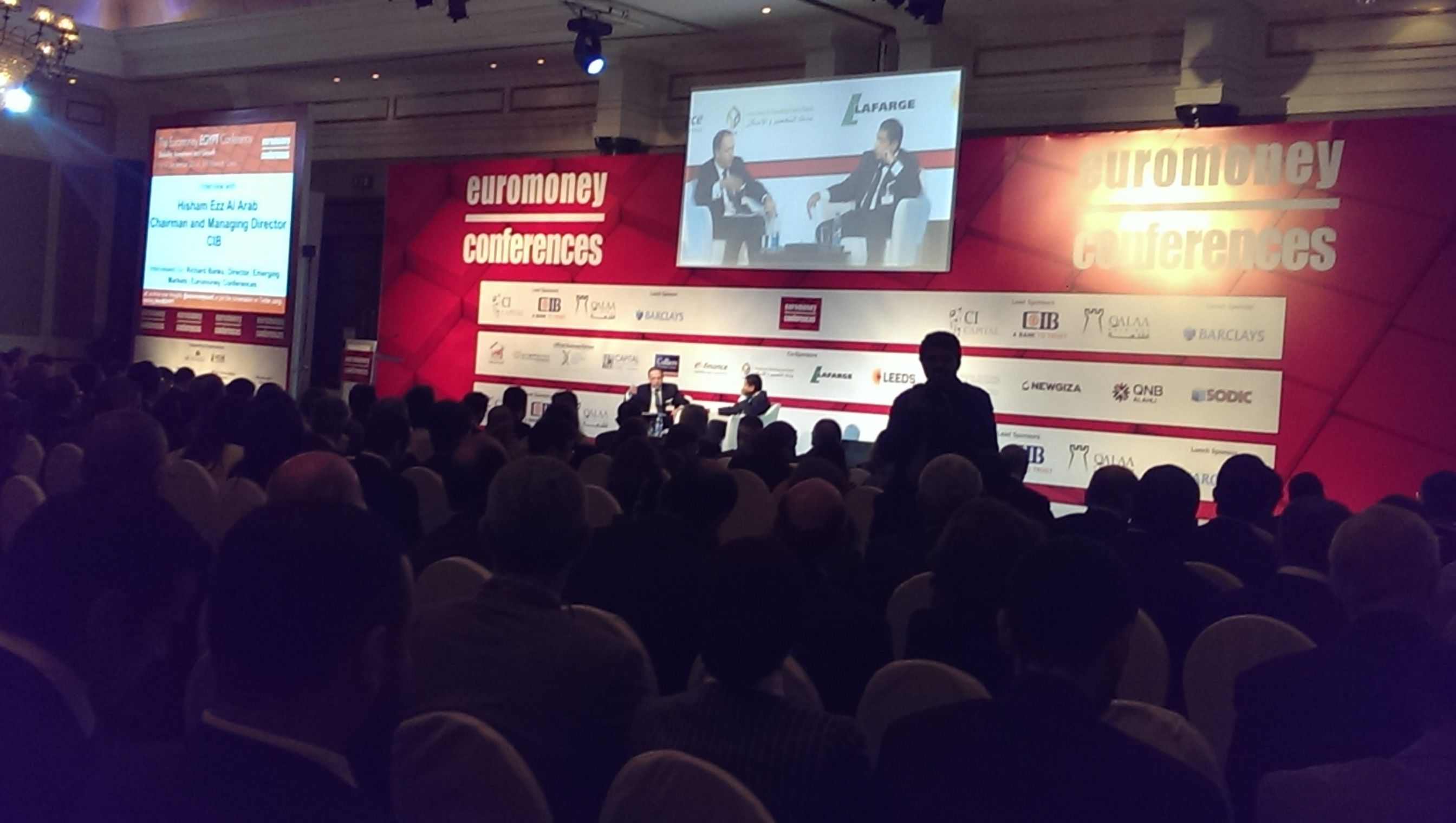
Euromoney: A message of stability from officials, private sector players
There’s no mistaking the message officials and private sector players were pushing at the opening of this year’s Euromoney Egypt Conference, whose titular theme is already a dead giveaway: stability, investment and growth.
Amid its massive drive to restore investor confidence and revitalize the inflow of capital needed to fund the major infrastructure projects planned to fuel a direly needed economic recovery, the main economy ministers spoke to a significantly larger gathering of attendees at this year’s installment of Euromoney.
According to Richard Banks, director of emerging markets at Euromoney Conferences, the number of attendance is back up to 2008 levels. In many ways, much of the official talk reflected an ambition to bring economic figures back up to the time when Egypt witnessed its highest growth rates and most robust indicators.
“This is the most confident I’ve ever been that Egypt can create the society and economy its people so richly deserve,” Banks said, adding that the new governing leadership needs support to implement its broad reforms and restructuring plans.
On part of the major stakeholders and business personalities, the support could not be more resounding, with most applauding government efforts to undertake some of the reforms previously labeled as tough and long-neglected.
It was perhaps most directly addressed by Finance Minister Hany Kadry Dimian, who repeated “We have the political will” four times before continuing, “for serious and real change.”
Kadry Dimian opened the day by declaring that this a message of confidence to investors, telling them that they can still “grow and achieve unmatched profit margins building on local and regional opportunities” by betting on Egypt.
“There is progress toward political stability. But the achievement of democracy is a nation’s will and that is also there,” he added.
On the economic front, it comes down to “rebuilding confidence in the economy and creating the socioeconomic architecture to achieve social peace.”
The one distinctive difference in rhetoric from today’s officials is in the way they more comfortably and directly address issues that were skirted in past conferences, namely in actually implementing tax reforms and subsidy restructuring, as opposed to merely talking about the need to do so.
But many of these same issues so confidently discussed today are some of the most controversial policy changes taking place for the very effect they have on social justice and inclusion, the main failures of past governments that produced robust levels of growth until the outbreak of the 2011 uprising.
On the part of officials, addressing inefficiencies in the system is the key to better available utilizing resources and capacities, an overall strategy that they bill as benefiting Egypt’s overall economic and social factors.
Kadry Dimian described “streamlined energy subsidies” as aiming to “rebuild efficiencies and improving the energy mix.” He also spoke of “better capital allocation, improving the tax system and measures taken to broaden the tax base.” There are impending reforms to the sales tax and a property tax law already in place and in the pipeline for implementation for years now, as well as changes to the customs law.
All of these policy changes, he noted, are to happen on the “principle of no economic reform unless it is alleviated with some social reform and a kind of security net.”
Along this line, in parallel the government will be working toward “social inclusivity as a major component with a constitutional basis.” This will come in the form of “income redistribution and increased spending on health and education,” as stipulated by the constitution, Kadry Dimian explained.
Major projects are being pursued to garner the resources these changes necessitate, including the most prominent of the batch, the mega scale Suez Canal development project, which comes at an investment cost of LE60 billion and is utilizing investment certificates made available to the public as a new financing scheme.
According to Investment Minister Ashraf Salman, the Suez Canal project can be split up into two endeavors, the first being the more widely discussed digging of the canal to expand its traffic capacity as well as decreasing transit time, all to increase the annual revenues generated. This can add $2-5 billion in revenues in three years, Salman says, although experts have questioned the feasibility of actually increasing traffic at the rates that would translate into more revenues.
The more feasible prospect could be what Salman described as project B, a broader opportunity to develop the Suez Canal area and build up a logistics and industrial hub in a space that covers around 93 kilometers of space.
More so, “This is a pilot for mega infrastructure projects and for the financing model,” he added.
Along with the Suez Canal come endeavors such as the reclamation of thousands of feddans of land, a massive network of new roads, river transport projects and renewable energy liberalization. According to Kadry Dimian, an agreement has already been reached for a feed-in tariff that may be announced on Wednesday after the Cabinet meeting.
Even though the state has admittedly taken the lead in spearheading most of the announced projects, Kadry Dimian says, “Our vision is not to have the state in the front seat,” calling on the private sector to play the bigger role.
“This is a turning point for a very dynamic economy. We are aiming to bring Egypt back on the investor map and my advice is first come first served, so please don’t stand behind the curve,” he advised investors.
Keiko Honda, CEO of the World Bank Group’s Multilateral Investment Guarantee Agency (MIGA), echoed the same sentiment, saying, “Savvy investors know that as a country comes out of difficult times, the ‘first movers’ are those that can ride the first wave of economic recovery and take advantage to establish a competitive edge.”
Based on the agency’s surveys, after significant divestment in 2011 and afterwards, many Investors interested in Egypt have chosen to sit and wait for situation to stabilize. Today, “MIGA is open for business in Egypt and can help link investors with governments. Our aim is to catalyze investment at moments of transition,” she said.
What investors are interested in hearing is what kind of structural reforms the government is ready to undertake so that the longstanding challenges underpinning the economy can finally be tackled. Kadry Dimian repeatedly reiterated the will to do so, stating that “our policy is to improve market based policies and of course we have to improve our institutions and change the legal framework.”
As for growth figures, Kadry Dimian stated the same figures that officials have been talking about for months. “The trend of growth is upward, we should easily expect to see three and a quarter to three and a half percent for coming year and this will come from pushing those major investments into the market and developing confidence on where we are heading,” he said.
In three years time, the government aims to reach 5-6 percent growth, which they say should address unemployment. However, it is widely recognized that Egypt needs to achieve at least 7 percent growth rates to be able to create enough jobs to cater to the needs of the growing market.
From a deficit of around 15 percent, this government plans on bringing that down to around 10-11 percent this year. The government also hopes to push inflation down to five percent within three years, from over 11 percent in August.
Overall, the strategy is toward consolidation that is highly dependent on the structural reforms set forth.
“There’s way less spending on wages and it’s time to redirect resources to infrastructure, including a sort of insurance coverage,” he said. In conclusion, he said “We are very keen to address our macroeconomic imbalances and that’s the entire government — there is an agreement to where this country should be heading,” he said.
Officials from the International Monetary Fund were on hand, and according to Kadry Dimian, the government is working with them closely on the VAT reforms. “Relations with the IMF never stopped,” he said.
For Salman, what distinguishes this government from its predecessors is “vision, coordination, commitment and goals,” with long, medium and short-term reform goals.
“For now the focus is on three things: structural reforms, a development and investment program and a legislative program,” he said.
He pointed to the strong performance of the capital market as an indicator of what’s to come, saying that “the index has surged 104 percent since June 30 and it’s become one of the best performing markets in the world. It’s said that market tends to go up before the economy does.”
In the works on the investment policy side are a unified investment law, bankruptcy law, unified industry law and a labor law. This along with a package of energy laws to work toward a more diverse energy mix to close Egypt’s electricity generation, a project which this year alone necessitates LE7 billion of investment.
He also expects a surge in FDI due to an oversubscription of investments in energy sector and mega projects, 75 percent of which must be financed by the private sector, with the rest covered by the government as well as banks and the capital market.

Amira Salah-Ahmed
Leave it to Amira to poeticize a stock market crash or an inflation hike. Her creative writing skills put a silver lining on the cloud that is Egypt’s economy. …

Isabel Esterman
Isabel Esterman holds Master's degrees in Journalism and Asian Studies from the University of California, Berkeley. Before somehow winding up in Egypt in 2011, she worked and studied in Indonesia,…
تقارير ذات صلة
Let it rot?
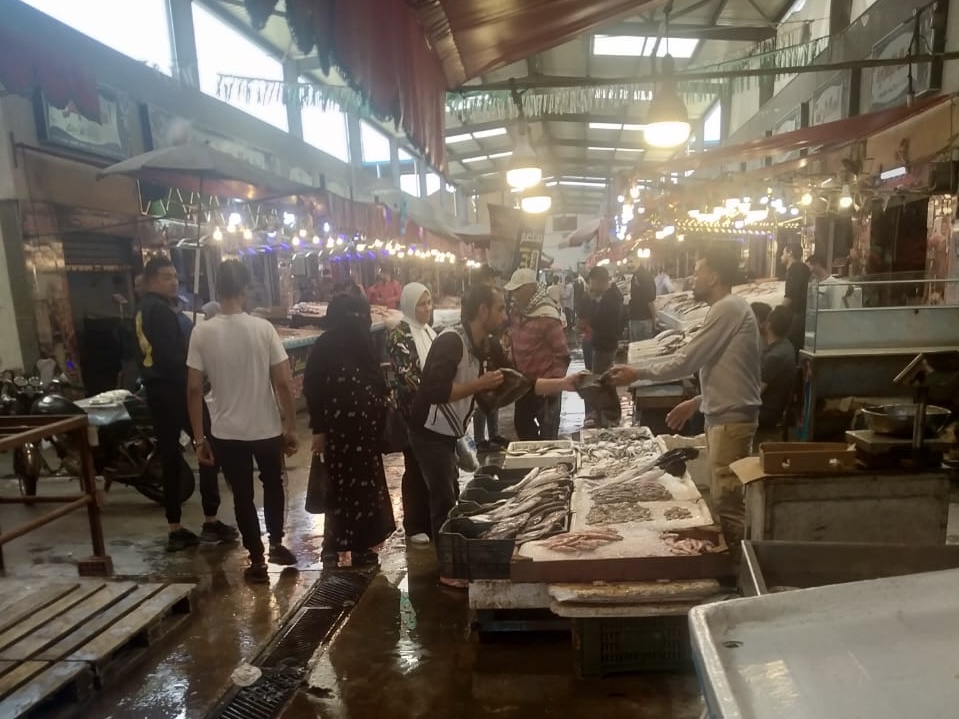
A new boycott campaign out of Port Said aims to tackle soaring fish and seafood prices

Generosity knocked out of the box: How economic crisis has shrunk Ramadan food donations
Every year, millions of donated food boxes, known as "Ramadan cartons," are distributed across Egypt throughout the month, circulated from individuals to small charitable organizations to large entities, including government…
Ras al-Hikma: No effect on citizens’ wallets yet
Egypt has secured US$10 billion from the United Arab Emirates as the first installment in the US$35 billion Ras al-Hikma deal. This inflow of funds came less than a week…
Your support is the only way to ensure independent, progressive journalism survives.
You have a right to access accurate information, be stimulated by innovative and nuanced reporting, and be moved by compelling storytelling. Subscribe now to become part of the growing community of members who help us maintain our editorial independence.
Join us